Call this round 5,839,493 in the continuing saga of letting customers generate your content. While everyone thinks they are an expert on advertising, few really are. While we live in a society that has the attention span that makes the 40 yard dash seem like forever- attempts to capture attention “by any means possible” are backfiring left and right.
Some may still believe that “Any press is good press”- but that was when newspapers ended up in birdcages instead of online forever.
When you start mixing religion with your brand- be aware, you could either lose or gain customers- and it may be permanent. Several times a year “Hobby Lobby” runs full page ads about Jesus- Christmas, Easter - and it makes me wonder how many Jews, Hundus, Muslims, Buddists etc. choose not to shop there every time.
When it comes to controversy as a marketing tool, it’s ok when you you are the upstart- but if you are the market leader, you are taking chances- here is the article about how God and Starbucks went on a collision course here in the flyover states:
SPRINGBORO — – Michelle Incanno was an admitted Starbucks addict.
She’d buy the company’s coffee beans every week. Whenever she’d get the chance to drop by a Starbucks, she would, placing the same order every time: a large, house brewed coffee with nonfat milk and two Splenda. When the Seattle-based chain opened a drive-through near her Springboro home, she was in java heaven.
That was until she got an unexpected jolt last week from her coffee cup.
Printed on the cup was: “Why in moments of crisis do we ask God for strength and help? As cognitive beings, why would we ask something that may well be a figment of our imaginations for guidance? Why not search inside ourselves for the power to overcome? After all, we are strong enough to cause most of the catastrophes we need to endure.”
It is attributed to Bill Schell, a Starbucks customer from London, Ontario, and was included on the cup as part of an effort by the company to collect different viewpoints and spur discussion.
“As someone who loves God, I was so offended by that. I don’t think there needs to be religious dialogue on it. I just want coffee,” said Incanno, a married mother of three who is Catholic.
She wasn’t satisfied with a company disclaimer saying the quote is the author’s opinion, not necessarily that of Starbucks. It invites customers to respond at www.starbucks.com/wayiseeit.
Starbucks spokeswoman Sanja Gould said the collection of thoughts and opinions is a “way to promote open, respectful conversation among a wide variety of individuals. “
But Incanno said her Starbucks days are over.
“I wouldn’t feel right going back,” she said.
This morning- it was the “most popular story” at the Dayton Daily News site- which means it will be making the rounds- and eventually becoming sermon fodder for the fire and brimstone set- and possibly setting off yet another Starbucks boycott.
I went to the Starbucks site- and couldn’t find this quote on the site (btw- the site wasn’t very web 2.0) and am already wondering if this had been pulled because of complaints already.
Often times agencies look for “hot, young, talent” to “spark” their creativity- and with many of the big agencies isolated from “mainstream America” by being in the major meccas of advertising- sometimes the sensibilities of business get overlooked.
No matter what your position on religion, it’s best to check it for being a universally accepted theme before allowing it to make it into your advertising.
Note: a quick Google of this phrase only brings up the Dayton Daily News article. I’m sure that will change soon.
Big ad campaigns are great- for clients with big budgets. But, sometimes it’s the little things that make all the difference. Seth Godin talks a lot about that “something extra” in his book, Free Prize Inside.
For Jason Liff, film festival organizer extraordinaire, there was no budget, no time and no real plan for how to present himself at the Toronto Jewish Film Festival as a consultant for other film festivals.
And, while you would think that a visionary would have these things all planned out- it’s often not the case. He just called us and said, “I need something to hand out, and I’m leaving tomorrow at 6am.”
Nothing like a deadline to get the creative juices flowing- and nothing like a rush to get clients to step outside their comfort zone and approve something that they would normally give the boot.
Business cards can be phenomenal selling tools- and having a great card is something we always stress for our clients. It’s often your first meeting- and first impressions can be game changing. So for a guy going to meet with a bunch of Jewish film festival types- only one solution seemed right- we hope you agree.
Would a title under his name said as much? And in your card file- would this one stand out? (note to SH, while a 2 sided business card would have been cleaner- if you’ve seen a business card case, with all the card contacts in it- this works a bit better- and saved the client some extra cash on the rush job).
Good, Fast and Cheap- doesn’t happen in advertising very often- but here it is.
More than three-fourths of consumers research products online before they buy, and they’re twice as likely to so on a retailer’s site as on a manufacturer’s site.
Do you want to know why? How about the fact that retailers build sites that are search-engine optimized, follow W3C standards and actually watch their stats- to examine how to improve their site- because a better site means more sales. There is a direct relationship from functionality to profitability. Many manufacturers sites don’t make this connection- or do everything they can to make things more complex than they need to be.
A few tips: Never move a URL- if you have a page for your product- the XYZ Widget- always have the same url. Add to it, update it- but don’t change the url. Make sure you have links to the owners manual, instructions, warranty info, a forum to discuss the product, tips on using it- etc.
Allow consumers to say good or bad things about it- if good- say thanks, if bad- try to make them happy. If they aren’t doing it on your site- they will do it somewhere else- and may not find out you have a simple fix or update for your product. Link to as many reviews as possible- making your site the hub (and first in Google) for your product. Make sure consumers can access all commercials, print brochures, spec sheets right from this page. Have S/N, date of production info available as well. Make sure you have high rez photos available so they can put your product on the report to their boss- with why they should buy it- and look good.
These are only a few of the tips for the new way customers research making buying decisions. If you are interested in more- feel free to contact us for a full site analysis.
Everyone knows the 80/20 rule, in fact an extension of this idea has become known as “the Long Tail.” However, the 80/40 rule might become the most important rule to marketers in the age of search engines and advertising effectiveness.
First- a reminder of what the 80/20 rule is:
Pareto’s Principle - The 80-20 Rule
n 1906, Italian economist Vilfredo Pareto created a mathematical formula to describe the unequal distribution of wealth in his country, observing that twenty percent of the people owned eighty percent of the wealth. In the late 1940s, Dr. Joseph M. Juran inaccurately attributed the 80/20 Rule to Pareto, calling it Pareto’s Principle. While it may be misnamed, Pareto’s Principle or Pareto’s Law as it is sometimes called, can be a very effective tool to help you manage effectively. Where It Came From
After Pareto made his observation and created his formula, many others observed similar phenomena in their own areas of expertise. Quality Management pioneer, Dr. Joseph Juran, working in the US in the 1930s and 40s recognized a universal principle he called the “vital few and trivial many” and reduced it to writing.
In an early work, a lack of precision on Juran’s part made it appear that he was applying Pareto’s observations about economics to a broader body of work. The name Pareto’s Principle stuck, probably because it sounded better than Juran’s Principle.
As a result, Dr. Juran’s observation of the “vital few and trivial many”, the principle that 20 percent of something always are responsible for 80 percent of the results, became known as Pareto’s Principle or the 80/20 Rule.
Traditional media based advertising has a major flaw: all ads are temporary. The ad in todays paper is in tomorrows trash, the spot in the TV show is over and gone (or skipped by Tivo- or ignored the second time it’s viewed) and most importantly- the old John Wanamaker adage about half his ad budget being wasted- only he didn’t know which half- still, even in todays hyper-targeted media, is pretty close to true. I’ve seen many ads for feminine hygiene products- but will never need them.
The difference between spending your budget on old-school media campaigns and putting your best efforts into online strategy- is that only people interested in your product or service will be interacting with your site- and they are there actively looking for information to substantiate their buying decision.
This is where the 80/40™- rule comes into play- insight directly from The Next Wave: 80% of Internet usage begins in search, 40% of people using search- type your URL into a search, instead of a direct access to your site- and get search results- which could include people talking about your business negatively- or trying to steal your eyeballs- even after you have spent millions of dollars promoting your URL.
Once they get to your site- what do they get? If your site is in Flash, often times they get frustrated. Also- remember, since 80% of use begins in search- are they able to access the specific information they seek? Or just get to your site? Many Flash sites do not allow your visitors to link to interior content with an exclusive URL.
One of the new realities in advertising and marketing is that people are depending on the Internet more for researching purchases- even having access when mobile to the web through WAP enabled sites- or soon- to any site with the introduction of the Apple iPhone. Everything is changing rapidly- and if you don’t make your information search friendly- you won’t be relevant in the decision making process.
How do you solve the 80/40 rule™? Building sites to be search friendly is just the start. Also, remember, it’s not about chest-beating ego sites- it’s about delivering information to the consumer that answers their problem (and the consumer can be a B-to-B customer just as easily as a B-to-C consumer). Your site should be searchable as well. Make every piece of relevant data available- in a web friendly form- and don’t remove material- always update it with relevant news (since links shouldn’t be broken by your maintenance).
But most importantly- always be aware- that when someone is looking for you- 40% of the time, they may get search results instead of directly to your site and someone else may have the answer and steal your lunch- and that is a much bigger problem than the old 80/20 rule.
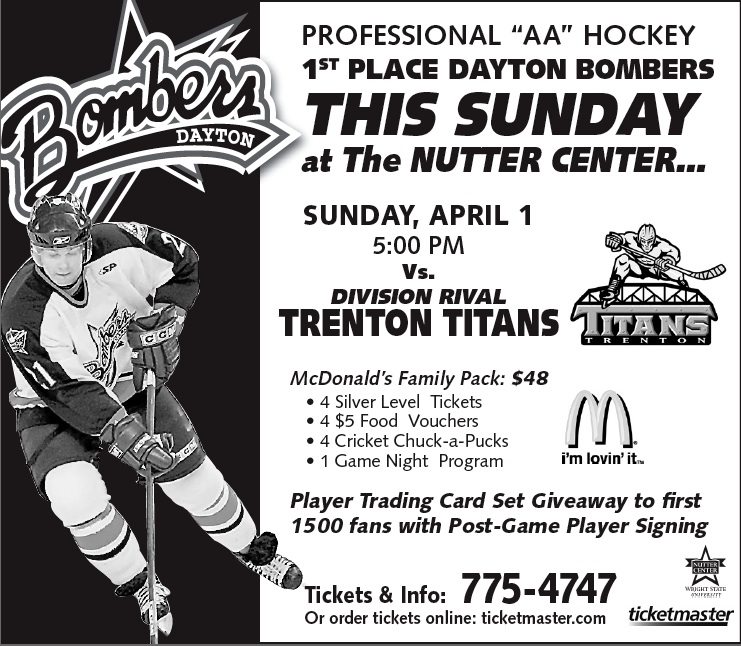
This before and after ad example will never win any awards, but, it could make the difference between being looked at- and being ignored.
The call came at 6pm tonight: Can you take this ad and make it better? In an hour?
This isn’t how to run a business, or how to get the best possible work, but it’s often the reality in advertising: you can have good, fast or cheap- pick any two.
The original isn’t really an ad at all. It’s an announcement. There isn’t really any type of call to action, or anything that would speak to the consumer emotionally. In fact, it’s mostly about the client- “the first place Dayton Bombers.” The ad was done by the ad department for a previous paid placement- you buy the space- we’ll have a flunky design something.
This is what we had to work with- plus the Kelly Cup logo. Some information could be stripped out- it wasn’t important to the customer: AA Hockey- well, there isn’t another team in Dayton, 1st place- doesn’t really matter in the minors as much as the majors, and the flow of white space is just all over the place.
So- take the elements that they have used all season- and try to make them work. The visiting team logo is only important to the hardcore fans- no one is coming to see the visiting team play so we can make that smaller. The McDonalds promo isn’t happening- so we loose that too. We’ve looked at the audience- and know that this is a NASCAR, WWF, Tough Man crowd- that loves to see fights- and to taunt the other team- so making the word “Fighting” a key part of the ad- may get some attention.
In less than an hour- this is the result. Not an award winner- but, at least bold, clean and making some sort of appeal to the emotional side of the fans.
What do you think?
We also threw together a low-budget TV spot to promote the game. Since we had no existing game footage to use (and couldn’t count on any great stuff in one game) we had to construct a concept that we could control. We were told the leading scorer spoke Romanian (not true) and thought we could have fun with a Borat style low budget spoof. The idea was to do something that would cut through the clutter of local ads (none have ever aired in Romanian in Dayton OH) and get people to look to their sets to see what’s going on. We also posted it on YouTube- where it has received over 600 views in 24 hours. The translator obviously knows less Romanian than we did.
One of the first design and advertising books that really spoke to me was Pentagram’s Living by Design (long out of print). Its basic premise was that design extended to more than graphics, architecture, advertising- but was the entire consumer/brand experience- long before people were talking about experiential marketing.
I was lent the book by a former employer, who had been given it as a gift by one of his professors. After I read it, I tried to talk to him about it, his response: “I don’t read books.” I didn’t stay at that job very long (probably because I did read).
I went to Pentagram’s London office to find a copy, several years later. They were nice enough to give me a copy- that had a section removed- and she copied the missing pages. I later got a complete copy from an art book store in Santa Monica- it’s one of my most prized books.
So, when I stumbled onto Pentagram’s blog- and saw this logo- I was instantly reminded of why I believe design does make a difference.
Take a look at this elegant logo- then read their description:
The identity is a hieroglyph, designed to be universally understood, that utilizes the icons of the OLPC laptop interface, also developed by Pentagram. The website design employs these symbols as the basis for navigation. Each icon leads to a corresponding section of information: the laptop to a section about hardware and software, the arrow to a section about participation, and so on. The site launched in English but is currently being translated into many languages.
For all the companies that don’t think they can afford to do a proper logo on start-up, just remember, you can pay now, or pay later. A well designed brand mark can make the difference between having a corporate identity- and becoming a lifestyle brand, ala Nike, Apple, BMW, Mini etc.
And, by the way, if you aren’t familiar with the One Laptop Per Child initiative, you need to read more about it- it’s truly something that could change the world.