by Next Wave Team | Apr 4, 2007 | Ad Agenices in Dayton, OH, Advertising, Creativity, Crispin Porter + Bogusky, Differentiating Your Brand, Everything You Want to Know About Advertising, Great Ad Agencies, How To Select An Ad Agency, Marketing & the Web, Practical Marketing 101, Secrets of Great Advertising, VW advertising, Web strategy
Crispin Porter + Bogusky is the über hot ad agency of the last few years. We write about them, other people write about them, and everybody has an opinion. While celebrities have their paparazzi, the hot agencies have their armchair quarterbacks.
We write about them, because we know there are people searching for great, smaller, independent agencies- and hope they take a look at us (we think we understand web 2.0 better than CP+B and can help our clients get bigger bang for their buck)- but also because, well, the ads are interesting to us.
So, while Seth Stevenson writes in Slate why he hates Crispin ads- (and we have a few we detest too)- we thought this section was worth discussing:
Why I sort of hate the hottest ad agency in the country. - By Seth Stevenson - Slate Magazine
Strong reactions. But that’s not necessarily a bad thing. In fact, a vigorous response is precisely what Crispin wants. As CEO Jeff Hicks told me, “We make a conscious effort to have our brands commented on and talked about.” It’s his feeling that in a world supersaturated with content—video games, Web clips, text messages, etc.—to “break through and be noticed is a huge victory.” Crispin is the master of breaking through, getting attention with its provocative TV ads and also with smart viral projects (remember the Subservient Chicken?).
But is all attention good attention? This is an age-old question at the heart of the ad game. And there’s really no right answer. Sometimes a provocative, attention-getting ploy is just what a brand needs. Other times, the tactic falls on its face.
You see, local car dealers have been doing the same thing for years (as did a really obnoxious carpet dealer named Buddy)- they did ads that people talked about- that “broke through” - and that drove our community nuts. Yes, they all have top-of-mind awareness, but, no, it wasn’t the most effective way of advertising. David Ogilvy suggests that you create ads that your mother would be able to like, understand and accept- screaming, being obnoxious, etc. isn’t the answer.
When we were challenged with changing the image of Mendelson’s Liquidation Outlet, we refused to put the owner on his own spots- screaming “I’m crazy Sandy, I’ve got deals” (which of course he did after we ended the relationship)- instead we created the “explorer dude” and his “shopping safari” concept- coupled with the tagline “The first place to look for every last thing”- which cut through the clutter, yet didn’t annoy.
As the industry leader, with everyone scrambling for competitive advantage, Crispin is able to sometimes dicatate to their own detriment. The Haggar Dog Crap spot- while entertaining, may loose the pants in the joke. And while we enjoyed the “Unpimp your auto” campaign for VW- it alienated an audience that could one day be potential VW buyers.
Creating an emotional response is critical in advertising- but, when given a choice, go for something your Mom would enjoy.
by Next Wave Team | Apr 1, 2007 | Advertising, Apple Advertising, BMW Advertising, Brand Relevancy, Crispin Porter + Bogusky, Differentiating Your Brand, Everything You Want to Know About Advertising, Great Ad Agencies, Practical Marketing 101, Secrets of Great Advertising, VW advertising
I’m finally getting around to reading “Juicing the Orange” by Pat Fallon and Fred Senn. (btw- the site sucks if you are blind- or Google, or even a reader looking for the material they reference). I’m withholding my opinion till I finish, but I did note something- Fallon convinced Timex to go back to “Takes a licking and keeps on ticking” with some new executions.
So, before Crispin Porter + Bogusky brought back “Have it your way” for Burger King- other agencies have done the same thing. Which leads me to the question: Why didn’t Crispin bring back “Tastes Great- Less Filling” for Miller Lite? Especially once they were in trouble with “Man Laws?”
Is it because in taste tests Miller doesn’t beat Bud (I’m not a beer drinker)? That would make the strategy fundamentally flawed- and then the ads will actually hurt the brand.
When the VW marketing chief asked for a return to an umbrella theme- shouldn’t Crispin look back at “Drivers Wanted” and see if the connection can be made?
BMW hasn’t abandoned “The ultimate driving machine” through several agencies (although the motorcycle division isn’t smart enough to use “The ultimate riding machine”)- and the concept still resonates.
A well known brand is shorthand for a set of emotions and conditioned responses from the consumer. The tagline, if it is closely identified and well known with your brand- is equity that shouldn’t be thrown away just because you are tired of it. The real creativity comes from being able to keep creating interesting executions that connect to the brand.
Apple has stood for ease of use in the consumers minds for years- but until the “I’m a Mac, I’m a PC” campaign came, they had a hard time getting people to look at them as serious business computers (granted, being able to run Windows has also helped). Nike has “Just do it”- a tagline that could live forever and never be topped. (And to the person who called me on the phone and asked me who wrote it- and I drew a blank- it’s Jim Riswold).
The book “The Brand Gap” by Marty Neumeier covers branding better than any book I’ve read. The hand test and the swap test are probably two of the simplest, most obvious tools a marketer should pass.
The hand test asks if you cover the logo- can you tell who did the ad? And the swap test is equally cool- could your logo and someone elses swap and work better- he shows Polaroid and Nationwide Insurance (I should grab a scan and put it in here).
So- does your tagline instantly identify your brand- and no one elses? If it does, consider yourself lucky- and be really careful about changing it unless you have a really good reason and know it will work.
If you know of other resurected taglines- feel free to add them to the comments.
by Next Wave Team | Mar 27, 2007 | Advertising, Brand Relevancy, Crispin Porter + Bogusky, Differentiating Your Brand, Everything You Want to Know About Advertising, Great Ad Agencies, How To Select An Ad Agency, Practical Marketing 101, Secrets of Great Advertising
Uber cool agency Crispin Porter + Bogusky fired Miller beer as a client after the client started thinking they could do a better job themselves.
Well, when it comes to selling beer, consumers are a mighty fickle group, and the one thing that brewers need to understand is your advertising programs need to be more strategic than tactical- where is the “Just do it” of beer advertising? Why did Miller ever veer from “Taste’s Great- Less Filling” campaign for Lite that got them to the top? In the article on Ad Age, Crispin makes it clear that too many chiefs were killing the creative- a common problem in many marketing programs. If you hire pros- make sure you understand the strategy- and establish what your performance goals are.
Advertising Age - Man Flaws: Why Miller and Crispin Couldn’t Stop Lite From Stumbling
Crispin was a different story. “We just have fundamental differences over creative and strategy” said Chief Creative Officer Alex Bogusky in a statement. “Although we made every attempt to find common ground, the process of multilayered approvals of creative and strategy has made doing work we can be proud of increasingly difficult.”
Those “multilayered approvals” are said to refer to Mr. Long, who was chief marketing officer before being promoted last year; Mr. Ransom; Deb Boyda, VP-brand management; and Erv Frederick, VP-brand strategy for Miller Lite. And it’s been said that Mr. Adami, the SABMiller president, has been taking a more active interest in marketing, although it’s unclear to what extent.
‘Contradictory points of view’
“You’ve got three or four different top-tier people with contradictory points of view,” said one person familiar with the matter, expressing a viewpoint that was shared by two other executives. “There’s a constant shifting of strategy, and a lack of a common vision.”
Miller is now stuck at the height of “beer season” without a mug to present to the public. While there will be many agencies running to Miller with ideas, maybe the guys in charge of marketing at Miller should put their asses on the line and do the campaigns themselves for a whole year- and risk their paychecks on the results?
Crispin proved they knew how to add value to beer with the Twin Label Technology they developed for Molson. Miller has had a string of failures. Remember “Dick.”
The lesson to learn from this debacle is that before you roll out a campaign like “Man Laws”- make sure you understand what the intended results will be- and what you are measuring? Hits on a website are nice- but sales are more important.
Crispin will have a new beer account within 6 months. Miller will have a new agency in 6 months, but this “beer season” will be a bust for Lite- thanks to Miller making the wrong call.
by Next Wave Team | Mar 26, 2007 | Advertising, Brand Relevancy, Differentiating Your Brand, Everything You Want to Know About Advertising, Marketing & the Web, Practical Marketing 101, Public Relations in the Web 2.0 world, Search and Business, Web strategy
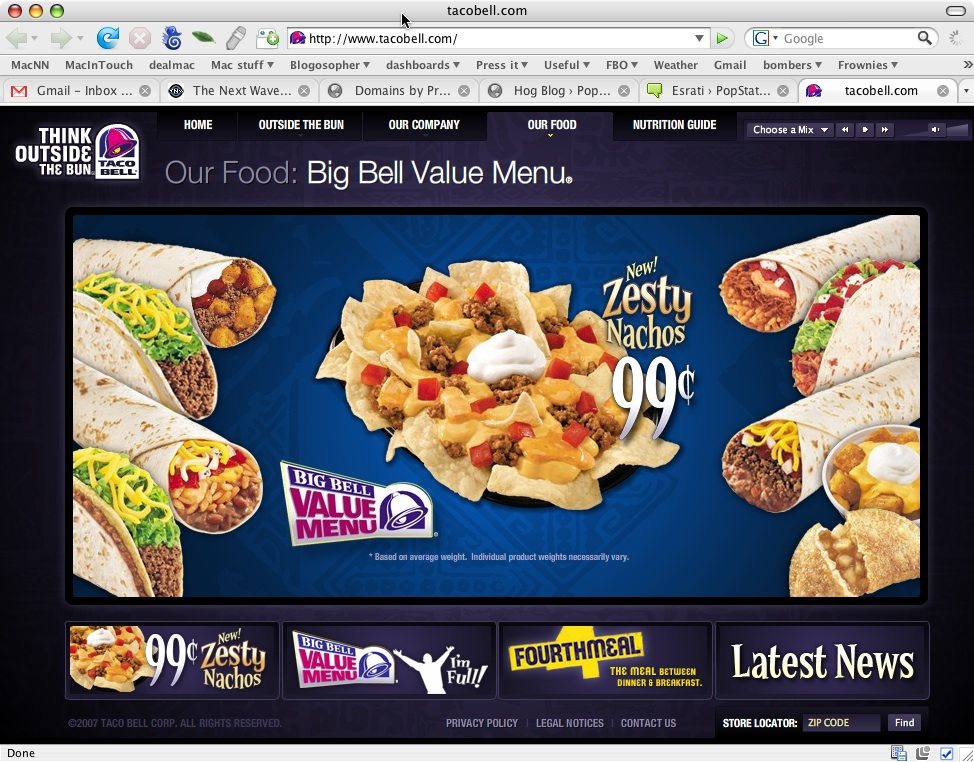
I wish my associate had kept the receipt, but, Taco Bell needs to work on their site integration with their stores: there’s nothing worse than a broken promise.
I text messaged Richard to pick me up three items off the “Big Bell Value Menu” where all items are .99- of course I can’t send a link, because they build their site in Flash- just like all the rest of the big chains- not searchable, not bookmarkable- and really, not that useful with it’s “pop-a-mole” navigation system. Never mind there aren’t actuall descriptions of what are in any of the items. There are so many things that a site for a national fast food restaurant could do- but unfortunately, none of them understand web 2.0
I ordered the Zesty Nachos, Grande Soft Taco and the Double Decker taco. When Richard got to the register- the girl had no clue. I ended up with three items that were similar to the items I ordered, but they came to $3.79.
Taco Bell just failed me over .82 cents- and now I remember why I don’t make a run for the border very often.
by Next Wave Team | Mar 21, 2007 | Change the world, Creativity, Everything You Want to Know About Advertising, Future of advertising, How To Select An Ad Agency, Marketing & the Web, Practical Marketing 101, Public Relations in the Web 2.0 world, Secrets of Great Advertising, Viral Marketing, Web strategy
Advertising is usually delivered in what we call “paid media” - which would include TV, Radio, Print, Direct Mail, Outdoor, Internet etc. It’s usually your company talking about yourself.
There is also what we’ve come to know as “unpaid media” which is usually described as Public Relations- where your press release, guerrilla stunt, amazing feat, etc. is actually newsworthy- and you appear in the media- usually print, radio, TV or Internet. This could be defined as others talking about you.
Then we have the new media form, and by that, I don’t mean web, Internet, etc. and it’s new name “earned media”- this is where something is so interesting that it gets circulated and watched out of fascination. It is the basic building block of a viral campaign. It is becoming the most valued form of advertising- but there is no price tag on it. You can’t just pony up money and get the eyeballs. Earned media is the result of the new currency in advertising (which really has always been the true currency) creativity. Creative solutions, creative executions, interesting, funny, informative and unexpected messages can take your brand message places that conventional (paid and unpaid media) can’t and won’t.
This creates a huge problem in advertising agency compensation - are you as a client, willing to pay for the value of a good idea? Or are you still basing your compensation plan on the size of your media buy or on hours worked? If you want to earn eyeballs instead of pay for them, the first thing you need to eyeball is what you are trying to buy from your ad agency.
And then decide what kind of media is going to get you what you want.
by Next Wave Team | Mar 19, 2007 | Ad Agenices in Dayton, OH, Everything You Want to Know About Advertising, Future of advertising, Great Ad Agencies, How To Select An Ad Agency, Marketing & the Web, Practical Marketing 101, Public Relations in the Web 2.0 world, Search and Business, Web strategy
In our effort to bring you the best, most useful, and interesting insight into advertising, ad agencies, and getting the most for your marketing dollar- we stumbled upon this post by “Gerry McGovern” in a non-web 2.0 site- but was right on:
Web design: never let an ad agency near your website: January 19, 2004 issue of New Thinking by Gerry McGovern
The average advertising agency fundamentally doesn’t get the Web. Saatchi & Saatchi, BBDO Worldwide, J. Walter Thompson and Ogilvy are great advertising agencies. When it comes to managing their own websites, however, they are rank amateurs. They bring their print and TV thinking to the Web with embarrassing results.
Well worth a click over - where he rants about the stupidity of the Flash intro, and the innane copy which makes every agency sound- well- alike. He doesn’t actually give your real stats on why big ad agency sites suck (we do that quite aptly here: ad agencies seek diversity) but he does describe some sites- that when you visit today- will realize haven’t changed or updated content in 3 years (we just went to LeoBurnett.com the other day- only to leave totally frustrated with the most worthless web navigation ever- and no search function).
We’re not saying that all big advertising agency sites are boring, or ugly- just that most of them aren’t actually useful.
Here are some key ways to evaluate an ad agencies web competence:
- Is the text selectable- and copyable- so you could easily put together their brilliant ideas for marketing into a memo for your boss on why to hire them? (This also means you can read the content with a text-to-speech reader for blind people- and that the site will be indexable by google).
- Are there separate pages for each piece of content- in other words- can you send a link to the exact spot that you think is relevant to your boss- “Hey, look at this brilliant marketing strategy” - I think it applies to our company.
- Is the content current- and changing? Google rewards fresh new ideas and content. If thy don’t update their content, how can they suggest you do it? Practicing what you preach is important on the web.
- Can you view the site without having to turn off noise, or have video start without you telling it to? Good for not disturbing the boss- or letting him know that you are secretly looking for a new ad agency because your current one isn’t very web-savvy.
- When you go to Google and type in: site:bigagency.tld you actually get more than one page. Try it for this site- site:thenextwave.biz and look at how many pages are indexed!
- Another key to finding out if your prospective agency is web 2.0 compliant- look for links out, and links in. Although not perfect- going to Google and type in link:thenextwave.biz will show you a smattering of what links to us. We know many more link to us, because we watch our web stats- a very informative tool to gather information about who is saying what about you.
There are a whole bunch of other questions to ask before hiring an ad agency- but we try to cover that in our topic “how to pick an ad agency”- as opposed to here- where we’re just talking about web 2.0 web skills.
If you have questions on how to analyze your ad agencies web competence, feel free to give us a call.