by Next Wave Team | Apr 24, 2007 | Advertising, Change the world, Everything You Want to Know About Advertising, Future of advertising, Future of TV, Marketing & the Web, Media, Procter & Gamble Advertising, Web strategy
As the automobile became the primary transportation method for the nation, the buggy whip inventors created their best offerings. Too little, too late- and other than for collectors of buggy whips- totally valueless.
That’s our analogy for commercial ratings.
Nielsen has been ruling the roost with abstract data for decades- taking a percentage of the total viewers and making an educated, statistically based guess on how many viewers are watching a program. While this worked well with only 3 networks, in the days of cable tv, satellite tv, vcr’s and dvr’s it became less relevant- but the system was so well dug in, and the alternatives so few- that the advertising industry stuck with it.
With broadband sneaking into more homes, with DVR’s doing the same thing- and with Internet use skyrocketing- and the advent of Internet Protocol TV (IPTV) with products like AppleTV, we are seeing the last days for Nielsen- and no real use for rating TV spots.
Here is why: Advertising is expensive- and therefore, advertisers aren’t interested in reaching people via “broadcasting” anymore. Broadcast reaches “broad audiences” including those who aren’t eligible to buy your product. The web, IPTV, and hard-drive enabled TV systems (cable and satellite) are able to deliver content that is targeted and able to generate hard data back. The ultimate one-to-one marketing, where if an ad dollar is wasted- it will only be wasted one time. This is the future, and with the ad industry being a multi-billion dollar business, it won’t be long before marketers demand accountability more exact than if someone saw the commercial- as offered by Nielsen- or even if they liked the commercial- they want to know if you are a real business prospect- and what it would take to make you one.
Nielsen to Offer Commercial Ratings
NEW YORK Nielsen will begin supplying national commercial ratings starting in the fall, the company confirmed today.
If the networks and advertisers can agree on a standard, the commercial ratings could be used as currency to buy and sell ads by as early as the start of the 2007-08 TV season.
But for now, program ratings will continue to be the currency for ad transactions.
A Nielsen representative said it received requests from all five major broadcast networks (ABC, CBS, CW, NBC and Fox) for commercial ratings based on live viewership plus seven days of recorded DVR playback viewing. Nielsen will begin delivering that data “sometime this fall,” the rep said. That will give the industry about a year to analyze the data before deciding whether or not to use it as currency in the following season.
The commercial ratings will provide the average audience for all paid national ads airing during each program transmitted by national broadcast and cable networks, the Nielsen rep said.
While the trade press, the buyers, and the networks talk about this “next big thing” they are just fiddling while Rome burns. The entire system of delivering advertising messages will be more like YouTube and GoogleVideo- with meta-tags driving ad choices with a rebate per-click to the viewer (that’s right- you will get paid for watching and interacting with advertising in the future) or similar to Amazon‘s suggestions with a profile built from information you have volunteered.
Soon content producers will take their programming direct, via online hubs like the iTunes store or Amazon- getting paid directly from the consumer for their content. Discounting your media bill will be accomplished by your willingness to watch targeted TV spots- that help build your profile.
If you accept more commercials than your media bill- the proceeds go to the media producers- not to the intermediaries. This levels the playing field- and allows capitalism to do its thing- the way it was meant to.
There are two articles in Ad Age- talking about “engagement” and how “YouTube isn’t getting it done” which are still based on the idea that TV is driven through the old school “Network as middle-man” model. Once you realize that the new middle man will be the one who delivers 2-way feedback and links to your product- you realize how stupid this whole commercial rating discussion is.
If Proctor and Gamble took their “Soap Operas” offline- and onto their site- and charged $1 per show for an enhanced program- with 2 way connections with the characters- and then offered the content for free- if you answered some questions about Pringles, Tide or Gillette- don’t you think they would find that infinitely more useful than a rating of the viewership during their commercial?
Commercial ratings- the best buggy whip for last centuries marketers. Get used to it.
If you have questions about how to navigate this new media landscape feel free to contact us. Surf at the next wave dot biz.
Note: in today’s Ad Age, an article called “Revenge of the nerds” talks about this very subject- it seems Backchannel media has the right idea- except the part about the delivery system still including the networks.
Mr. Kokernak’s vision is to implement long-sought dreams of fully interactive, individually addressable and accountable TV. Backchannel wants to become the software and technology backbone of a new era dawning in TV as it transitions from analog to digital broadcasting — one Mr. Kokernak likens to the broadband tipping point that ushered in the age of YouTube.
In this era, ads are served to people according to the blocks or households where they live. They respond to TV ads with a simple remote click on an icon to, say, get more information about a car they just saw advertised, buy a song they just heard on the Grammys or the book Oprah just touted, or reserve a table at a nearby restaurant. In this era, based on real-time analysis of who’s clicking on what offers and programs, media plans change continuously.
TV, like the internet, but better?
In Backchannel’s vision, TV is a direct medium a la the internet, only, as Mr. Kokernak sees it, much better — without click fraud, phishing scams and other security threats. It’s enough, he believes, to shift much of the money that’s been going into search and other direct media back into TV, replace eyeball counts with the harder currency of response, and ultimately eliminate most upfront deals as dollars gravitate daily in a continuous-improvement cycle toward programming proven to generate response.
Sounds like a pay for performance plan doesn’t it?
by Next Wave Team | Apr 15, 2007 | Advertising, Apple Advertising, Change the world, Everything You Want to Know About Advertising, Future of advertising, Future of TV, Marketing & the Web, Media, Practical Marketing 101, Public Relations in the Web 2.0 world, Search and Business, Secrets of Great Advertising, Web strategy
Everyone knows the 80/20 rule, in fact an extension of this idea has become known as “the Long Tail.” However, the 80/40 rule might become the most important rule to marketers in the age of search engines and advertising effectiveness.
First- a reminder of what the 80/20 rule is:
Pareto’s Principle - The 80-20 Rule
n 1906, Italian economist Vilfredo Pareto created a mathematical formula to describe the unequal distribution of wealth in his country, observing that twenty percent of the people owned eighty percent of the wealth. In the late 1940s, Dr. Joseph M. Juran inaccurately attributed the 80/20 Rule to Pareto, calling it Pareto’s Principle. While it may be misnamed, Pareto’s Principle or Pareto’s Law as it is sometimes called, can be a very effective tool to help you manage effectively.
Where It Came From
After Pareto made his observation and created his formula, many others observed similar phenomena in their own areas of expertise. Quality Management pioneer, Dr. Joseph Juran, working in the US in the 1930s and 40s recognized a universal principle he called the “vital few and trivial many” and reduced it to writing.
In an early work, a lack of precision on Juran’s part made it appear that he was applying Pareto’s observations about economics to a broader body of work. The name Pareto’s Principle stuck, probably because it sounded better than Juran’s Principle.
As a result, Dr. Juran’s observation of the “vital few and trivial many”, the principle that 20 percent of something always are responsible for 80 percent of the results, became known as Pareto’s Principle or the 80/20 Rule.
Traditional media based advertising has a major flaw: all ads are temporary. The ad in todays paper is in tomorrows trash, the spot in the TV show is over and gone (or skipped by Tivo- or ignored the second time it’s viewed) and most importantly- the old John Wanamaker adage about half his ad budget being wasted- only he didn’t know which half- still, even in todays hyper-targeted media, is pretty close to true. I’ve seen many ads for feminine hygiene products- but will never need them.
The difference between spending your budget on old-school media campaigns and putting your best efforts into online strategy- is that only people interested in your product or service will be interacting with your site- and they are there actively looking for information to substantiate their buying decision.
This is where the 80/40™- rule comes into play- insight directly from The Next Wave: 80% of Internet usage begins in search, 40% of people using search- type your URL into a search, instead of a direct access to your site- and get search results- which could include people talking about your business negatively- or trying to steal your eyeballs- even after you have spent millions of dollars promoting your URL.
Once they get to your site- what do they get? If your site is in Flash, often times they get frustrated. Also- remember, since 80% of use begins in search- are they able to access the specific information they seek? Or just get to your site? Many Flash sites do not allow your visitors to link to interior content with an exclusive URL.
One of the new realities in advertising and marketing is that people are depending on the Internet more for researching purchases- even having access when mobile to the web through WAP enabled sites- or soon- to any site with the introduction of the Apple iPhone. Everything is changing rapidly- and if you don’t make your information search friendly- you won’t be relevant in the decision making process.
How do you solve the 80/40 rule™? Building sites to be search friendly is just the start. Also, remember, it’s not about chest-beating ego sites- it’s about delivering information to the consumer that answers their problem (and the consumer can be a B-to-B customer just as easily as a B-to-C consumer). Your site should be searchable as well. Make every piece of relevant data available- in a web friendly form- and don’t remove material- always update it with relevant news (since links shouldn’t be broken by your maintenance).
But most importantly- always be aware- that when someone is looking for you- 40% of the time, they may get search results instead of directly to your site and someone else may have the answer and steal your lunch- and that is a much bigger problem than the old 80/20 rule.
by Next Wave Team | Apr 5, 2007 | Ad Agenices in Dayton, OH, Advertising, Change the world, Everything You Want to Know About Advertising, Future of advertising, How To Select An Ad Agency, Marketing & the Web, Public Relations in the Web 2.0 world, Search and Business, Viral Marketing, Web strategy
Today, the Greater Dayton Advertising Association (formerly known as the Dayton Ad Club) made an effort to finally bring it’s members into the year 2003. The speaker was Matt Bailey from SiteLogic- a Search Engine Optimization consultancy.
Matt did a decent job of explaining the power of social media in his alloted 45 minutes- using eepybird’s Mentos/Diet Coke video as a viral example, discussing how Price Rite Photo got destroyed after a bait/switch deal and the Pork Producers failed attempt to slam a breast feeding support site for using the phrase “the other white milk.”
All great stuff- all stuff we’ve been trying to get the ad club to discuss for over 2 years. All the stuff that we’ve been offering in our Websitetology seminars- but, of course, if you aren’t from out of town, you can’t be an expert.
Matt had a hard time coming up with business to business blogs as an example of generating business- yet, had we been the presenter- we would have been able to point to this blog- to show the b-to-b results. I looked at Matt’s blog- and found this bit:
SiteLogic - Marketing Logic » Why are Analytics so Difficult? by Matt Bailey
Building a website requires an understanding of search engines, as search engines are one of the primary methods of acquiring visitors and customers. However, once the search engine’s information requirements are met, the site has to be able to communicate a different message to the human visitor.
We agree- since 80% of Internet use begins in search, search is key. And, once they get to your site- they need to engage. Apparently Matt’s blog isn’t providing him the kind of traffic he needs. We think we know why.
In the Q&A, someone asked if “tags” in a blog are like Meta tags of old- and he answered they weren’t the same- which is true. Metatags were for the machines; blog tags/categories/taxonomy are for the user. He got that straight- but then, he took what I call a Guru Nosedive- he said that he didn’t use them much, they aren’t that important- content is.
WRONG. At least with WordPress, categories are a way to supercharge a search term, by grouping a bunch of posts into a single post. It’s probably one of the most important SEO techniques we teach- but, alas, the Dayton Ad Club people won’t learn that. Their Executive Director still won’t attend our seminar- and is still building sites the old fashioned way.
It was particularly telling of the 2.0 literacy in the room when there was only one other person in the room that knew what the Long Tail was (besides yours truly) and only a handful (including SAA students) had heard of Digg.
If the Greater Dayton Advertising Association and it’s members (and SAA students) hope to survive, they are going to have to do some serious catch-up. Web 2.0 is only the beginning of The Next Wave, and they aren’t there yet.
by Next Wave Team | Apr 4, 2007 | Ad Agenices in Dayton, OH, Advertising, Creativity, Crispin Porter + Bogusky, Differentiating Your Brand, Everything You Want to Know About Advertising, Great Ad Agencies, How To Select An Ad Agency, Marketing & the Web, Practical Marketing 101, Secrets of Great Advertising, VW advertising, Web strategy
Crispin Porter + Bogusky is the über hot ad agency of the last few years. We write about them, other people write about them, and everybody has an opinion. While celebrities have their paparazzi, the hot agencies have their armchair quarterbacks.
We write about them, because we know there are people searching for great, smaller, independent agencies- and hope they take a look at us (we think we understand web 2.0 better than CP+B and can help our clients get bigger bang for their buck)- but also because, well, the ads are interesting to us.
So, while Seth Stevenson writes in Slate why he hates Crispin ads- (and we have a few we detest too)- we thought this section was worth discussing:
Why I sort of hate the hottest ad agency in the country. - By Seth Stevenson - Slate Magazine
Strong reactions. But that’s not necessarily a bad thing. In fact, a vigorous response is precisely what Crispin wants. As CEO Jeff Hicks told me, “We make a conscious effort to have our brands commented on and talked about.” It’s his feeling that in a world supersaturated with content—video games, Web clips, text messages, etc.—to “break through and be noticed is a huge victory.” Crispin is the master of breaking through, getting attention with its provocative TV ads and also with smart viral projects (remember the Subservient Chicken?).
But is all attention good attention? This is an age-old question at the heart of the ad game. And there’s really no right answer. Sometimes a provocative, attention-getting ploy is just what a brand needs. Other times, the tactic falls on its face.
You see, local car dealers have been doing the same thing for years (as did a really obnoxious carpet dealer named Buddy)- they did ads that people talked about- that “broke through” - and that drove our community nuts. Yes, they all have top-of-mind awareness, but, no, it wasn’t the most effective way of advertising. David Ogilvy suggests that you create ads that your mother would be able to like, understand and accept- screaming, being obnoxious, etc. isn’t the answer.
When we were challenged with changing the image of Mendelson’s Liquidation Outlet, we refused to put the owner on his own spots- screaming “I’m crazy Sandy, I’ve got deals” (which of course he did after we ended the relationship)- instead we created the “explorer dude” and his “shopping safari” concept- coupled with the tagline “The first place to look for every last thing”- which cut through the clutter, yet didn’t annoy.
As the industry leader, with everyone scrambling for competitive advantage, Crispin is able to sometimes dicatate to their own detriment. The Haggar Dog Crap spot- while entertaining, may loose the pants in the joke. And while we enjoyed the “Unpimp your auto” campaign for VW- it alienated an audience that could one day be potential VW buyers.
Creating an emotional response is critical in advertising- but, when given a choice, go for something your Mom would enjoy.
by Next Wave Team | Apr 1, 2007 | Careers in Advertising, Crispin Porter + Bogusky, Great Ad Agencies, Marketing & the Web, Public Relations in the Web 2.0 world, Search and Business, Web strategy
You can tell who is web 2.0 savvy- and who isn’t.
Agencies are apparently paying $199 for 30 days to post jobs on Krop.com
Krop - Creative & Tech Jobs
Krop jobs are everywhere! When you post your job with Krop, not only is it instantly listed at krop.com but your job is also automatically listed and broadcasted to our entire network of top industry websites proudly featuring krop jobs. Your opportunity will be seen by millions of talented creative and tech candidates on the sites that they already visit daily.
Build your own site to be searchable- and you can get all the job applicants you want for free. Even ones you don’t want. We get bombarded with applications here at The Next Wave, because we can be found in search. Unfortunately, many large agencies have no clue how this works- and pay to post jobs.
Craigslist.com is always a free option to post jobs, but, so are many of the advertising communities online. Adrants has its soflow community or where you can pay even more on their own little job board. Even Ernie Schenck experimented with a job board on his blog.
I was looking at page rank for searches on Crispin Porter + Bogusky and saw that they were hiring more Flash and motion developers on Krop. Figures- the agency that gets search the least, is looking for more developers that will set them even lower in Google results.
Considering I get search referrals for “is Crispin Porter Bogusky Hiring” and “Jobs at Crispin Porter Bogusky” maybe they should just pay us to fix their site and teach them how web 2.o works and save money on all the job postings?
by Next Wave Team | Mar 26, 2007 | Advertising, Brand Relevancy, Differentiating Your Brand, Everything You Want to Know About Advertising, Marketing & the Web, Practical Marketing 101, Public Relations in the Web 2.0 world, Search and Business, Web strategy
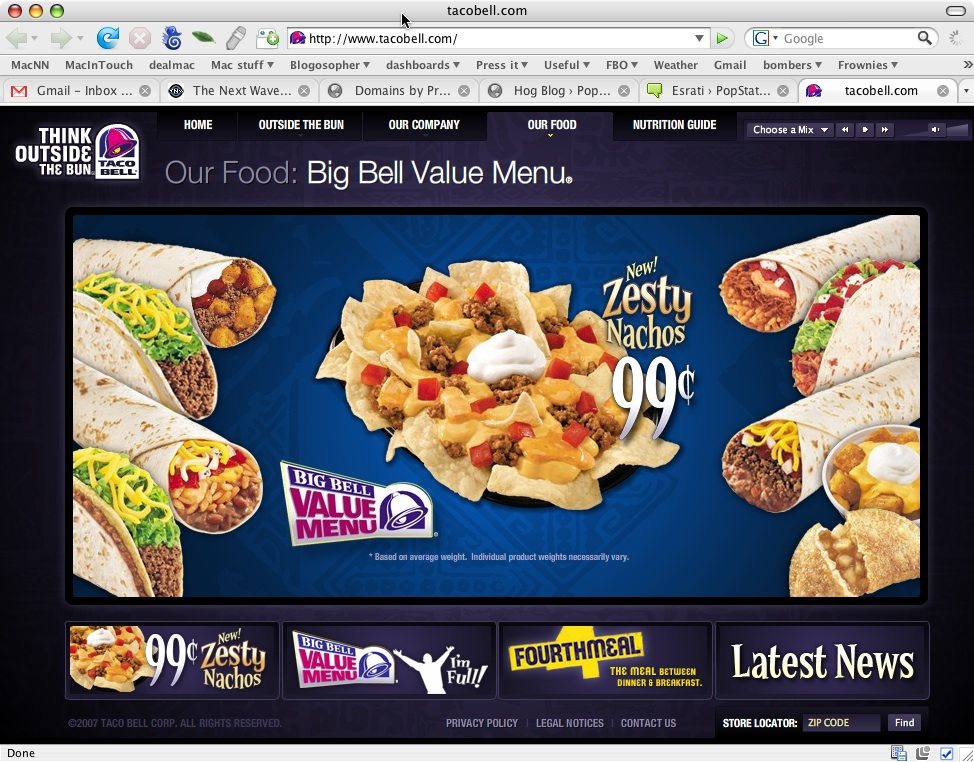
I wish my associate had kept the receipt, but, Taco Bell needs to work on their site integration with their stores: there’s nothing worse than a broken promise.
I text messaged Richard to pick me up three items off the “Big Bell Value Menu” where all items are .99- of course I can’t send a link, because they build their site in Flash- just like all the rest of the big chains- not searchable, not bookmarkable- and really, not that useful with it’s “pop-a-mole” navigation system. Never mind there aren’t actuall descriptions of what are in any of the items. There are so many things that a site for a national fast food restaurant could do- but unfortunately, none of them understand web 2.0
I ordered the Zesty Nachos, Grande Soft Taco and the Double Decker taco. When Richard got to the register- the girl had no clue. I ended up with three items that were similar to the items I ordered, but they came to $3.79.
Taco Bell just failed me over .82 cents- and now I remember why I don’t make a run for the border very often.