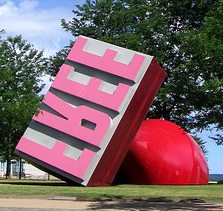
We have a book called “Words that Sell” and one of the best is the word “Free.”
The obvious question is how are you supposed to make money by giving things away? It all depends on what you are getting in return.
Getting attention is the wrong reason to give things away for free, although it’s unfortunately, the reason most businesses use it. They feel that the only way to get attention or to compete in a crowded marketplace is to give people an offer they can’t refuse. Unfortunately, this is the fastest way to going out of business too.
Sampling is often a code word for free. This is the hail Mary pass for marketers- thinking that if people only try my product once, they’ll be convinced that we have the better mousetrap. And while sampling can work great in-store for impulse type purchases (think the little lady’s in a grocery store offering you food to try)- the problem is that on your return visit- you may not have the prompt without them handing you a taste right there in the aisle. I’ve got a whole collection of razor handles- that came as a demo, but, my ability to find and justify the prices of the blades once in the store stops me from becoming a mach 6 regular.
The real benefit of “Free” comes when the customer thinks they are getting something for free- a service, an opportunity to win etc. without realizing they are in fact giving the marketer something back. These days- the most valuable asset a marketer can hold is a list of real, verifiable, valid potential customers with qualifying data. This is where “free” becomes a marketers best friend.
The perfect example of the power of “Free” as a business model is Google. Google provides a whole suite of “Free” tools to make your life easier- and what you give them in return is more valuable by far than the search results, e-mail service or software- you give them information about you, your buying habits and a fairly complete profile that only gets better with time.
Google knows what you want- and then sells access to you to advertisers in the forms of sponsored ads that are amazingly similar to what you are searching for. You write an e-mail to your friend about a yoga class- and there, next to your gmail message- are ads for yoga books, videos, mats etc. It’s non-intrusive and relevant if you want to take the bait.
Even if you aren’t Google sized, you can use the power of free to finely tune your brand messaging. With media becoming ever more fragmented and more expensive- making sure you are getting your message directly to people most likely to need your product or service can be the difference between making or breaking your advertising budget.
Working with a local orthodontist, we know that our market is parents of kids aged 8-16 and the kids themselves- that may need braces. It doesn’t do us much good to reach people without kids (or seniors who take their teeth out at night)- so by offering a contest to “Win free braces” we create an opportunity to build a database of potential customers so that we can focus our marketing dollars on only those with crooked teeth. In exchange for “Free” we’ve gained something extremely valuable to our small market client.
Another tool was to give away free mouth guard fittings for school aged athletes. You know the ones you boil in water and then press in place. The ones that almost never fit quite right. By buying the mouth pieces in bulk- and providing a branded case for the mouthpiece, we keep our brand in front of a group of influencers in our target market: jocks in junior high and high school.
Besides the acquisition of data, true free offers often generate buzz marketing- where consumers tell each other about the amazing offer. It’s absolutely mandatory that when the consumer follows through- they get what they were expecting. Chick-fil-a and Coke teamed up to offer a free sandwich with an online promotion- but, when I went into a Chick-fil-a to redeem the offer, I was told that they were a “remote store” and the coupon was only available in stores where they make the sandwiches. Needless to say- I’ve not been inclined to go to a Chick-fil-a ever again.
Many marketers confuse discounts with free by offering things like buy one get one (BOGO) offers- or other offers that really aren’t free- but just a price cut. Don’t make this mistake. Free must mean free- at least if you want the maximum number of leads for your business.
Of course, this is free advice, so you can take it or leave it, but, if you are interested in maximizing the effectiveness of your marketing/advertising dollar, never underestimate the power of free. Just make sure you are getting something valuable back from your free offer without the consumer knowing it.
There aren’t ad agencies bending over backwards to solve the problems of the micro-enterprise unless they want to win awards, because the value equation just isn’t there. Big clients equal big media budgets, small clients equal no media budget, and even though the media budget shouldn’t have any connection to the compensation of an agency, every one would rather have Burger King instead of Benjamins Burger Meister on their account list.
So, if you own a small business, and may want to be big one day- this post is for you. But, right now, you just want customers and have a small marketing budget and need real answers so here we go.
Branding is the most critical decision you can make. They say “what’s in a name” and the simple answer is everything. Yet, I don’t know how often little thought is given to the corporate moniker and the associated mark. This will be what you have to live with for the life of your business. The name needs to be unique, catchy, have meaning, be memorable- and preferablly spellable with out having to go to phonetics.
Here’s the short don’t list:
Don’t name it after yourself, in case you ever want to sell the business. Yes- I know it worked for Ford, Chevrolet and Chrysler and Toyota, but, there was no Mr. Scion, Mr. Lexus or Mr. Infiniti.
Don’t name it after the location- in case you ever have to move the business ie. Dorothy Lane market has three locations- none on Dorothy Lane.
Don’t make it cute using numbers for words or abbreviations- ie. Marketing4Performance or Gold4yaMouth.
Don’t limit your business by a technology or what you do- ie. “Muffler Brothers” does complete car care and “Dayton Electrolysis Center” now uses lasers to remove hair.
After naming comes the brand mark. Nike originally paid $35 for the “Swoosh” and thought it would never be as good as the Adidas 3 stripes which actually helped reinforce the shoe. Next Computer paid Paul Rand $100,000 for their logo- only to have the company last a few years.
Rule of thumb- it’s not a good logo if only you would ever want to wear it. Invest in a good design.
15 years ago, the URL wouldn’t make a difference- now it does. It’s preferable to get a dot com address- even though search engines have made this really irrelevant (a good site will be found no matter what). Find something people can spell- like www.smileodontics.com as opposed to www.phonyx.com
The importance of a website that can be searched and indexed is absolutely critical- and it’s why we teach our Websitetology seminar at least once a month in our market. Small business can’t afford to either have a static website that isn’t updated frequently, or an over the top Flash site that looks uber cool but can’t be updated or found. If nothing else, make sure your business is listed in Google local.
While we could spend quite a bit of time on building a better site your website must have the following:
While having a great brand and site are a good start- the real problem is how to tell people where you are and what you do- FOR THEM. It’s not about you- it’s about how you solve your customers problems.
If you are a restaurant- what will be different, what is your value proposition, what kind of experience you will provide. This was dubbed “The Unique Selling Proposition” or USP- and today it is even more relevant. In a web 2.0 world where ideally, the consumer is all knowing of all options available, how will you convince them to buy from you? While paid media was the method of choice for the last century, recent studies are suggesting that 57%+ of internet shoppers are more likely to trust “someone like them” than a professional reviewer. Remember where we said customers need to be able to comment on your site- well, either they’ll comment on yours- or someone elses (this restaraunt lasted a little over a year).
Building links to the community isn’t any faster than building an ad campaign. No one shot silver bullet solutions- it’s a long term commitment to forging ties that connect you to your marketplace. Sure, sponsoring t-ball leagues doesn’t seem like a sophisticated marketing strategy, but for an orthodontist, it’s one way to reach kids that will probably need braces.
Mass media is failing small business miserably. While local broadcast TV used to be a viable solution- with the addition of first cable, then sattelite, then competing IPTV over phone lines- it’s becoming less of a BROADcast and more of a hit-or-miss cast. Local radio is now splintered by multiple formats, owned by a very few companies, providing very little localization. People are tuning into internet radio, podcasts and their own personal music servers (iPods). Newspapers are losing readers in droves in print- and picking up readers online- yet, the ads they serve are just as untargeted as before. Until these media build a marketing profile of their customers to gain permission to provide focused marketing in exchange for their content it’s still a hit-or-miss marketing strategy.
This one-to-one marketing relationship is the holy grail of our current media landscape. The best example of providing meaningful targeted advertising is now coming from “sponsored search” where marketing messages are keyed to the topic you are searching. Google has become a mega brand and a powerful force in media by only showing text ads that relate to the searches you are making. No pretty pictures- just words based on your words. Even though 70% of searchers ignore the sponsored ads, these may actually be the best option for small business available. Even with the spectre of click-fraud, and high cost per click, at least the ad is being served to someone looking for your specific product or service.
Ideally, you are on the first page in organic search. It can be done for any business, if you make the effort. Instead of spending time cold calling or shotgun marketing- work hard at building your site to be the “expert’s answers” to your customers problems. We provide the most complete listing of our competition for ad agencies in Dayton on our site as one way to make sure we are considered in a customers search for an ad agency. You can do the same for your local business, or join in a trade association that keeps a list.
While we’ve spent quite a bit of this post on internet strategy, old fashioned Public Relations (PR) and event marketing should also be part of your plan. Even though readership is decreasing in newspapers- there is nothing like an article on your business to build awareness. Look to become friends with local business writers and bloggers- and be available as a source. Any time there is a new development in your field, make sure to write about it on your site- to share your expertise on the subject.
Knowing your customer: We can’t stress enough the importance of getting at least a name and e-mail address from every single customer. Comment cards in restaurants can be a great tool- but only if you reward your servers for getting completed cards from every table. A simple bowl to enter to win a meal, or movie tickets can be your best source of leads for your next promotion.
If you are still reading at this point- you must really care about marketing your business and want to differentiate your business from the competition. Here is the magic that makes small business work- you have passion for what you do, and love being the best at what you do.
Often times this means not taking yourself so seriously. Seriously. Have fun, make your business the place that people like to talk about, make your ads that you do run- fun, friendly and funky. We once names an electrician “Singing Joes Electric”- only to have it nixed by Singing Joes Wife. After years of struggling as the boring “Electrical Quality Services” he bought an established brand “Jahn Electric” and took over their brand. We’ve run into too many people who want to stand out- yet say they want an ad just like the competitions- don’t make that mistake.
When we do posters for the Second Street Public Market events- people steal them, frame them, decorate their room in the same color palette. When was the last time you wanted to take one of your ads home with you? What happens when customers want to wear your shirt, hang your poster up, or stick a bumper sticker on their car? Business.
We have no problem laughing at beer ads during the Super Bowl- but, when it comes to wiring a kids mouth with braces- why not make fun of it? Marketing is about building relationships- and there is nothing better than humor and fun to break the ice.
So when looking for an agency to work with your small business, look for the one that has ads that you would want to take home with you, the ads that speak on multiple levels, that interest, intrigue, inform or just instigate some sort of emotional connection between you and the brand.
You aren’t hiring an agency to spend your money on media- but to give you a message that people would want to make a part of their life. And remember, the agency can only make an introduction- it’s the execution and delivery of your product or service that will cement the relationship and be the platform for your business to grow.
Apple announced the 3G iPhone on Monday, June 9 2008. I imagine the lawsuits will start by today, but, don’t quote me on it. If they don’t, they should- and Apple should be ashamed.
This isn’t the first iPhone price debacle, the first generation iPhone started out at $599, only to have the price cut by $200 less than 60 days after launch. Apple made it up (sort of) to early adopters by granting them a $100 credit at the Apple store.
This time, the part that’s missing from the small print is that Apple’s US partner in this, ATT, is going to require all 3G iPhone buyers to sign up for a new 2 year contract that is $10 more a month for the data plan that you have to have with the iPhone if you want to use all of its features. That works out to $240 extra- $40 more than you’d pay for the original iPhone with service. This iPhone might be $199 instead of $399, but, you will pay more monthly.
It’s not clear if ATT is offering the old “EDGE” or 2.5G price option to new 3G buyers or not. As a user of the original iPhone, I can tell you this:
ATT’s idea of “Internet access” via the “EDGE” network- is an absolute farce- my old carrier, Sprint- not only had faster access, but less dropped calls, and better coverage. Also, the visual voice mail on the phone only works when you have internet access- which means without EDGE or a WiFi connection- you can’t reliably easily retrieve your voice mail.
Apple still has other issues in this price change. The old iPhone hasn’t been readily available for months. If your 2.5G iPhone (still under warranty) has an accident (like mine did on Saturday night- slipping out of the holster into a bucket of ice water)- Apple is still charging $249 for a refurb, with no additional warranty:
This price- $249 to replace a phone that will soon be obsolete- and that can be purchased new on July 11 for $199 makes no sense. Apple’s pricing guru’s are asleep at the wheel on this.
It’s also sending a message to Apple’s customers that Apple really doesn’t care about taking care of it’s best customers- the early adopters.
Besides the “half the price” being a lie, Apple and ATT still haven’t learned the number one truth of the internet enabled consumer: pricing games are over; “There are no secrets. The networked market knows more than companies do about their own products. And whether the news is good or bad, they tell everyone.” This was thesis 12 of the “Cluetrain Manifesto” published in 1999.
Subsidizing prices with subscription plans isn’t a viable way to build in hidden costs. Apple and ATT will have to learn this the hard way, which is really too bad, since they are probably reintroducing the greatest product in history- with features that will change the perception of what a phone can do as a computing platform- again.
When the Dayton Bombers called and wanted a 15 second spot, all they thought that could be in there was date and time. Had they had the station do it- they would have had some news footage, with graphics on top and the same announcer that does every single local spot on the air.
The reality is, no one cares about your hockey game that doesn’t already know about it. Advertising is supposed to make people who don’t care- care. Good ads get your attention, and suck you in. Bad ads tell you about a product you could care less about.
Simple connections between client and consumer happens when you grab a fundamental truth- and make it relevant. Here we use “hockey is painful” - complete with missing teeth, black eyes, broken nose and organ music more fit for a funeral than a hockey game.
Getting the message to resonate with something the customer already believes is a great first step to engaging them in your brand. Even in 15 seconds.
I’m not going to go Sun Tzu on you, but a guiding principle in warfare is to attack where your enemy is weakest. In judo, you try to make your weakness your strength. Political advertising may be one of the areas where this is toughest- since incumbency and large campaign chests are considered prime indicators of product value. Shrewd political contributors don’t give to longshots, they bet their dollars on who they think can win. It’s the nature of the game, and a very hard marketing battle.
Think of it as launching a challenger brand, with no money, no time, and a very absolute deadline to dominate the market (election day). Can you imagine Procter and Gamble launching a new detergent and having to have 51% of the market make a purchase in two months?
Here is our first shot at launching a local political activist into a National Congressional race. Please note, not only did the candidate star in the ad, he wrote it himself (unlike his competition) because of course, the candidate is the same person writing this post.
One of the keys of viral marketing and leveraging your low budget campaign is getting others to talk about it- the “word of mouth” factor. You can’t count on this happening automatically. This is where your established network of customers can make or break you. First, you have to actively tell them that the campaign is out there. Digitally- this means sending e-mails, posting appropriate comments in appropriate places, and reaching out to people who think as you do. It used to be marketing to the influencer or early adopter- now, it’s to your social network either formal (Facebook, LinkedIn, MySpace) or informal as I did. Here is what creative genius Ernie Schenck said about the spot:
Ernie Schenck Calls This Advertising?
Seriously, people, show me a spot in this already tired political year that comes close to this simple little gem from Dayton ad guy, David Esrati, and I will eat my moustache. Attention, candidates: A little imagination, a little self-deprectation and a little ability to lighten up can go a long way. The man ought to get elected on the spot alone. Nice work, Esrati.
A client, and really smart guy, Charles Halton posted on his Awilum site:
it’s the funniest political ad I have ever seen. If politics were more like this it would make election season actually fun!
Google doesn’t spend a lot on advertising, that’s what their competition does. Guess what? It doesn’t matter how much you spend if you are Yahoo, Microsoft or Ask.com, Google will continue to win.
But, kudos to Crispin Porter + Bogusky, they were able to bump Ask.com from a nobody to a better known nobody with their campaign (“Experience Instant Getification” and “The Algorithm”) more than any of the other also rans, up a whole one-tenth of a percentage point.
Guess Who Gained Search Share - Advertising Age - Digital
…scrappy little Ask was dropping millions on a high-profile, Crispin-designed ad campaign and telling everyone it had the best algorithm. So guess which company gained the most share in search this year. Yes, it was Google.
According to ComScore, Google’s share in January was 52.6%, and by October, the most recent month with available data, that number had climbed to 58.5%. Others peg its share as even bigger: Hitwise has it at 65.1% in November, up from 64.1% in January.
In the meantime, Yahoo, Microsoft and AOL all lost share, and Ask was the only gainer, up one-tenth of a percentage point. (It’s not very likely, but things still could turn around in November and December, as those returns aren’t in yet.)
“Google has really become the verb of search,” said James Lamberti, senior VP at ComScore. “It’s a combination of viral and branding power.”
Pepsi vs. Coke
“If you did the equivalent of the Pepsi Challenge and had a blind taste test of Google, Yahoo and Microsoft results, I don’t think people would find Yahoo’s results are necessarily bad,” said Ellen Siminoff, CEO of Efficient Frontier, a search-marketing-technology company. “But it comes down to branding. Google has done a heck of a job continuing to build its brand.”
Absolute search numbers tell a different story. According to ComScore, only one search engine, AOL, declined in terms of total queries. Yahoo gained 5%, Google gained 37%, Microsoft sites gained 15% and Ask gained 24%.
So should marketers be worried? As the search category — estimated at $8 billion in 2007 by Forrester — becomes an increasingly important part of a marketing plan, the seeming consumer consolidation with one player arguably gives Google more control over the search experience.
“Marketers sure would like for someone to give Google a run for its money,” Ms. Siminoff said. “There’s lots of emotional support behind Microsoft and Yahoo.” But, she said, “marketers aren’t spending on Google because Google’s a nice guy but because Google works for them.”
It’s worth noting that the share gains didn’t manifest themselves only in consumer search-engine use. They carried over into ad spending. Efficient Frontier, which has $400 million under its management, said more than 73% of that went to Google in October of this year, up from 62% two years ago.
Looking for innovation
Google is not a monopoly — yet — but luckily for paid-search marketers, even if it were, price inflation is less likely thanks to Google’s market-driven, auction-based pricing.
“Marketers just want to see the innovation,” Mr. Lamberti said. “That’s why there’s buzz around Ask.”…
So even though Google spends less, their brand delivers more. Sounds like serious marketing judo doesn’t it. Here is the lesson to learn, and it applies to all those who want to effectively use Google to drive business to their site: in a land of similar products the only differentiation that you can control as marketer is the user experience - and that is what you should focus your marketing efforts on.
It’s why Apple is the only personal computing company that stands apart from the crowd; why no other online retailer has the customer base of Amazon and why Google is the winner in search. The focus is on the customer experience as much as the actual product. Google could have delivered banner ads- but at the expense of slowing the delivery of results. Amazon could have advertised, but instead chose to spend that money on free shipping. No matter what Crispin Porter + Bogusky does for ask.com, the problem is that search now depends on critical mass and massive investment on technology to refine results- and no one can catch up with Google.
Now, more than ever, there is a science to advertising: deliver answers instead of ads, experiences instead of excess, and results instead of rhetoric. Everything can be tracked and measured either by clicks or by sales, so when looking at an ad agency to deliver customers via search, think twice about the creativity and look for the science behind the campaign. You’ve already found one agency that understands how to make this work or you wouldn’t be reading this.