by Next Wave Team | Aug 27, 2006 | Advertising, Brand Relevancy, Change the world, Crispin Porter + Bogusky, Everything You Want to Know About Advertising, Future of advertising, Great Ad Agencies, Marketing & the Web, Search and Business, Web strategy
Google is perhaps one of the greatest market research tools ever. Want to find out when someone or something peaks the interest of the market- go to Google labs and look at Google trends. Find out when searches peak for what term.
The two major areas where search engines still aren’t very useful are by location and by time, but Google trends is one of the early tools to be able to show us time and place.
Imagine being able to track buzz by market when launching a new campaign- without having to do expensive research- look at the search for Crispin Porter + Bogusky- and see that winning a major account and winning major awards- create a bump in search.
Google Trends: crispin porter bogusky
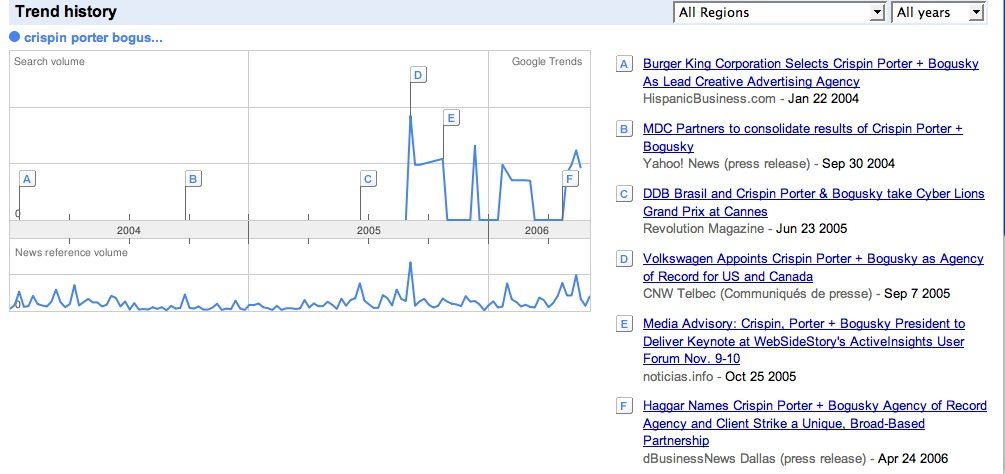
Want to see if a new campaign started an increase in interest?
Here is the link to Google trends for the word “Pontiac”- remember they ran a campaign asking customers to google them? Well, it seems labor issues and plant closings are more likely to push search than ads asking people to Google you:
Google Trends: Pontiac
This only works for terms with huge search numbers- trying it on my name results in an error message saying not enough search volume to display graphs- and search Chiat Day- gives a graph- with no data points- but does give location stats.
Tools like this will become increasingly relevant to agency compensation structures- if your campaign doesn’t increase search, or site traffic- it’s not doing its job.
What do you think?
by Next Wave Team | Aug 19, 2006 | Advertising, Creativity, Design, Everything You Want to Know About Advertising, Future of advertising, Low Budget Advertising, Marketing & the Web, Practical Marketing 101, Viral Marketing
If you are involved in advertising, more than ever, there are two mediums that you shouldn’t ignore- the web and outdoor.
We’re here trying to educate clients (and other ad agencies) about not making “brochure-ware” websites and “Chest-beater” sites.
Definition of a chest-beater website:
a ego-centric site all about the site owner, and how great they are, without any real, useful information, typically built in Flash, so it’s guaranteed not to index or be W3C compliant (accessible to blind people).
Example copy: We’re the best advertising agency in the world- and that’s why you should hire us. We’ve won every major ad award, and throw amazing parties at Cannes. We work with all “A” level directors, and allow our creative departments to spend all your budget on very expensive TV spots, while ignoring your website, operational opportunities for marketing and anything we can’t win an award for.
Outdoor advertising on the other hand, is often the budgetary afterthought. After all, agencies don’t make as much money on cost effective media- due to the stupid idea of paying agencies with a discount on media billings. (more…)
by Next Wave Team | Aug 16, 2006 | Advertising, Everything You Want to Know About Advertising, Guerrilla Campaigns, Low Budget Advertising, Marketing & the Web, Search and Business, Web strategy
We took to the streets today to promote the Websitetology.com seminar. Downtown Dayton Ohio has the cleanest sidewalks - making this both fun and easy.
Of course some people around here always get their panties in a twist about something - the post in front of the Mead Tower- was poking fun at the “New Page” Corporation- which just announced they are bailing for the ‘burbs-


“A “New Page” is a Websitetology.com”
In front of CityWide Development- we put a message about the realities of our website technology:


We also suggested you can get a great website for less:
“A Great website shouldn’t cost an arm and a leg”


We also reminded people that no one watches TV commercials anymore- which is a good reason for chalk on sidewalks- Guerrilla Marketing-

 There were more- including
- “I came, I saw! Because I googled”
- “I Google, therefore I am”
- “Get a PhD in Websitetology for only $79”
We’ll let you know how far $5 of chalk and a couple of hours can get you.
by Next Wave Team | Aug 3, 2006 | Advertising, Brand Relevancy, Crispin Porter + Bogusky, Everything You Want to Know About Advertising, Guerrilla Campaigns, How To Select An Ad Agency, Marketing & the Web, Practical Marketing 101, VW advertising
The debate in the ad community about the video launched on YouTube by an agency (who will now remain unnamed) on their pitch for Subway’s online business will continue for a while.
Which is fine- but the question to really answer, is if any ad agency can help Subway sell more sandwiches? And is advertising the answer?
The following is a cheeky review comparing Subway and its fast growing competitor Quizno’s. Neither has good advertising, but in this battle, it might not be advertising that’s needed:
Munch goes to Quizno’s and Subway
Point is, the Quizno’s-Subway question inspires both competition and passionate discourse, and Munch now feels obligated to interject. “Subway or Quizno’s?” is the “paper or plastic?” of the 21st century. At some point, everybody must answer. So cueing the drum roll at this precise time, Munch will now deliver the verdict.Quizno’s.
Yup, Quizno’s is better.
In fact, it isn’t even close.
Munch came by this decision after one week of careful scrutiny, during which Munch sought opinions from several confidants and promptly dismissed all who dared to contest Quizno’s superiority.
It’s the same reason that Toyota, Honda and Nissan are making money, while GM, Ford, Chrysler and VW are having problems.
Quality.
In today’s world of information empowered consumers- if your product sucks, everyone will know. No matter how good your advertising is.
If you are smart, as VW has been in hiring Crispin Porter + Bogusky, you can distract audiences with entertainment, and making the brand water cooler discussion while you work like mad to fix your quality problems. The thing VW has going for it, unlike Subway or Quizno’s, is that at one time it had good advertising and a great reputation for quality. The brand was at one time a lifestyle brand. People who owned VW’s thought they were special.
About the only thing people can say about eating Subway is that:
- It was cheap.
- I think I’m eating healthy.
Not exactly a great foundation for an ad strategy.
Quizno’s has had lousy ads. Seriously lousy ads. But, they have a reputation for quality and own a position of “Toasted” in the sub market. Much better foundation to build from, but unfortunately their growth hasn’t caught up with their aspirations for a national ad budget yet, and they’ve continued to try to overreach with painful results.
Quizno’s could benefit from better advertising. Subway needs to reevaluate their value proposition and the offering. “Eat Fresh” as a tag line doesn’t fit with their plastic bagged products and their processed ingredients. By basing their positioning on a statement that most people wouldn’t agree fits, they are hurting themselves. A better strategy might be “Eat cheap”- which is based on an underlying truth.
While many agency types are offering opinons on the attempted “viral” pitch- the fact is not many are offering anything useful in the discussion. We hope that we’ve done our part to help elevate the conversation from talking about agency pitches- to how to solve Subway’s problems.
What would you suggest Subway do to improve sales?
by Next Wave Team | Aug 2, 2006 | Advertising, Brand Relevancy, Creativity, Crispin Porter + Bogusky, Everything You Want to Know About Advertising, Future of advertising, Great Ad Agencies, Guerrilla Campaigns, Marketing & the Web, Viral Marketing, VW advertising, Web strategy
It’s not just advertising that makes the work from Crispin Porter Bogusky interesting- it’s the sites that go with the ads. Not always the best from a search engine standpoint- but always fun.
Here is a partial list from their site of microsites to support campaigns. Almost every ad you see from them has some kind of website to go along with the ad. These links give you insight into the thinking behind each site.
CP+B microsites
BK Subservient Chicken
http://www.cpbgroup.com/awards/subservientchicken.html
MINI Robots
http://www.cpbgroup.com/awards/r50r.html
BK Ugoff Website (the spot was one of my personal favorites)
http://www.cpbgroup.com/awards/ugoff.html
BK Angus Interventions
http://www.cpbgroup.com/awards/angusintervention.html
Borders Giftmixer 3000
http://www.cpbgroup.com/awards/giftmixer.html
BK Chicken Fight
http://www.cpbgroup.com/awards/chickenfight.html
Method Come Clean
http://www.cpbgroup.com/awards/comeclean.html
IKEA Musical Chairs Banner
http://www.cpbgroup.com/awards/musicalchairs.html
IKEA Back2School Banner Campaign
http://www.cpbgroup.com/awards/b2s.html
Virgin Massage Banner
http://www.cpbgroup.com/awards/massage.html
Virgin Haircut Banner
http://www.cpbgroup.com/awards/haircut.html
Virgin Dreams Banner
http://www.cpbgroup.com/awards/dreams.html
Virgin Feather Banner
http://www.cpbgroup.com/awards/feather.html
Virgin Bounce Banner
http://www.cpbgroup.com/awards/bounce.html
Virgin Golf Banner
http://www.cpbgroup.com/awards/golf.html
and if you don’t want to just look at what Crispin Porter +Bogusky thinks you should be looking at-
try
www.thejettareport.com for VW
www.manlaws.com for Miller Lite
If you know of others- please feel free to add them in the comments.
by Next Wave Team | Jul 27, 2006 | Advertising, Change the world, Everything You Want to Know About Advertising, Future of advertising, Marketing & the Web, Practical Marketing 101, Search and Business, Web strategy
This “news section” of our site is a blog about advertising- it’s our way of letting clients and potential clients what’s on our minds when it comes to advertising. It also gets us to the top of Google and improves our search results and brings a lot of visitors to our site. Can’t beat that.
We are students of advertising- we pay attention to what is happening in the business. We believe it’s essential for us to know what leading thinkers are thinking about, who did what campaign, what the strategy is, and if it’s working. To do that- we read other advertising blogs- and often, we’re disappointed- not in the content- but in the tools they use.
Web 2.0 depends on “building community” with your readers. That’s what the little comments section at the bottom of each post is all about. It’s a way to become part of a discussion- and to build connections with people who share your interests. Unfortunately, many of the ad blogs don’t include tools to keep those conversations going- and it frustrates me no end.
Example: Ernie Schenck, co-founder of Pagano Schenck & Kay, winner of all the big ad awards, and now a freelance creative, has an insightful blog Ernie Schenck calls this advertising? He has a ton of bright readers, who comment often- however, Ernie uses a hosted TypePad solution- and has no way of notifying commenters that there have been additional comments on their thread. In WordPress, this is the subscribe to comments plug-in, and it can help your comment count (user generated content) grow considerably- fostering long discussions on a subject (we have one post with 109 comments at last count). Alas, Ernie is another great creative- with minimal understanding of the technology. Room 116 at VCU suffers from this same issue.
Same can be said of Mark Silveira’s “Ordinary Advertising” blog- again, using a non-wordpress platform, the site almost never is able to post comments without an e-mail to Mark. He doesn’t post that often, but I keep it in my feed reader because I liked his book “Ordinary advertising – and how to avoid it like the plague.” WordPress has an excellent plug-in called “Spam Karma II” that allows you to make sure you aren’t being comment spammed- and post immediately (without moderation) to keep your site discussions humming without requiring your attention to every comment (you can still blacklist bad words, or go back in and edit comments easily).
Some sites use Blogger- like “The ranch”- the University of Texas ad blog. Blogger ticks me off because to comment- they want you to set up your blogger blog. Just like good advertising, a good blog back-end shouldn’t force you to do something you don’t want to do (or make it difficult to contact you).
Luckily- all these sites can switch to WordPress- since there is a built in import and translate function for Blogger, Dotclear, LiveJournal, Moveable type and Text Pattern- there is also a way to import via RSS – which could be used for importing from some other arcane solution. See more about importing on the codex.
While there are successful blogs using tools other than WordPress- the key to good open source software is the size of the development community. The bigger the community- the more developers, bug testers, bug squashers, theme developers, plug-in writers etc. WordPress seems to be the technology with momentum- and, it also allows for a pretty simple translation to Drupal if you need your site to do much more (although the commenting functions in Drupal still don’t work as well as WordPress- see D’Arcy Normans site for info on making the change).
WordPress also has an amazingly simple, yet powerful interface- and allows for multiple authors on the same blog- with different levels of access- making it a great tool for any agency to get their entire staff into the content creation process. We’ve been so successful with results for our clients with WordPress that we now offer a seminar called Blogosopher, but soon to be rechristened “Websitetology” (due to the Midwest’s fear of the word “blog” it’s not considered a serious business tool by the local Luddite community). We’re available to come speak to your Ad Club chapter with an abbreviated version of the seminar- and/or to give the seminars (a basic and advanced course- each 3.5 hours long) to your membership- contact us for details.
Using the right tools to blog is like using the right media to reach your audience. The creative types who have taken the leap to use a blog to communicate their message to the masses are all smart people- just not all are tech savvy. Hopefully, this post will lead them to a better blog- and a larger audience.
Comments anyone?