by Next Wave Team | Apr 10, 2007 | Ad Agenices in Dayton, OH, Advertising, Careers in Advertising, Everything You Want to Know About Advertising, Future of advertising, Great Ad Agencies, Hot New Creative Agencies, How To Select An Ad Agency, Marketing & the Web, The Craft Of Advertising
When I first started in this business, a very smart group of people were just breaking the national scene; Fallon, McElligott, Rice opened in 1981 in Minneapolis Minnesota- far away from Madison Avenue and the whole “ad scene.”
It seemed almost as stupid as opening a small ad agency in Dayton Ohio in 1988- the only difference was that these people had all worked at some bigger agencies, and weren’t starting from scratch.
In fact, most agencies start by mitosis (splitting of cells). And, it seems it’s happening again, as some former Fallon people are hanging their own shingle, taking Fallon’s star client; United Airlines with them.
Personally, I find this repugnant. It’s called biting the hand that feeds you. If you can do such great work for the client on your own, why can’t you do it for the company that brought you? I’ve never met Pat Fallon, but, I’ve met some of the people he’s mentored in this business; Luke Sullivan, Sally Hogshead and former business partner Joe Duffy, three of the classiest, nicest, most talented people in the ad world. (Note, I’ve also met another former Fallon/Duffy employee who started his own thing- that was a total jerk, but very talented as a one-trick pony). So, while I’m sure these guys that Ernie gives kudo’s to are all nice guys, I’m wondering what Pat Fallon has done to deserve having so much business and talent- slip out the door lately?
Ernie Schenck Calls This Advertising?: Rhapsody In Minneapolis
Barrie D’Rozario Murphy’s star just went from on the ascent to full zenith mode with United Airline’s decision to go with the fledgling but oh so talented Minneapolis shop, thus ending a long-standing relationship with beleagured Fallon. Am I surprised? Yes. Am I surprised? No. Bob Barrie and Stuart D’Rozario and the work they did for United when the airline was in its darkest hour continues to be one of the classiest and tasteful campaigns in the business. So while I honor all that Fallon has done for United, these guys deserve much of the credit.
The site for Barrie D’Rozario Murphy is www.bdm.net (and like most recent Fallon spin off agencies- it’s in Flash and can’t be found).
While I try to keep up on the superstars of advertising (sometimes it gets a little difficult), I have to wonder: of the great ad agencies in this country- which agency would get the honor of being the best breeding ground for superstar talent? Which agency has spun off the most “hot shops”- and, where are the best places to hone your skills?
I’m also wondering how clients like United, can believe that a small start-up can take over a major account and do a truly better job, just out of the gates. Fallon has demonstrated over the years that they “get it” and are as forward thinking as any agency on the planet.
Is loyalty absolutely impossible in the advertising world anymore?
Any thoughts?
by Next Wave Team | Apr 5, 2007 | Ad Agenices in Dayton, OH, Advertising, Change the world, Everything You Want to Know About Advertising, Future of advertising, How To Select An Ad Agency, Marketing & the Web, Public Relations in the Web 2.0 world, Search and Business, Viral Marketing, Web strategy
Today, the Greater Dayton Advertising Association (formerly known as the Dayton Ad Club) made an effort to finally bring it’s members into the year 2003. The speaker was Matt Bailey from SiteLogic- a Search Engine Optimization consultancy.
Matt did a decent job of explaining the power of social media in his alloted 45 minutes- using eepybird’s Mentos/Diet Coke video as a viral example, discussing how Price Rite Photo got destroyed after a bait/switch deal and the Pork Producers failed attempt to slam a breast feeding support site for using the phrase “the other white milk.”
All great stuff- all stuff we’ve been trying to get the ad club to discuss for over 2 years. All the stuff that we’ve been offering in our Websitetology seminars- but, of course, if you aren’t from out of town, you can’t be an expert.
Matt had a hard time coming up with business to business blogs as an example of generating business- yet, had we been the presenter- we would have been able to point to this blog- to show the b-to-b results. I looked at Matt’s blog- and found this bit:
SiteLogic - Marketing Logic » Why are Analytics so Difficult? by Matt Bailey
Building a website requires an understanding of search engines, as search engines are one of the primary methods of acquiring visitors and customers. However, once the search engine’s information requirements are met, the site has to be able to communicate a different message to the human visitor.
We agree- since 80% of Internet use begins in search, search is key. And, once they get to your site- they need to engage. Apparently Matt’s blog isn’t providing him the kind of traffic he needs. We think we know why.
In the Q&A, someone asked if “tags” in a blog are like Meta tags of old- and he answered they weren’t the same- which is true. Metatags were for the machines; blog tags/categories/taxonomy are for the user. He got that straight- but then, he took what I call a Guru Nosedive- he said that he didn’t use them much, they aren’t that important- content is.
WRONG. At least with WordPress, categories are a way to supercharge a search term, by grouping a bunch of posts into a single post. It’s probably one of the most important SEO techniques we teach- but, alas, the Dayton Ad Club people won’t learn that. Their Executive Director still won’t attend our seminar- and is still building sites the old fashioned way.
It was particularly telling of the 2.0 literacy in the room when there was only one other person in the room that knew what the Long Tail was (besides yours truly) and only a handful (including SAA students) had heard of Digg.
If the Greater Dayton Advertising Association and it’s members (and SAA students) hope to survive, they are going to have to do some serious catch-up. Web 2.0 is only the beginning of The Next Wave, and they aren’t there yet.
by Next Wave Team | Apr 4, 2007 | Ad Agenices in Dayton, OH, Advertising, Creativity, Crispin Porter + Bogusky, Differentiating Your Brand, Everything You Want to Know About Advertising, Great Ad Agencies, How To Select An Ad Agency, Marketing & the Web, Practical Marketing 101, Secrets of Great Advertising, VW advertising, Web strategy
Crispin Porter + Bogusky is the über hot ad agency of the last few years. We write about them, other people write about them, and everybody has an opinion. While celebrities have their paparazzi, the hot agencies have their armchair quarterbacks.
We write about them, because we know there are people searching for great, smaller, independent agencies- and hope they take a look at us (we think we understand web 2.0 better than CP+B and can help our clients get bigger bang for their buck)- but also because, well, the ads are interesting to us.
So, while Seth Stevenson writes in Slate why he hates Crispin ads- (and we have a few we detest too)- we thought this section was worth discussing:
Why I sort of hate the hottest ad agency in the country. - By Seth Stevenson - Slate Magazine
Strong reactions. But that’s not necessarily a bad thing. In fact, a vigorous response is precisely what Crispin wants. As CEO Jeff Hicks told me, “We make a conscious effort to have our brands commented on and talked about.” It’s his feeling that in a world supersaturated with content—video games, Web clips, text messages, etc.—to “break through and be noticed is a huge victory.” Crispin is the master of breaking through, getting attention with its provocative TV ads and also with smart viral projects (remember the Subservient Chicken?).
But is all attention good attention? This is an age-old question at the heart of the ad game. And there’s really no right answer. Sometimes a provocative, attention-getting ploy is just what a brand needs. Other times, the tactic falls on its face.
You see, local car dealers have been doing the same thing for years (as did a really obnoxious carpet dealer named Buddy)- they did ads that people talked about- that “broke through” - and that drove our community nuts. Yes, they all have top-of-mind awareness, but, no, it wasn’t the most effective way of advertising. David Ogilvy suggests that you create ads that your mother would be able to like, understand and accept- screaming, being obnoxious, etc. isn’t the answer.
When we were challenged with changing the image of Mendelson’s Liquidation Outlet, we refused to put the owner on his own spots- screaming “I’m crazy Sandy, I’ve got deals” (which of course he did after we ended the relationship)- instead we created the “explorer dude” and his “shopping safari” concept- coupled with the tagline “The first place to look for every last thing”- which cut through the clutter, yet didn’t annoy.
As the industry leader, with everyone scrambling for competitive advantage, Crispin is able to sometimes dicatate to their own detriment. The Haggar Dog Crap spot- while entertaining, may loose the pants in the joke. And while we enjoyed the “Unpimp your auto” campaign for VW- it alienated an audience that could one day be potential VW buyers.
Creating an emotional response is critical in advertising- but, when given a choice, go for something your Mom would enjoy.
by Next Wave Team | Apr 1, 2007 | Careers in Advertising, Crispin Porter + Bogusky, Great Ad Agencies, Marketing & the Web, Public Relations in the Web 2.0 world, Search and Business, Web strategy
You can tell who is web 2.0 savvy- and who isn’t.
Agencies are apparently paying $199 for 30 days to post jobs on Krop.com
Krop - Creative & Tech Jobs
Krop jobs are everywhere! When you post your job with Krop, not only is it instantly listed at krop.com but your job is also automatically listed and broadcasted to our entire network of top industry websites proudly featuring krop jobs. Your opportunity will be seen by millions of talented creative and tech candidates on the sites that they already visit daily.
Build your own site to be searchable- and you can get all the job applicants you want for free. Even ones you don’t want. We get bombarded with applications here at The Next Wave, because we can be found in search. Unfortunately, many large agencies have no clue how this works- and pay to post jobs.
Craigslist.com is always a free option to post jobs, but, so are many of the advertising communities online. Adrants has its soflow community or where you can pay even more on their own little job board. Even Ernie Schenck experimented with a job board on his blog.
I was looking at page rank for searches on Crispin Porter + Bogusky and saw that they were hiring more Flash and motion developers on Krop. Figures- the agency that gets search the least, is looking for more developers that will set them even lower in Google results.
Considering I get search referrals for “is Crispin Porter Bogusky Hiring” and “Jobs at Crispin Porter Bogusky” maybe they should just pay us to fix their site and teach them how web 2.o works and save money on all the job postings?
by Next Wave Team | Mar 26, 2007 | Advertising, Brand Relevancy, Differentiating Your Brand, Everything You Want to Know About Advertising, Marketing & the Web, Practical Marketing 101, Public Relations in the Web 2.0 world, Search and Business, Web strategy
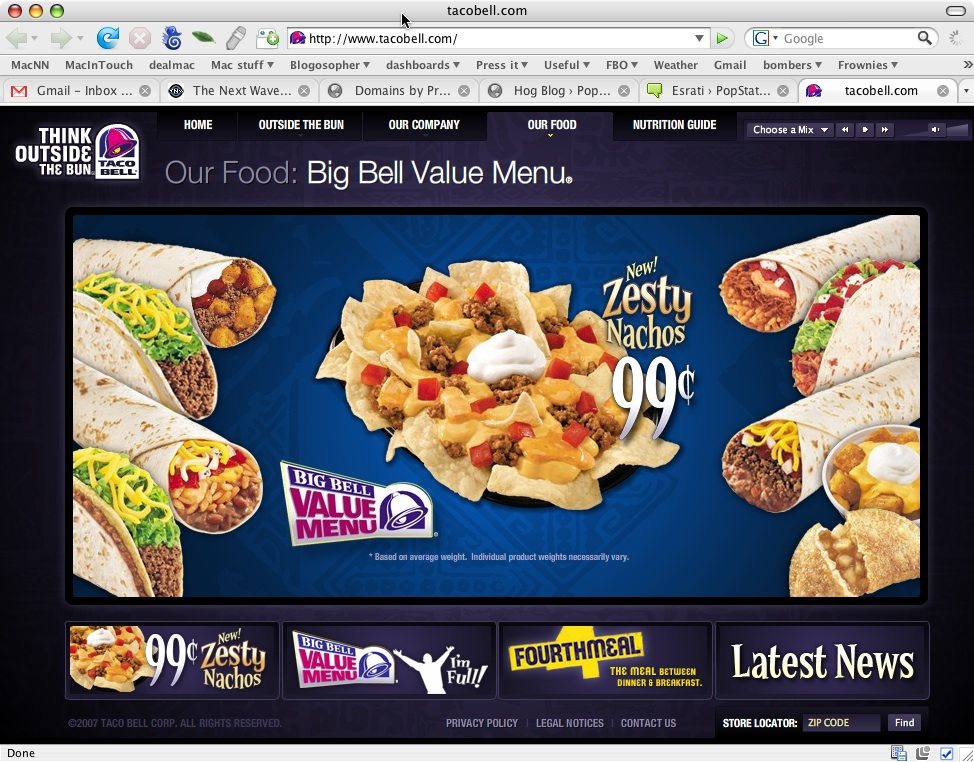
I wish my associate had kept the receipt, but, Taco Bell needs to work on their site integration with their stores: there’s nothing worse than a broken promise.
I text messaged Richard to pick me up three items off the “Big Bell Value Menu” where all items are .99- of course I can’t send a link, because they build their site in Flash- just like all the rest of the big chains- not searchable, not bookmarkable- and really, not that useful with it’s “pop-a-mole” navigation system. Never mind there aren’t actuall descriptions of what are in any of the items. There are so many things that a site for a national fast food restaurant could do- but unfortunately, none of them understand web 2.0
I ordered the Zesty Nachos, Grande Soft Taco and the Double Decker taco. When Richard got to the register- the girl had no clue. I ended up with three items that were similar to the items I ordered, but they came to $3.79.
Taco Bell just failed me over .82 cents- and now I remember why I don’t make a run for the border very often.
by Next Wave Team | Mar 21, 2007 | Change the world, Creativity, Everything You Want to Know About Advertising, Future of advertising, How To Select An Ad Agency, Marketing & the Web, Practical Marketing 101, Public Relations in the Web 2.0 world, Secrets of Great Advertising, Viral Marketing, Web strategy
Advertising is usually delivered in what we call “paid media” - which would include TV, Radio, Print, Direct Mail, Outdoor, Internet etc. It’s usually your company talking about yourself.
There is also what we’ve come to know as “unpaid media” which is usually described as Public Relations- where your press release, guerrilla stunt, amazing feat, etc. is actually newsworthy- and you appear in the media- usually print, radio, TV or Internet. This could be defined as others talking about you.
Then we have the new media form, and by that, I don’t mean web, Internet, etc. and it’s new name “earned media”- this is where something is so interesting that it gets circulated and watched out of fascination. It is the basic building block of a viral campaign. It is becoming the most valued form of advertising- but there is no price tag on it. You can’t just pony up money and get the eyeballs. Earned media is the result of the new currency in advertising (which really has always been the true currency) creativity. Creative solutions, creative executions, interesting, funny, informative and unexpected messages can take your brand message places that conventional (paid and unpaid media) can’t and won’t.
This creates a huge problem in advertising agency compensation - are you as a client, willing to pay for the value of a good idea? Or are you still basing your compensation plan on the size of your media buy or on hours worked? If you want to earn eyeballs instead of pay for them, the first thing you need to eyeball is what you are trying to buy from your ad agency.
And then decide what kind of media is going to get you what you want.