by Next Wave Team | Jun 10, 2007 | 2007 AAF National Convention, Advertising, Brand Relevancy, Careers in Advertising, Change the world, Creativity, Differentiating Your Brand, Everything You Want to Know About Advertising, Future of advertising, Great Ad Agencies, Marketing & the Web, Media, Public Relations in the Web 2.0 world, Search and Business, Secrets of Great Advertising, The Craft Of Advertising, Web strategy
One of the recurring themes by some of the high-level speakers at the 2007 AAF National Convention was the crazy money being spent to snatch up web related ad companies. Another was how to monetize their newley discovered new media vehicle: the web. Yeah, you read me right- they are all rushing to figure out the metrics to quantify the ad buy on the web. Sorry guys- smart advertisers don’t need a third party to tell them if a campaign is working- they get really good stats (much better than Nielsen, the MPA or any other “validation company” ever provided) they have web stats and sales to evaluate.
What is even more sad- was so few of them really had a clue what Web 2.0 is, how it worked, or what it meant to them. Still worried about the silly notion of “control”- they sort of missed the Cluetrain Manifesto back in 1999 while they were busy buying up Web 1.0 companies.
Not only are most ad agency sites not much more than bad brochureware in Flash, most of the excitement about the web is still in an “how do we continue doing business the way we did, only using the web” instead of realizing- your business model is totally broken, start thinking purely about being branded content creators that makes it as earned media- never paid. Yeah, you can try to talk a client into placing ads through DoubleClick- (and get laughed out of the room. Or start talking a language of opt-in, immersive, brand experiences that the consumer builds their personal brand by combining in a unique way.
The endorsers of tomorrow aren’t LeBron James, Oprah or Britney Spears (heaven help us) but every single customer who choses to affiliate themselves with your brand and others- and none of it is under your control.
It’s probably not clear to most people attending the Ad Conference how this post came- since this is a pretty far stretch from most of what was talked about (although I’m looking forward to reading the autographed copy I picked up of Carat Americas, CEO David Verklin’s “Watch This Listen Up Click Here“).
But, this post about a post by Dave Winer- who was the guy who made the cutting edge of Web 2.0 possible (while most other people were still trying to figure out how to install AOL on their computers) about the new digital divide between those who get Web 2.0 and those who don’t:
Dave Winer: “It’s Time for Web 2.0 to Stop Being Exclusive” @ WEB 2.0 JOURNAL
A war of words has broken out in the world of Web 2.0 - between the software developer Dave Winer - who created or was a lead contributor to several of the most popular XML dialects and APIs related to web publishing such as RSS 2.0, XML-RPC, OPML, and the MetaWeblog API - and the founder of O’Reilly Media - the newly self-proclaimed “technology transfer company.”
Winer’s beef? “We need to get all hands involved in what we used to call Web 2.0,” he laments. “It’s time for it to stop being exclusive, and it’s way past time for one company to be controlling who’s supposed to participate.”
Winer’s contention is that events such as “FOO Camp” are harming the greater good, which is to make software easier, better, scalable, more reliable, and more secure, and instead turning Internet technology into an elitist world where it becomes a question not of what you know but who you know.
In Winer’s view, the very future of computing is at stake:
“We need to start doing some real investing in technology, not the BS that passes for technology investing that’s been going on for the last decade.”
In other words, what Winder fears is another Nasdaq run-up, followed by the inevitable explosion:
“But what I do want is to avoid a bloody mess,” he says. “We have work to do here. We have a bubble-pop to avoid.”
Brooklyn-born Winer, who is also the author of one of the first ever weblogs…
The bold italics were added by me- to highlight the big leap ad people need to make- it’s time to start doing real investing in your creative departments, training, molding, challenging your teams to learn how this new paradigm needs to work. It’s time for all of you to get more than six measly pages indexed in Google for your site (like McCann’s site- note McCann bills itself as the largest US agency).
Like it or not, ad agencies today are the buggy whip manufacturers of the turn of the last century. It’s an attention economy, but only for those who understand that it has to be earned, not bought. The more you understand all this, the more Howard Luck Gossage becomes relevant: “People don’t read ads, they read what interests them- and sometimes it’s an ad.”
Well said Howard, too bad you aren’t still here. The bubble’s about to pop, and the sad part is- most won’t understand why.
by Next Wave Team | Jun 10, 2007 | 2007 AAF National Convention, Advertising, Brand Relevancy, Careers in Advertising, Change the world, Creativity, Differentiating Your Brand, Everything You Want to Know About Advertising, Future of advertising, Great Ad Agencies, Marketing & the Web, Media, Public Relations in the Web 2.0 world, Search and Business, Secrets of Great Advertising, The Craft Of Advertising, Web strategy
One of the recurring themes by some of the high-level speakers at the 2007 AAF National Convention was the crazy money being spent to snatch up web related ad companies. Another was how to monetize their newley discovered new media vehicle: the web. Yeah, you read me right- they are all rushing to figure out the metrics to quantify the ad buy on the web. Sorry guys- smart advertisers don’t need a third party to tell them if a campaign is working- they get really good stats (much better than Nielsen, the MPA or any other “validation company” ever provided) they have web stats and sales to evaluate.
What is even more sad- was so few of them really had a clue what Web 2.0 is, how it worked, or what it meant to them. Still worried about the silly notion of “control”- they sort of missed the Cluetrain Manifesto back in 1999 while they were busy buying up Web 1.0 companies.
Not only are most ad agency sites not much more than bad brochureware in Flash, most of the excitement about the web is still in an “how do we continue doing business the way we did, only using the web” instead of realizing- your business model is totally broken, start thinking purely about being branded content creators that makes it as earned media- never paid. Yeah, you can try to talk a client into placing ads through DoubleClick- (and get laughed out of the room. Or start talking a language of opt-in, immersive, brand experiences that the consumer builds their personal brand by combining in a unique way.
The endorsers of tomorrow aren’t LeBron James, Oprah or Britney Spears (heaven help us) but every single customer who choses to affiliate themselves with your brand and others- and none of it is under your control.
It’s probably not clear to most people attending the Ad Conference how this post came- since this is a pretty far stretch from most of what was talked about (although I’m looking forward to reading the autographed copy I picked up of Carat Americas, CEO David Verklin’s “Watch This Listen Up Click Here“).
But, this post about a post by Dave Winer- who was the guy who made the cutting edge of Web 2.0 possible (while most other people were still trying to figure out how to install AOL on their computers) about the new digital divide between those who get Web 2.0 and those who don’t:
Dave Winer: “It’s Time for Web 2.0 to Stop Being Exclusive” @ WEB 2.0 JOURNAL
A war of words has broken out in the world of Web 2.0 - between the software developer Dave Winer - who created or was a lead contributor to several of the most popular XML dialects and APIs related to web publishing such as RSS 2.0, XML-RPC, OPML, and the MetaWeblog API - and the founder of O’Reilly Media - the newly self-proclaimed “technology transfer company.”
Winer’s beef? “We need to get all hands involved in what we used to call Web 2.0,” he laments. “It’s time for it to stop being exclusive, and it’s way past time for one company to be controlling who’s supposed to participate.”
Winer’s contention is that events such as “FOO Camp” are harming the greater good, which is to make software easier, better, scalable, more reliable, and more secure, and instead turning Internet technology into an elitist world where it becomes a question not of what you know but who you know.
In Winer’s view, the very future of computing is at stake:
“We need to start doing some real investing in technology, not the BS that passes for technology investing that’s been going on for the last decade.”
In other words, what Winder fears is another Nasdaq run-up, followed by the inevitable explosion:
“But what I do want is to avoid a bloody mess,” he says. “We have work to do here. We have a bubble-pop to avoid.”
Brooklyn-born Winer, who is also the author of one of the first ever weblogs…
The bold italics were added by me- to highlight the big leap ad people need to make- it’s time to start doing real investing in your creative departments, training, molding, challenging your teams to learn how this new paradigm needs to work. It’s time for all of you to get more than six measly pages indexed in Google for your site (like McCann’s site- note McCann bills itself as the largest US agency).
Like it or not, ad agencies today are the buggy whip manufacturers of the turn of the last century. It’s an attention economy, but only for those who understand that it has to be earned, not bought. The more you understand all this, the more Howard Luck Gossage becomes relevant: “People don’t read ads, they read what interests them- and sometimes it’s an ad.”
Well said Howard, too bad you aren’t still here. The bubble’s about to pop, and the sad part is- most won’t understand why.
by Next Wave Team | Jun 9, 2007 | 2007 AAF National Convention, Advertising, Careers in Advertising, Change the world, Everything You Want to Know About Advertising, Future of advertising, Marketing & the Web, Media, Public Relations in the Web 2.0 world, Search and Business, Web strategy
From the roundtable this morning, it became really clear that a lot of clubs could use help with their websites. Many people didn’t have a content management system (or even know what one is), were delaying a new site because the chapter was going through an identity changeover, didn’t take credit cards via the web (or offline either), were paying for e-mail programs, didn’t know what RSS is- or know what to use for content.
All these questions and more can be answered by inviting The Next Wave to host a seminar for your AAF chapter. We’ll give a talk at your meeting, give a seminar that you can make money on, and provide assistance in building a site that can help your club grow. We’ll share the secrets of Google, the power of categories and tagging, and answer questions about if you should be on MySpace or Facebook, what to do about your member list, job banks, event calendars, building community- all using open source software and common sense.
Best of all, the information is from someone in your business- not a web geek. We share powerful information on how to get organic search results in Google so you don’t have to spend client budget on ad words- and how ad agencies fit into the new media landscape. We’ll also share our insight on how this technology is changing brand management and the media landscape. We can demonstrate how huge budget advertising is missing a low-budget opportunity for more eyeballs and how to build a better website for every agency.
Web 2.0 isn’t going anywhere- sooner or later your ad association, be it in Honolulu or Houston, Dayton or Daytona, will have to go 2.0. We’re here to help. A day with us will make you smarter- and make your life easier in maintaining your association website.
Call today, or e-mail, or visit our seminar site Websitetology, to learn more about how we can work together to make technology your best friend.
David Esrati, 937.228.4433, websitetology at the next wave dot biz (remove spaces)
by Next Wave Team | Jun 7, 2007 | 2007 AAF National Convention, Ad Agenices in Dayton, OH, Advertising, Careers in Advertising, Change the world, Crispin Porter + Bogusky, Everything You Want to Know About Advertising, Guerrilla Campaigns, Marketing & the Web, Web strategy
First things first: Louisville’s ad federation has the right attitude- seems to be connected to the community, realizes the value of bringing people in from all over the country- and showing them Louisville’s best.
The hotel, didn’t look like much on the outside as I pulled up on the motorcycle after a really hot ride from Dayton- but inside- the place is grand. Really amazing main ballroom- and a lobby that makes you think back to the grand hotels of the 30’s and 40’s. It’s 2 years old- and a Marriott- only complaint I’ve heard is no wireless in the rooms (you have to use a cable and pay for access- although access is free downstairs if you type in “Public Wireless” and then give your name). Even heard the chef came out and made a custom vegetarian meal for one of the attendees- that’s customer service.
The goodie bag from AAF was OK- the one from Louisville AAF- rocked- a box of girl scout cookies, Makers Mark Burbon Chocalates (I had one and got a buzz) a t-shirt, and their club magazine “Communique” which is awesome. I happened to sit with their board at lunch- and the people were friendly and firmly believe that Louisville has a shot at becoming the next Minneapolis or Miami. It’s that kind of winners attitude that needs to come to Dayton.
Got to see three student NSAC (National Student Advertising Competition) presentations for Coke. One was great- from SCAD (the Savannah College of Art and Design)- the other two were weak. Going back to my judging of Postal Vault in the districts last year- same issues in presentation: the client doesn’t need to know who you are, what your name is- let the work, the ideas, the analysis be the star. Even if you are David Oglivy, Howard Luck Gossage and Bill Bernbach, the people who will see your ad won’t know, they’ll just like it- or hate it. With the average CMO life expectancy dropping by the day (the Macy’s CMO just left after 13 months) the only people who care about the names of people working on the account are the ones trying to use the old “no one ever got fired for buying IBM” (or any other leading brand). Face it- if your ads are working the checks keep coming- it’s only when there is a hickup do people start thinking “Oh, we need Agency XYZ working on the account.” So, students- all your school branding, titles, etc- are moot- just start out with- “I’m Jason, and here is the account planning data to justify our strategy” and move into the meat.
I’m also hating the memorized speeches that, if one person loses their lines- the others all pipe in - face it, if you want to deliver lines- don’t be in advertising, go into theater (or hire actors to deliver your pitches)- now, more than ever advertising is about having a conversation with the customer- you wouldn’t do that from a script, would you? Feel confident in your ability to deliver- ad lib- it has more authenticity and that closes deals- not a push paly and off you go type presentation.
In a forum session “Digital Innovations & Social Networking” they had to expand the room to get all the people in. Great, but, the speakers were in chairs- where anyone sitting in the back couldn’t see them, some staging would have been great. Well moderated session by Murray Gaylord of the New York Times- and by all means, moderating panels is an art- and this was better than most. The scary part was that probably half the audience had no clue what “Second Life” is- which means a lot of clubs should be adding speakers on Web 2.0 to their speakers lists asap.
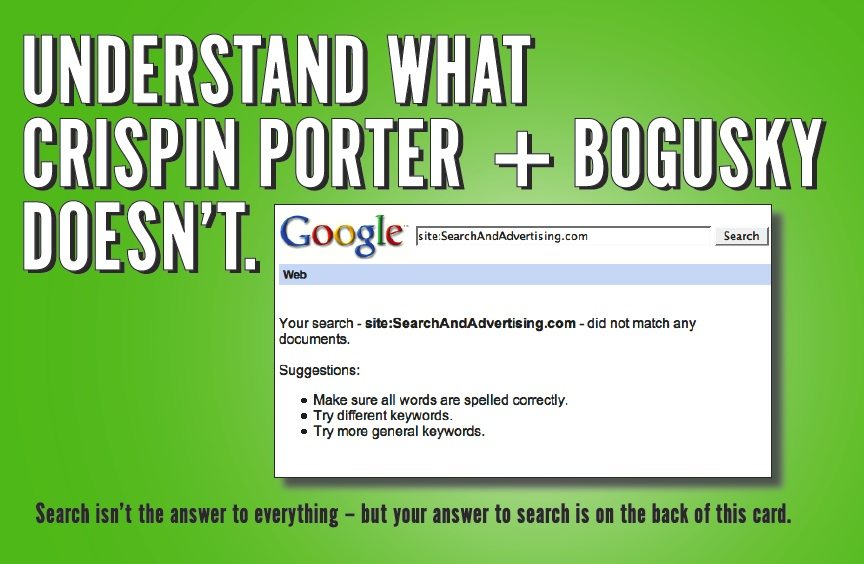
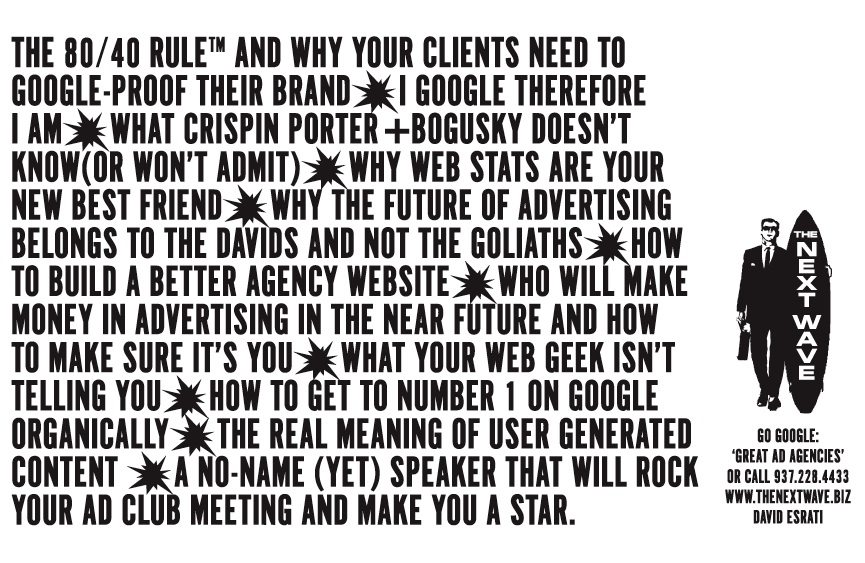
Which brings me to my last morsel of the day- I was dropping off my Understand What Crispin Porter + Bogusky doesn’t flyer (link is to a printable PDF) for club execs and schools to promote me as a speaker- and seminar presenter. Next thing you know- I’m being told to “Cease and desist” from my little guerrilla marketing effort. It’s unclear if it’s because I didn’t pay big bucks to be a sponsor, or because I said “Understand what Crispin Porter + Bogusky doesn’t” on the piece (apparently it’s ok to compare detergents in advertising- by name, but not ad agencies). This news was delivered by our club exec director who seems to feel that any kind of self promotion is evil- but, she gave me a card of an AAF executive that was the authority on this.
I’m almost surprised I wasn’t told to take off my Next Wave t-shirt. I’m tempted to wear my “I blogged your mom” t-shirt tomorrow- just to take the edge off these people. If you can’t have fun at a convention of ad people- what is this world coming to?
I’ll have more after Friday’s festivities. And, to any of you who are here- and have read this far- when was the last time you put some new content on your agency site?
And last but not least- If you are a student- and haven’t bought Steve Lance’s “The little blue book of advertising” yet- shame on you. It’s a classic- and well worth the $14 to have an autographed copy. Forget the mojitos- get some marketing mojo from someone who understands this new economy.
by Next Wave Team | Jun 5, 2007 | Careers in Advertising, Everything You Want to Know About Advertising, Future of advertising, Marketing & the Web, Minorities in Advertising, Search and Business, Web strategy
Extending the myth that great advertising can be produced on the fly- ignoring the hard work of studying the customer, the market and the clients unique selling position- we now have a new pimp for the creative superstars: thetalentbusiness.com
Comparing themselves to Creative Artists Agency- which is more of a rep firm than a placement company- brings a whole new level of sneer to the ad world. In an industry that already has proven itself unable to integrate, or provide pay equity, we now have another tip-of-the-hat to the good ol’ boy network concept.
Yes, bringing in top talent can help you refine a good plan, a good concept, or help you brainstorm- but, the idea that you can freelance a brand to stardom must end.
With the Internet making it really simple to share your skill set with the world- finding the right people has gotten easier, not harder. When was the last time you had to wait for a portfolio to arrive by FedEx before you knew what the person was capable of?
Advertising Age - Headhunting Has a Whole New Look
The former CEO of Bartle Bogle Hegarty USA has joined forces with Gary Stolkin, chairman-CEO of global recruitment agency Kendall Tarrant, to rebrand his business with no less an aim than creating the ad-world equivalent of the entertainment industry’s Creative Artists Agency — and, in the process, change headhunting as it’s been known.
Answer to industry ills?
Today the pair relaunches the London-based agency with offices in Shanghai, Hong Kong, São Paulo and San Francisco as the Talent Business, adding a 10-person New York office under the direction of U.S. CEO Lucy Meredith. As the name — a shift away from the stodgy legal-firm approach of putting the principals’ names above the door — may suggest, Ms. Gallop and Mr. Stolkin believe they can create a different type of talent agency at a time when the industry regards itself as being in a talent crisis.
“The industry is going through a big bang right now,” Mr. Stolkin said. “All the agencies say, or want to be able to say, that they can do everything: ads, digital, direct or whatever. But recruitment is typically done by recycling the same ad people. We wanted to create an agency that would cut across the silos of the different disciplines. We also wanted to come up with a genuinely global offering, so that we can find and provide a resource for talent all over the world.”
While silo-integration efforts always prompt industry skepticism, the Talent Business is backing its bluster with an internal fee structure that eschews the usual recruitment-agency model of paying each individual headhunter a commission on candidates placed in jobs. Instead, employees share 25% of the company’s pre-tax profit — last year Kendall Tarrant made around $3.5 million after employee bonuses were paid. By removing the focus on commission, Ms. Meredith said, the company will encourage sharing of candidates among recruiters and focus on clients’ best interests rather than on simply putting butts in seats.
Removing stigma
The Talent Business is hoping strong branding across its website — thetalentbusiness.com — and other communications efforts will help turn the shop into a destination for people interested in changing jobs and take away the stigma of knocking on a headhunter’s door. As one media-industry recruitment consultant admitted: “At some consultants, there’s a belief that the best candidates are the ones you root out, not the ones who come to you. Good candidates probably feel the same way.”
The consultant doubted that mind-set could be easily changed, but Ms. Gallop and Mr. Stolkin think candidates should be asking recruiters to show them the money. They envisage something akin to a firm of sports or entertainment representatives, offering life coaching and job advice throughout a person’s career. “The reason we focused so heavily on the branding here is that if we get this right, the candidates will come to us,” Mr. Stolkin said.
No matter how good thetalentbusiness thinks they are- they have no clue about one type of search that executives use now: Google.
Their site, built in Flash, doesn’t show up in Google at all:
Your search - site:thetalentbusiness.com - did not match any documents.
Guess the first person they should place is someone who can help them with their own search results.
by Next Wave Team | May 18, 2007 | Ad Agenices in Dayton, OH, Advertising, Advertising Case Studies for The Next Wave, Apple Advertising, Careers in Advertising, Dayton Bombers Advertising, Differentiating Your Brand, Everything You Want to Know About Advertising, Marketing & the Web, Practical Marketing 101, Public Relations in the Web 2.0 world, Search and Business, Secrets of Great Advertising, Web strategy
One thing that drives me nuts about the advertising business is that many clients still think of spending money on advertising is a gamble. I’ve never felt that way, because, as our motto says “our job is to make you more money than you pay us.” Advertising, when done right, is never a gamble- it’s an investment.
 So why am I feeling like a gambler for the first time in my ad career today? Because our client (of late) the Dayton Bombers, are playing game 7 of the Kelly Cup semi-finals tonight- and if they win, we get to do the campaign for the finals and if they loose- we don’t get the job. Money riding on a hockey game- who woulda thought?
As I said, it’s a first. We’ll know more around 10 pm tonight.
Because we believe we have to provide something useful in everything we post- a few tips on making sure your advertising doesn’t feel like gambling:
- Advertising is a more like a marriage, not like a date. Think about the long term, and invest in campaigns that will have “legs” - a concept, or idea that lasts. Think like Apples “get a mac” campaign instead of Burger King’s one shot “Manthem” (of which more was written about here).
- Branding is a shorthand for what your company stands for- make sure you think about it in everything you do, from what your employees wear, to how you answer the phone- and then get it to communicate clearly in your advertising.
- Consumers are getting very smart about marketing messages- never; lie, deceive, or talk down to them- they now have the ability to talk right back and it may come in higher in search than your message.
- Embrace the Internet, it’s everything you want your best employee to be- if you take really good care of it.
- The immortal words of Howard Luck Gossage are even more important today than 50 years ago: “People don’t read ads. They read what interests them, and sometimes it’s an ad”- so make your stuff interesting, make it art, make it entertaining- but what ever you do, stop saying things like “make the logo bigger” and start saying- “can we make the idea bigger.”
Hope that helps. Now, all the Bombes have to do is win tonight, so we get to keep building their brand.