by Next Wave Team | Jul 22, 2006 | Advertising, Brand Relevancy, Change the world, Creativity, Crispin Porter + Bogusky, Everything You Want to Know About Advertising, Future of advertising, Great Ad Agencies, Practical Marketing 101, Retail
Welcome to Room 116: Alex Bogusky says…
Alex Bogusky says…
- To creatives: “This is your company. What are you going to do to make it famous?”
- On approach: What’s really going on here?” If you can step outside your own culture, you can get an angle on what’s going on inside it.”
- “We always say, ‘Have faith in the process, even though you have to go through a period where you’re confused,’”
- “We don’t really believe in advertising”
- Bogusky uses a visual analogy to describe CP B’s methodology. At the center of his schema is the product destined to become famous, and around that are concentric circles that represent different means of marketing and advertising. The outermost circle–the one that takes the most effort to align with the essential brand message–represents traditional advertising. “We push the marketing toward the product,” Bogusky explains. “We spend all our time in the center: the product.”
- “The process is finding the questions first and coming up with answers,” says Bogusky. “After you come up with the questions, that leads you to finding the core [strategies].”
- “With MINI, it’s less about doing an ad and more about making it a part of the culture,” says Bogusky. “If we can come up with a lease that matches the personality of the car, that’s probably better than advertising.”
- Not from Alex, but still interesting: “[CP B] helped us look at all these consumer touchpoints, [and] mass marketing is just one of them,” Martin says. “The agency doesn’t call their work advertising, they call it creative content. They don’t call it media, they call it creative-content distribution.”
From Creativity, Print, Business 2.0, and Adweek.
Thanks to Brian Chiao for gathering these. This isn’t really supposed to be an all about Crispin Porter + Bogusky site- but, if the idea is to stimulate a discussion between our potential clients and The Next Wave- they need to know what interests us.
We used to require all clients to read “Ogilvy on Advertising” to have a common ground to begin discussing their brand evolution through advertising- now, we hope they read our site.
Is “Product focused Brand culture” the secret of great marketing?
One of the things Chuck Porter shared at a Cincinnati Ad Club meeting is that anyone can do a better price and product ad- just by having a lower price. Seems so obvious- but try telling that to every local car dealer, grocery store or window salesman.
If you think competing on price is a solution- you don’t need better advertising- you need a lobotomy.
Advertising and merchandising as a entertainment? Nothing that hasn’t been talked about before. Tom Peters showcased Stew Leonard’s grocery store in “In search of Excellence” in the early 80’s- the problem was- most in advertising never bothered to read many business books.
So- is Bogusky and company formulating the next eveolution of advertising or not?
What do you think?
by Next Wave Team | Jul 22, 2006 | Advertising, Brand Relevancy, Careers in Advertising, Change the world, Creativity, Crispin Porter + Bogusky, Design, Everything You Want to Know About Advertising, Future of advertising, Great Ad Agencies, Guerrilla Campaigns, Marketing & the Web, Practical Marketing 101, Retail, Viral Marketing, VW advertising, Web strategy
Welcome to Room 116: Crispin Copies itself
It’s long- it’s full of off topic comments- and it focuses on the darlings of the ad world “Crispin Porter + Bogusky.” It started with an observation that some of the VW outdoor- looked a lot like the mini campaign.
I placed a comment at the end- that probably deserves reposting here- so here you go:
Ripping off oneself isn’t illegal- it used to be called “having a style” and- if something is proven to work- and the client is in deep shit- do it.
Some of you seem to have missed bothering to read the CP+B site- they build advertising like Detroit builds cars- not for long lasting practical lives- but like throw aways, planned obsolecence. It keeps them in business- and it keeps audiences entertained. They don’t strive for “Just do it” or “Got milk” - they are like a comedian on tour- each show has to evolve- or the audience won’t laugh.
Ad people and CMO’s are the only people who know what agency did what- most consumers just want to know who did that catchy little ditty on the Rabbit- “multiply” spot. Most consumers aren’t stupid enough to go out and buy a VW because of it- they still know that the cars suck.
Which brings us to a major point about CB+P- they actually go outside the halls of advertising- into the brand world the product lives in- and work on the touchpoints- that’s more than advertising and pretty pictures- that’s real marketing- something lost on most advertising students- I still believe CB+P thinks about actually selling things- as opposed to creating pop-culture (which from reading this thread- seems waaaay more important than discussing how to sell crappy cars).
For all of Crispin’s strengths- they still make mistakes- esp. with how they use the web to connect with their customers- they still are using it as a broadcast medium instead of a 2-way exchange.
And on BK- no one mentioned “subservient chicken” or “Ugoff”- both of which were brand changing positioners.
What do you think?
by Next Wave Team | Jul 20, 2006 | Advertising, BMW Advertising, Change the world, Creativity, Crispin Porter + Bogusky, Everything You Want to Know About Advertising, Future of advertising, Great Ad Agencies, Guerrilla Campaigns, Low Budget Advertising, Marketing & the Web, Media, Practical Marketing 101, Retail, Search and Business, Viral Marketing, Web strategy
As many of you know, we run a seminar on using a blog (specifically WordPress) as a content management system for a business website. The news section of The Next Wave site (where you are now) was added in January of 2005 and now accounts for most of the traffic on our site.
Although we got an early start on having a website (our first site went up in 1994) and we soon figured (back while everyone was still on dial-up) that Flash wasn’t the way to build an entire site (later we looked really smart- since search engines and Flash don’t go together very well)- we were pretty slow to realize how important webstats are to providing customer feedback and marketing opportunities.
The reason: when our content didn’t change often, neither did our web stats. That all changed with the news/blog- and analyzing web stats has become one of the most important parts of our seminar. As you add content- people find your site using different search terms- and link to you for different reasons- these are all opportunities to do business or learn about your customers.
It’s how we decided to begin the seminars- and it’s also taught us a lot about how to build websites for our customers- so they can get more customers. Just like there are keywords- or trigger words in print advertising (Free- being the “best” one), search terms can tell you a lot about your customers hot buttons. For us, guerrilla ad campaigns, viral marketing, and non-traditional advertising have been hot topics- as have low-budget ads. In a highly competitive media environment, it’s become obvious that just spending more on traditional media isn’t a cost effective solution. The flip-side is, many of these potential clients aren’t willing to pay for the services to get the “more bang for your marketing buck” to the agency for coming up with the “big idea.”
One of the places we find the big idea for a client- or at least get a start on the idea, is by searching through their well crafted website stats- where the search terms can show what’s on customers minds. Think of a website stats package as a way to eavesdrop on your virtual sales floor- as if you had a way to listen to every single customer that had an interest in your products.
When we land a retail client, we like to do site studies- where we observe customer interactions with our clients staff, the environment, the product, the sales process- and then make suggestions on improvements. We also visit the competition and do the same analysis. We want to discover what drives your most profitable customers to shop with you – and how to find more like them. We can do the same with visiting your sites backend- analyze, review, and build new strategies to connect and close the sale.
To repeat what we’ve said before- it’s imperative for a business to post all marketing materials online, in a place with a unique url link, and in a format that can be shared. Let the customer print your ad, own your TV spot, be able to listen to your radio spot over and over if they so choose. Even better- let them link back to your page, comment on the ad, be able to find out everything they can about it- because it most probably is what brought them to your site in the first place (isn’t that the reason you ran the ad in the first place).
One of our most popular posts was where we scanned and posted a BMW motorcycle ad, and placed the copy in a Google friendly format (remember, search engines can’t read flash- or the text in the contents of a jpg file) – another was where we compared an Apple TV campaign to a Burger King TV spot- which brought us mad traffic for information on the BK spot. For all the creativity Crispin Porter Bogusky showed in the BK spot and the strategy, they made it hard for people to find out where “I am man, hear me roar” came from.
So instead of driving people to Burger Kings site, where they could have been rewarded with a special offer, or discovered additional information about the product- like the exact ingredients in a Texas Double Whopper- they were on our site.
One of the outcomes of the BMW ad- is that when people search for “BMW motorcycles in Dayton” they end up on our site- and are disappointed that we were mentioning that our market has lost it’s closest dealer- partially because BMW hasn’t been successful at driving traffic to the shops- in our opinion, because of lackluster advertising and a poor web strategy.
We are now getting a lot of traffic on our site for people searching out answers to marketing questions- so we’re starting a new category: Practical marketing 101. We will be writing about ways to build successful marketing plans- utilizing well built websites as a basis for formulating sales plans that generate high traffic- especially for smaller businesses- independent businesses and our favorite type of client- the underdog.
We hope this helps you understand what The Next Wave means when we say we aren’t just an “ad agency”- but a source for marketing and innovation.
What do you think?
by Next Wave Team | Jul 17, 2006 | Advertising, Brand Relevancy, Creativity, Crispin Porter + Bogusky, Everything You Want to Know About Advertising, Great Ad Agencies, Guerrilla Campaigns, Low Budget Advertising, Marketing & the Web, Search and Business, Web strategy
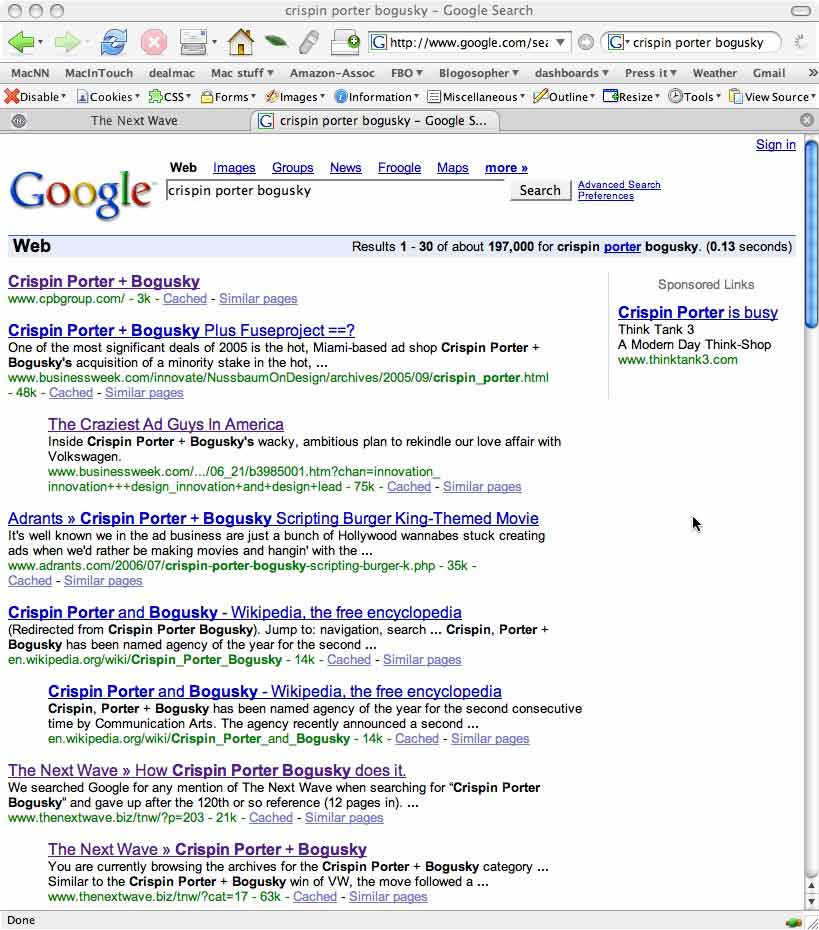 We just took a look on Google for Crispin Porter + Bogusky, we are now ranked 7, that’s from not in the first 120+ search results last week. Found this interesting article from the Miami Herald about the growth of CP+B that’s worth a read:
MiamiHerald.com | 02/13/2006 | Crispin Porter + Bogusky’s rise to the top
Our favorite quote from Chuck Porter: ‘When we were small, we learned to use imagination — not money” - well, not that they are big- they sometimes use a lot of money (not always bad) like for the Burger King Manthem spot that we compared to the Apple Campaign in “Is your agency ego in line with your budget”
Crispin Porter + Bogusky is now over 400 employees, and in two offices (Denver and Miami)- and while the quality of their work continues to be spectacular, the question that Guy Day and Jay Chiat once asked may become relevant one day: “How big can we get before we get bad?”
With the demand so high for CP+B’s magic, they have the opportunity to pick and choose their clients, and to dictate what their clients should do. Gateway didn’t like the advice to scale back their offerings to a simplified product matrix- and now Gateway isn’t a client. Compare the Apple store to the Dell store, and you will quickly see that Apple has a far easier site to navigate and sticks to a simple “Good, better, best” type matrix- Crispin was absolutely correct in their advice to Gateway, and it’s this type of advice that clients should be willing to pay more for, instead of bigger ad budgets.
Another quote from this article stands out:
”They’re really vested and interested in our commercial objectives,” says Chris Rossi, vice president of sales and marketing for Virgin Atlantic Airways North America. ‘You don’t just go in and say `give me a print concept.’ I have a conversation with Alex [Bogusky] about sales and market share. You don’t usually have a conversation with the creative director like that.”
Our first meeting with clients almost always includes the question: “what is your most profitable part of your business- and how can we jump start that” - it’s not about doing advertising for advertising’s sake, it’s about building a relationship on mutual growth and profitability. If your agency isn’t asking these kinds of questions, maybe you should be looking for a new advertising agency.
As the old quote goes “it’s not creative, unless it sells.”
And if you can’t get Crispin Porter + Bogusky to talk to you about growing your business, we know a small shop that would love to talk to you.
We can get you to the top of search, create relationships with your clients, and get people talking about your brand- using more imagination, not money.
by Next Wave Team | Jul 16, 2006 | Advertising, Crispin Porter + Bogusky, Everything You Want to Know About Advertising, Future of advertising, Great Ad Agencies, Guerrilla Campaigns, Low Budget Advertising, Marketing & the Web, Search and Business, Web strategy
Think Tank 3 thinks they are brilliant. They bought ads on Google (the ones that show up on the right of a search) for key phrases for searches for other hot shops. Here is their site:
think tank 3 | a modern day think-shop
Note- no RSS feeds, pop-up windows- all the things that Google and blind people really don’t like.
If you look at how Google sees them by typing in site:thinktank3.com you will find they only have 51 results- many with the same headline. The OneShow thinks this idea of buying keywords was an innovative use of media- we say, it’s embarrasing. We can get to the top of search for free. The following is from their site- I can’t link to the exact page- because it’s a pop-up):
THINK TANK 3
This online campaign for and by Think Tank 3 is the first ever idea based campaign to run on Google, using Google’s ad-words program. Search marketing accounts for gazillions of dollars in online advertising and it had never been used to host an idea based campaign. That’s why our series of ads, which appear on Google when you type in searches like “Crispin Porter”, “Alex Bogusky”, “DDB”, “Modernista”, or “Kaplan Thaler,” stand out so much. It’s also the reason they were worthy of a One Show Merit Award for exceptional innovation in media.
We’ve gone from not showing up in search for Crispin Porter Bogusky to number 11 because we understand that content brings real results. Google AdWords is an expensive way to get people to your site. And once people get to your site- wouldn’t it be great if they could comment on it- or point to an exact part of it- so they can send it on to their friends. Sort of like what this site accomplishes? What do you think?
by Next Wave Team | Jul 16, 2006 | Advertising, Brand Relevancy, Crispin Porter + Bogusky, Everything You Want to Know About Advertising, Great Ad Agencies, VW advertising
In the 2006 Initial Quality Study from J. D. Power and Associates, only Isuzu (191) and Land Rover (204) ranked lower than Volkswagen that was tied with Hummer at 171 in problems per 100 vehicles.
For comparison, Porsche, also made in Germany, and fully “pimped” straight from the factory, had 91 and Lexus 93.
Hyundai, which not too long ago, was at the bottom of quality surveys, implemented an amazing 10 year warranty a few years back, and now only has 102 problems per 100. Toyota, long known for quality came in with 106.
There is an adage that great advertising will kill a bad product faster than bad advertising will kill a great product, and with VW hiring the brand magicians at Crispin Porter + Bogusky, is VW committing suicide?
Crispin did wonders with the Mini (which had 150 problems per 100) but abandoned the brand (spending about $35 million a year) for VW (spending $330 million a year) when the Mini brand manager moved to VW.
So far, interest and sales of VW are on the upswing, as is a quality move within VW, but could the answer be partially in VW’s hands - offer a bulletproof warranty and have VW take responsibility for what they build?
 One of the beautiful things about Crispin is that they are willing to go outside the traditional confines of what an ad agency is “supposed to do” and offer sound business advice. Some in the auto business laughed at Crispin rebranding the VW Golf back to it’s original “VW Rabbit” badge. Considering that neither econobox sold as well as the Bug- which was known for its quality, dependability and value- qualities that have escaped VW since the Bug’s departure from the line up.
Note: if you click on the frame- you will get a pop up window to the spot.
The song is “The Birds and the Bees” By Patrick and Eugene.
You can visit the iTunes store for this album by clicking this link: Postcard from Summerisle and the catchy lyrics are:
The sky is perfect blue
No clouds could spoil the view
It’s a sign from above
That shows that we’re in love
All the birds and the bees
Are flying in the trees
The sun is in the sky
Just for you and I
the VW site promises to tell you this stuff- but they don’t have the spot loaded yet.
Consumers already have a bullshit detector when it comes to advertising- and with VW’s reputation for quality in tatters, the current crop of entertaining ads are a solid attempt to bring back some of the love for early VW advertising- with it’s self-deprecating cheekiness.
The big question will be answered next year, when JD Power rankings come out, and VW will learn if the cost of selling more cars is an even worse ranking- or a huge move up in perceived quality thanks to actual better quality- and a halo effect from good advertising.
What do you think?