The payola scandals of the Fifties were a black-eye on commercial radio, where record labels would pay radio stations to play certain albums.
Now with corporate and satellite radio controlling the airwaves, and internet radio still in the nascent stages- the best way to get your songs played to mass audiences is to sell your song to a major advertising campaign. When Wieden + Kennedy bought the Beetles “Revolution” for Nike there was a major outcry of selling out. (Personally, this commercial still makes me love advertising- and what I do)
But, besides bringing new exposure to old hits- or even hits in the making- there is also an area of concern for artists- will they be seen as selling out? Some artists have sworn off commercialization of their art- Bob Dylan taking a hit for selling music through Starbucks for instance.
So, when Crispin Porter + Bogusky follows in the footsteps of Arnold by putting Wilco’s “Sky Blue Sky” into a campaign, Wilco fights back- and in the tradition of David Ogilvy who believed you should use the products you shill, admits to driving V-dubs.
Pitchfork: Wilco Explain Volkswagen Ads
After millions of infuriated Wilco fans around the globe set fire to their copies of Sky Blue Sky and drove their Jettas off cliffs yesterday, Wilco took it upon themselves to explain their recent involvement in a Volkswagen ad campaign.
“With the commercial radio airplay route getting more difficult for many bands,” wrote the Chicago sextet on its official website, “we see this as another way to get the music out there.”
They continued: “And we feel okay about VWs. Several of us even drive them.”
Securing rights to popular music isn’t always easy- we once traded building a website for Buckwheat Zydeco in exchange for using his music as the background for a local neighborhood non-profit marketing piece- which cost us a bunch- but gave the neighborhood new life. Besides the website- (which has been sadly and badly basterdized over the years) Buckwheat gained a whole new bevy of fans- who would not have been exposed to his great music any other way.
With viral videos like Jud Laipply’s “Evolution of Dance” using a bunch of copyrighted music- the question is- is it better marketing for the music than the old school pay-to-play? If I was the copyright holder, I’d be thrilled to have “tastes” of my music given that much exposure.
It’s a whole new world out there in marketing, what you learned in school doesn’t apply anymore. Sharing is the new currency and attention is the new jackpot.
There was an IBM tv ad called “Deep Intelligence” about a sage who saw relationships in the data that drove sales. He says things like “Greeting cards, Lip Gloss” “Beer/Diapers” “Motor oil/ Turkey franks” we can’t be sure that he knows- all we know is that he knows.
If either the agency, Ogilvy, or IBM was tuned into this web 2.0 thing- they’d have it on YouTube to share- but they don’t. [UPDATE Dec 2010]If you have access to Ad Critic, it’s right here: http://www.adcritic.com/content/ibm-deep-intelligence.html
I’ve always liked this spot- but tonight, it became relevant- someone searching for “mark cuban buys hotel chain” ended up finding us at number 4 in Google- and calling us to see if we could help them sell wine.
This wasn’t search engine optimization- he wasn’t searching for small creative ad agency, or ad agencies in Dayton OH, or even great ad agencies- he wasn’t looking for the next Crispin Porter + Bogusky, or how to pick an ad agency (all terms that we’ve ended up on the first page of Google)- he was looking to find independent thinkers in the hotel industry to market to them as outlets for wine from his LA County vinyard.
There we were: The Next Wave>low budget advertising at number four, because we had combined content in a category that managed to put Mark Cuban and the Drury Inn- into the same place.
Go figure- good technology leads to happy accidents. Once the potential client read that “Our job is to make you more money than you pay us” he was reaching for his phone.
Can you ad agency get you this kind of happy results?
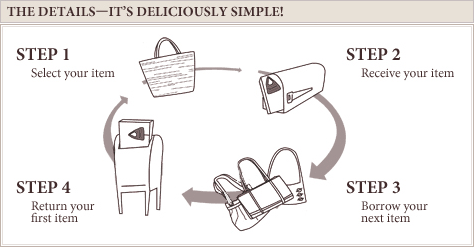
James Brown, lookout. It ain’t papa sportin that brand new bag, it’s momma. Yep, they’ve created the Netflix of handbags- just sign up and never have to worry about being seen with the same handbag twice.
It’s called adding value, and if your business is still in the business of selling goods (like designer handbags) it’s time to innovate or die, because without adding value - customers can always find a cheaper price.
Take a look at this site- and start making plans to change your business model:
When the “Get a Mac” campaign broke - we wrote about it, comparing it to the Burger King Manthem spot from Crispin Porter + Bogusky. We said one was a campaign, the other- a one shot wonder. One had brilliant strategy, the other a big budget. And for all the things we said, it turned true: TBWA Chiat Day is still churning out more of the simple spots- and Burger King is on execution 243.
Effie Awards : Effie Awards Press Release
June 8, 2007 (New York, NY) – Apple Inc.’s “Get a Mac” campaign, created by Media Arts Lab\TBWA was awarded the Grand Effie at the 39th Annual Effie Awards gala last night at the Metropolitan Pavilion in New York. The Effie Awards honor the most significant achievement in the business of marketing communications: ideas that work. Results from the “Get a Mac” campaign included market share growth of 42%, record sales and cultural influence.
“After much spirited discussion, the jury unanimously awarded Apple the Grand Effie for its portrayal of the Mac/PC rivalry. They managed to do it with humor, class, and honesty without falling into the trap of overtly negative competitive advertising,” said John Butler, Co-Creative Director of Butler Shine Stern & Partners and the 2007 Grand Effie Jury Chair.
There was a quote I heard at the 2007 AAF National Convention that summed the contrast of these two ideas up quite nicely:
“practice safe advertising: never do it without a concept”
Take note- a great concept wins an effie- and a stock price that’s climbed 50+ points- the other, continues to require extraordinary efforts to keep the brand fresh.
One of the recurring themes by some of the high-level speakers at the 2007 AAF National Convention was the crazy money being spent to snatch up web related ad companies. Another was how to monetize their newley discovered new media vehicle: the web. Yeah, you read me right- they are all rushing to figure out the metrics to quantify the ad buy on the web. Sorry guys- smart advertisers don’t need a third party to tell them if a campaign is working- they get really good stats (much better than Nielsen, the MPA or any other “validation company” ever provided) they have web stats and sales to evaluate.
What is even more sad- was so few of them really had a clue what Web 2.0 is, how it worked, or what it meant to them. Still worried about the silly notion of “control”- they sort of missed the Cluetrain Manifesto back in 1999 while they were busy buying up Web 1.0 companies.
Not only are most ad agency sites not much more than bad brochureware in Flash, most of the excitement about the web is still in an “how do we continue doing business the way we did, only using the web” instead of realizing- your business model is totally broken, start thinking purely about being branded content creators that makes it as earned media- never paid. Yeah, you can try to talk a client into placing ads through DoubleClick- (and get laughed out of the room. Or start talking a language of opt-in, immersive, brand experiences that the consumer builds their personal brand by combining in a unique way.
The endorsers of tomorrow aren’t LeBron James, Oprah or Britney Spears (heaven help us) but every single customer who choses to affiliate themselves with your brand and others- and none of it is under your control.
It’s probably not clear to most people attending the Ad Conference how this post came- since this is a pretty far stretch from most of what was talked about (although I’m looking forward to reading the autographed copy I picked up of Carat Americas, CEO David Verklin’s “Watch This Listen Up Click Here“).
But, this post about a post by Dave Winer- who was the guy who made the cutting edge of Web 2.0 possible (while most other people were still trying to figure out how to install AOL on their computers) about the new digital divide between those who get Web 2.0 and those who don’t:
Dave Winer: “It’s Time for Web 2.0 to Stop Being Exclusive” @ WEB 2.0 JOURNAL
A war of words has broken out in the world of Web 2.0 - between the software developer Dave Winer - who created or was a lead contributor to several of the most popular XML dialects and APIs related to web publishing such as RSS 2.0, XML-RPC, OPML, and the MetaWeblog API - and the founder of O’Reilly Media - the newly self-proclaimed “technology transfer company.”
Winer’s beef? “We need to get all hands involved in what we used to call Web 2.0,” he laments. “It’s time for it to stop being exclusive, and it’s way past time for one company to be controlling who’s supposed to participate.”
Winer’s contention is that events such as “FOO Camp” are harming the greater good, which is to make software easier, better, scalable, more reliable, and more secure, and instead turning Internet technology into an elitist world where it becomes a question not of what you know but who you know.
In Winer’s view, the very future of computing is at stake:
“We need to start doing some real investing in technology, not the BS that passes for technology investing that’s been going on for the last decade.”
In other words, what Winder fears is another Nasdaq run-up, followed by the inevitable explosion:
“But what I do want is to avoid a bloody mess,” he says. “We have work to do here. We have a bubble-pop to avoid.”
Brooklyn-born Winer, who is also the author of one of the first ever weblogs…
The bold italics were added by me- to highlight the big leap ad people need to make- it’s time to start doing real investing in your creative departments, training, molding, challenging your teams to learn how this new paradigm needs to work. It’s time for all of you to get more than six measly pages indexed in Google for your site (like McCann’s site- note McCann bills itself as the largest US agency).
Like it or not, ad agencies today are the buggy whip manufacturers of the turn of the last century. It’s an attention economy, but only for those who understand that it has to be earned, not bought. The more you understand all this, the more Howard Luck Gossage becomes relevant: “People don’t read ads, they read what interests them- and sometimes it’s an ad.”
Well said Howard, too bad you aren’t still here. The bubble’s about to pop, and the sad part is- most won’t understand why.
One of the recurring themes by some of the high-level speakers at the 2007 AAF National Convention was the crazy money being spent to snatch up web related ad companies. Another was how to monetize their newley discovered new media vehicle: the web. Yeah, you read me right- they are all rushing to figure out the metrics to quantify the ad buy on the web. Sorry guys- smart advertisers don’t need a third party to tell them if a campaign is working- they get really good stats (much better than Nielsen, the MPA or any other “validation company” ever provided) they have web stats and sales to evaluate.
What is even more sad- was so few of them really had a clue what Web 2.0 is, how it worked, or what it meant to them. Still worried about the silly notion of “control”- they sort of missed the Cluetrain Manifesto back in 1999 while they were busy buying up Web 1.0 companies.
Not only are most ad agency sites not much more than bad brochureware in Flash, most of the excitement about the web is still in an “how do we continue doing business the way we did, only using the web” instead of realizing- your business model is totally broken, start thinking purely about being branded content creators that makes it as earned media- never paid. Yeah, you can try to talk a client into placing ads through DoubleClick- (and get laughed out of the room. Or start talking a language of opt-in, immersive, brand experiences that the consumer builds their personal brand by combining in a unique way.
The endorsers of tomorrow aren’t LeBron James, Oprah or Britney Spears (heaven help us) but every single customer who choses to affiliate themselves with your brand and others- and none of it is under your control.
It’s probably not clear to most people attending the Ad Conference how this post came- since this is a pretty far stretch from most of what was talked about (although I’m looking forward to reading the autographed copy I picked up of Carat Americas, CEO David Verklin’s “Watch This Listen Up Click Here“).
But, this post about a post by Dave Winer- who was the guy who made the cutting edge of Web 2.0 possible (while most other people were still trying to figure out how to install AOL on their computers) about the new digital divide between those who get Web 2.0 and those who don’t:
Dave Winer: “It’s Time for Web 2.0 to Stop Being Exclusive” @ WEB 2.0 JOURNAL
A war of words has broken out in the world of Web 2.0 - between the software developer Dave Winer - who created or was a lead contributor to several of the most popular XML dialects and APIs related to web publishing such as RSS 2.0, XML-RPC, OPML, and the MetaWeblog API - and the founder of O’Reilly Media - the newly self-proclaimed “technology transfer company.”
Winer’s beef? “We need to get all hands involved in what we used to call Web 2.0,” he laments. “It’s time for it to stop being exclusive, and it’s way past time for one company to be controlling who’s supposed to participate.”
Winer’s contention is that events such as “FOO Camp” are harming the greater good, which is to make software easier, better, scalable, more reliable, and more secure, and instead turning Internet technology into an elitist world where it becomes a question not of what you know but who you know.
In Winer’s view, the very future of computing is at stake:
“We need to start doing some real investing in technology, not the BS that passes for technology investing that’s been going on for the last decade.”
In other words, what Winder fears is another Nasdaq run-up, followed by the inevitable explosion:
“But what I do want is to avoid a bloody mess,” he says. “We have work to do here. We have a bubble-pop to avoid.”
Brooklyn-born Winer, who is also the author of one of the first ever weblogs…
The bold italics were added by me- to highlight the big leap ad people need to make- it’s time to start doing real investing in your creative departments, training, molding, challenging your teams to learn how this new paradigm needs to work. It’s time for all of you to get more than six measly pages indexed in Google for your site (like McCann’s site- note McCann bills itself as the largest US agency).
Like it or not, ad agencies today are the buggy whip manufacturers of the turn of the last century. It’s an attention economy, but only for those who understand that it has to be earned, not bought. The more you understand all this, the more Howard Luck Gossage becomes relevant: “People don’t read ads, they read what interests them- and sometimes it’s an ad.”
Well said Howard, too bad you aren’t still here. The bubble’s about to pop, and the sad part is- most won’t understand why.