by Next Wave Team | Jun 2, 2007 | Advertising, Creativity, Differentiating Your Brand, Everything You Want to Know About Advertising, Practical Marketing 101, Secrets of Great Advertising, The Craft Of Advertising
Found this via Ernie Schenck- (who still has no clue what trackbacks are).
And while it’s hip jargon in the stratosphere of advertising to say something like “your strategy is showing” as if that’s a bad thing- I always fall back to Ogilvy’s famous line about the consumer not being a moron- but your mother. Mom understands she’s being sold to- she knows it’s an ad- and strategy or no strategy showing it comes to Howard Luck Gossages classic quote “People don’t read ads, they read what interests them, and sometimes it’s an ad.”
So, flaunt your strategy for all I care- just make sure it’s interesting. I liked the definition of what “creative work should” do- (and note- the spelling isn’t wrong- it’s just a Brit talking)
adliterate: Too damn right my strategy is showing
Creative work should engage people, provide an emotional connection, build memorability, invite people to join the conversation, absorb them in the moment, build emotional desire and all of those wonderful things that it does. But it should also dramatise the strategy.
I can’t for the life of me think why you wouldn’t want your strategy showing unless of course it is so lifeless and limp that 10,000 volts wouldn’t bring the bloody thing to life.
If that is the case then burying it under layers of creative artifice and never speaking of it again is the least you can do.
Our definition at The Next Wave of strategy is even shorter: Create lust • Evoke trust™ and that’s what drives us. No matter what you do in the realm of marketing- always remember, keep it interesting- no price and product laundry lists, or simple feature lists- not unless you want to pay for those 10,000 volts to keep it alive in the customers mind.
What do you think?
by Next Wave Team | May 26, 2007 | Advertising, Brand Relevancy, Creativity, Crispin Porter + Bogusky, Differentiating Your Brand, Everything You Want to Know About Advertising, Future of advertising, Great Ad Agencies, Practical Marketing 101, Secrets of Great Advertising, The Craft Of Advertising
McCann trademarked this phrase in 1926, and it’s as important today as then: Truth Well Told ® and it should be a cornerstone of any ad, not just the great ones.
This TV spot from Element 79 Partners in Chicago, is actually one of a series called “Origins” and it will serve us well for an example of what makes great advertising.
https://youtube.com/watch?v=vpfzBMj8T58
Gatorade is a category leader, and may as well have invented the sports drink market. From a leadership position they understand they need to make a connection with their target market- but not beat their chests. This is a key ingredient that car companies would do well to learn. Nobody likes a braggart- and this applies to your advertising as well. They have taken the story of their products beginnings and turned it into a near mythological tale- if you have history, if you have a story, take it and use it.
Up until watching these spots, the connection between Gatorade and the Florida Gators wasn’t obvious to me, it was just a trade name that spurred a whole bunch of other ‘ades- with the exception of the original one- Kool Aid® which totally missed this market segment. (Right now, anything with the word “Gator” in it might hit a sore spot in our home state of Ohio- thanks to two national championship losses to Florida this year). Element 79 has managed to do several versions of this same story- and still keep them different. Unfortunately, I can’t find the other treatments to share with you.
But, the key to realize is that it tells the story, solidifying the category leading position, and can be done several different ways. Both good ingredients.
Another key ingredient is to play with the familiar. This spot uses both familiar music- and familiar sports stars, stories and even the announcer (sorry I don’t have his name).
While hit music, star athletes and well known personalities are all great to have in a campaign, this one does it without making them upstage the product. Although I love Michael Jordan in so many of the ads he did- they often ended up being more about him than the product.
Which brings up the next trick to making a great tv spot: cool by association. In and by itself, Gatorade is just a drink. Once you connect it to the mythos of sport, and particularly championships, you’ve planted a brand statement that speaks to the innermost desires in all of us: the dream of greatness. If you can make someone believe that your product will make them great, better looking, smarter, richer, sexier etc. you have done your job.
Telling your story in :30 or :60 seconds is a major accomplishment. Most TV commercials can’t do a fraction of what this spot does- typically a spot is good if it hammers home one salient point- this one is coup de grace for the category of sports drinks. If you can’t tell your story in your spot- can you at least get their attention and make them curious enough to go to your website?
Budget also plays a part in your formula for a great tv spot. Some of this was archival footage, other parts were shot to look that way- but, always remember, if you don’t have a big budget, go for a big concept (I’ve been told that this is a mantra at Crispin Porter + Bogusky).
The last secret to getting the best results for your TV commercial- put it on your site, put it on YouTube, let as many people have access to it as possible. Let your customers talk about it- discuss it- analyze it (just like what we’re doing here) the days of “controlling” your message are over- your customers are now at the helm. When you post it- remember to add a lot of descriptive text, since search engines have no idea what a video file contains. For this spot we would suggest: The history of Gatorade, Gatorade tv commercial, origins of gatorade, the story of gatorade and how gatorade was part of the Florida Gators sports success - get the idea?
If you have more questions about how to make great tv spots on a big or little budget, or on how to get them seen by the most people- ask us. We’ve got plenty of good ideas on how to make your brand stand out and your message heard.
by Next Wave Team | May 18, 2007 | Ad Agenices in Dayton, OH, Advertising, Advertising Case Studies for The Next Wave, Apple Advertising, Careers in Advertising, Dayton Bombers Advertising, Differentiating Your Brand, Everything You Want to Know About Advertising, Marketing & the Web, Practical Marketing 101, Public Relations in the Web 2.0 world, Search and Business, Secrets of Great Advertising, Web strategy
One thing that drives me nuts about the advertising business is that many clients still think of spending money on advertising is a gamble. I’ve never felt that way, because, as our motto says “our job is to make you more money than you pay us.” Advertising, when done right, is never a gamble- it’s an investment.
 So why am I feeling like a gambler for the first time in my ad career today? Because our client (of late) the Dayton Bombers, are playing game 7 of the Kelly Cup semi-finals tonight- and if they win, we get to do the campaign for the finals and if they loose- we don’t get the job. Money riding on a hockey game- who woulda thought?
As I said, it’s a first. We’ll know more around 10 pm tonight.
Because we believe we have to provide something useful in everything we post- a few tips on making sure your advertising doesn’t feel like gambling:
- Advertising is a more like a marriage, not like a date. Think about the long term, and invest in campaigns that will have “legs” - a concept, or idea that lasts. Think like Apples “get a mac” campaign instead of Burger King’s one shot “Manthem” (of which more was written about here).
- Branding is a shorthand for what your company stands for- make sure you think about it in everything you do, from what your employees wear, to how you answer the phone- and then get it to communicate clearly in your advertising.
- Consumers are getting very smart about marketing messages- never; lie, deceive, or talk down to them- they now have the ability to talk right back and it may come in higher in search than your message.
- Embrace the Internet, it’s everything you want your best employee to be- if you take really good care of it.
- The immortal words of Howard Luck Gossage are even more important today than 50 years ago: “People don’t read ads. They read what interests them, and sometimes it’s an ad”- so make your stuff interesting, make it art, make it entertaining- but what ever you do, stop saying things like “make the logo bigger” and start saying- “can we make the idea bigger.”
Hope that helps. Now, all the Bombes have to do is win tonight, so we get to keep building their brand.
by Next Wave Team | May 16, 2007 | Ad Agenices in Dayton, OH, Advertising, Advertising humor, Creativity, Differentiating Your Brand, Everything You Want to Know About Advertising, Future of advertising, Low Budget Advertising, Practical Marketing 101, Retail, Secrets of Great Advertising, The Craft Of Advertising
Ad Age Small Agency Diary had a post from Doug Zanger who hails from Portland Ore. It seems bad car dealer ads run from coast to coast.
He gives us 5 (give or take) rules for local car dealers to have better commercials. I doubt any car dealer in Dayton Ohio would bother to read this- or follow the rules, since everyone of them believes they are über creative and smart with their ad dollars.
See if you can figure out what car dealers fit which commandment. My choice list of egregious offenders would include (in no particular order):
Frank Z Chevrolet, Hidy Honda (and now Hidy Ford), Key Chrysler, Prestige Ford, Chuck George Chevrolet, White Allen, Jeff Schmidt, Dave Dennis Dodge- and that’s just for starters.
Advertising Age
Sadly, there are plenty of dealers who still pollute every possible breath of air with that used-car smell. For those egregious offenders, I propose some local-car-advertising commandments. I’ll start with five-ish and invite you to contribute your suggestions to complete the list.
1) Thou Shalt Stop Yelling
This isn’t an air raid. The world won’t come screeching to a halt because the factory authorized an incentive. We know you have to sell cars, but just talk with us about it for goodness sake. Rick Dalbey, creative director at Livengood/Nowack, in Portland, put it best when he said this about auto dealer radio ads: “Think about someone sitting next to you in the car. If they started yelling at you, you would tell them to shut up, wouldn’t you?” Good point.
2) Thou Shalt Stop Using Some Kind of Mascot
OK, Trunk Monkey from R-west in Portland for Suburban Auto Group doesn’t count. That campaign was just flat-out funny. What I’m talking about is an untrained goat, Pickles the family kitty or some college intern dressed as a lobster, all designed to sell cars. Worse yet is animated clip art or a creepy, superimposed mouth on an animal. Unless it’s a dog with opposable thumbs that can actually drive the car, argue with the cop after being pulled over for going 12 miles an hour on the freeway and fight the ticket in court, please stay away from it.
3) Thou Shalt Stay Away from Humor and Your Own Commercials (Unless You Can Pull it Off)
You might fancy yourself funny. Your inner haberdasher may think you’re a riot. That joke about the penguin and the bale of hay always kills at the local watering hole, but we prefer you keep it to yourself. You may also be great in front of a crowd after a few samples of Novortsky Prospekt’s finest, but a fair number of people freeze up like Charlie Brown in a spelling bee when the little red light on the camera blazes up.
4) Thou Shalt Stay Away From 40-Second Disclaimers
I know, you have to use them. But can’t we just keep asking the attorneys general in our states to cut us all some slack and allow you to put all of that crap somewhere other than a radio spot? You hate it. We hate it. If I want to hear someone talk that fast, I can dial up my former intern, my cousin Abby or go to Aqueduct and listen to the call of the fifth race.
5) Thou Shalt Be Proud of Customer Service
If you’ve won an award, cool. Tell us why you won. Those things aren’t easy to win and they shouldn’t be bungled in with the rest of your message. Take pride in the achievement and make that the main point of your message if this is the route you choose. Anyone can find the car they want, but finding honest, good service is another issue. Parker Johnstone, CART driver and owner of a Honda dealership in Wilsonville, Ore., put it best when he once explained to a group of us: “We’re in the service business. We just happen to sell cars.” Johnstone’s shop backs up its claim every time I bring my (paid-for) ’92 Accord in for service. It’s not “just about the deal,” fellas. We’re human. We like to be treated well.
5.5) Thou Shalt Give Us a Shot
Most of us like cars. Most of us are pretty good at advertising and marketing. Let us help you, the dealer, come up with something mind-blowing. There’s some remarkable work out there. (RPA’s work for Honda Element in L.A. is a personal favorite.) It can be done just as well locally if you let us try for you. Ask yourself if what you’re doing is working. If it’s not, give us a call or read “Purple Cow” as fast as possible.
5.75) Thou Shalt Turn Off the Grill
A friggin’ hot dog never sold a car. Neither did popcorn nor balloon animals. Clowns are creepy. A petting zoo may interest me as long as the local health department clears it and there is an ample amount of hand sanitizer for everyone.
The good news is there are a few dealers who don’t break any of these rules- but could still use a more sophisticated, or interesting message.
Face it- the car industry has enough problems foisted upon it by the great “CEO” leaders who remember to pay themselves crazy well- while producing crap cars and flooding the market with dealers and me-too variations. Bad local advertising shouldn’t be adding to the problems.
There are some other commandments in the comments- with a chance to win prizes- so I recommend you head over to the link and see what other creatives add. By the way- I wrote about the Trunk Monkey ads and how local dealers could learn from them long ago here: A car dealer that gets it.
by Next Wave Team | May 8, 2007 | Advertising, Change the world, Everything You Want to Know About Advertising, Future of advertising, Future of TV, Marketing & the Web
If anyone thought you were getting something for nothing when you flipped on the tube- or still thinks that- they are an idiot. TV has always cost consumers money- even PBS has its fund drives. Broadcast made you sit through the same stupid commercials, multiple times- even though you weren’t ever going to buy feminine hygiene products (guys) or Cruex (girls). It cost you time- and wasted advertisers money, delivering their message to people who would never buy their products. I like watching beer ads- even though I’ll never drink one- but, that’s ’cause I’m in advertising.
Cable and satellite is another matter- everyone who gets their TV delivered this way pays- and in the US, it’s about 80% of us. So, we’re already paying for the programming- but how much are we paying for stuff we don’t want? A lot. That’s why TV via the Internet is the future- only the programs you want- with only the ads you want- so why ABC and ESPN are coming up with this stuff- it’s a case of too little, too late:
Marketplace: Putting ‘a word from our sponsor’ on demand
LISA NAPOLI: ABC and ESPN said today they’re going to offer some of their programs to Cox Cable free, on demand.
There’s a catch. They’re going to disable the fast forward button on your digital video recorder so that you have to watch the ads.
Don’t panic. This is only a test for the moment.
But media professor Ken Wilbur of the Marshall School of Business says if you’re gonna watch a TV show whenever you want, the industry has to get creative in order to make money.
KEN WILBUR: Deals are being done virtually on a daily basis. And I can’t remember a time when the television industry was in a more dynamic state of change.
TV watchers are forcing that change by recording programs and skipping the ads. But why would anyone pay for a digital video recorder if you can’t do that?
Analyst Brahm Eiley of Convergence Consulting says there doesn’t appear to be a win-win solution to this problem.
BRAHM EILEY: I mean, something has to give one way or another. These shows exist on advertising revenue. And if they’re not going to see that type of advertising revenue, then the cost of making these shows are going to be passed on to the consumer .
In other words, ultimately viewers will pay somehow — either with their time or by having to pay for shows that might otherwise be free.
As I said- there is no such thing as “free”- and the failure to understand that is what’s making this whole shift so entertaining. Why can’t we just admit it- and pay for what we want? And have our message subsidized directly by advertisers who want to reach us individually (1 to 1 marketing)- and have feedback- instead of wasting their money “Broadcasting” to people who will never buy their product.
by Next Wave Team | May 8, 2007 | Ad Agenices in Dayton, OH, Advertising, Advertising Case Studies for The Next Wave, Creativity, Dayton Bombers Advertising, Everything You Want to Know About Advertising, How To Select An Ad Agency, Low Budget Advertising, Practical Marketing 101, Secrets of Great Advertising, The Craft Of Advertising
There is a secret to great advertising- and it’s not the size of the agency or the number of awards on the wall. It’s not how hip the creatives are, or how cool the offices or even how big the budget is. And even though you could argue that the quality of the account planning can make all the difference in the world- it’s not what makes great ads.
What makes great advertising is the same thing that makes great leaders, great athletes, great scholars – basically great anything, and it’s one word: passion.
If the people coming up with the ad have a passion for the task at hand- and know the product and who they are trying to reach- you will end up with advertising that doesn’t suck- the kind that actually brings in the big bucks- without costing big bucks.
It’s taking what you have- and turning it into something that is a bit more than advertising- it’s a conversation that you just can’t turn away from. It’s a battle cry that resonates and won’t go away- be it “Where’s the beef” https://www.youtube.com/watch?v=Ug75diEyiA0 or “Whazzzup” https://www.youtube.com/watch?v=2GWrrTpJ1eU- it sticks in your head like peanut butter to the roof of your mouth.
When you are in the business of advertising, and know a good ad from a bad ad, you can tell when you do something great- because you can’t get it out of your head either.
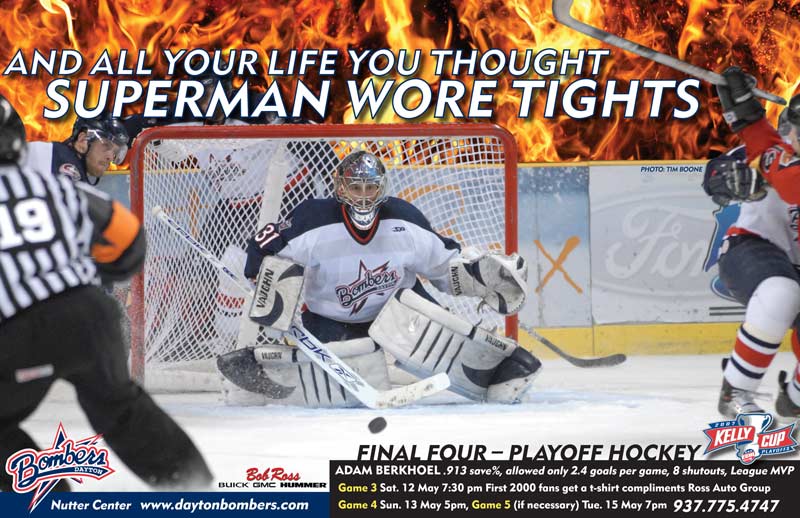
So, here’s the latest in the saga of pulling rabbits out of the hat for the Dayton Bombers- a client that no matter how vexing the time frame, budget, material to work with- brings out the passion from us at The Next Wave.
It comes from two things: we love ice hockey and, we love it when underdogs are kicking ass and taking names. The Bombers are in Florida right now- about to play the first 2 games of the semi-finals before heading back for 3 possible games at home. We were asked to put together a poster for the games- over the weekend- so far, everyone who has seen it has loved it. We hope you do too.
Come to the Game Saturday night- and maybe you can get one too.