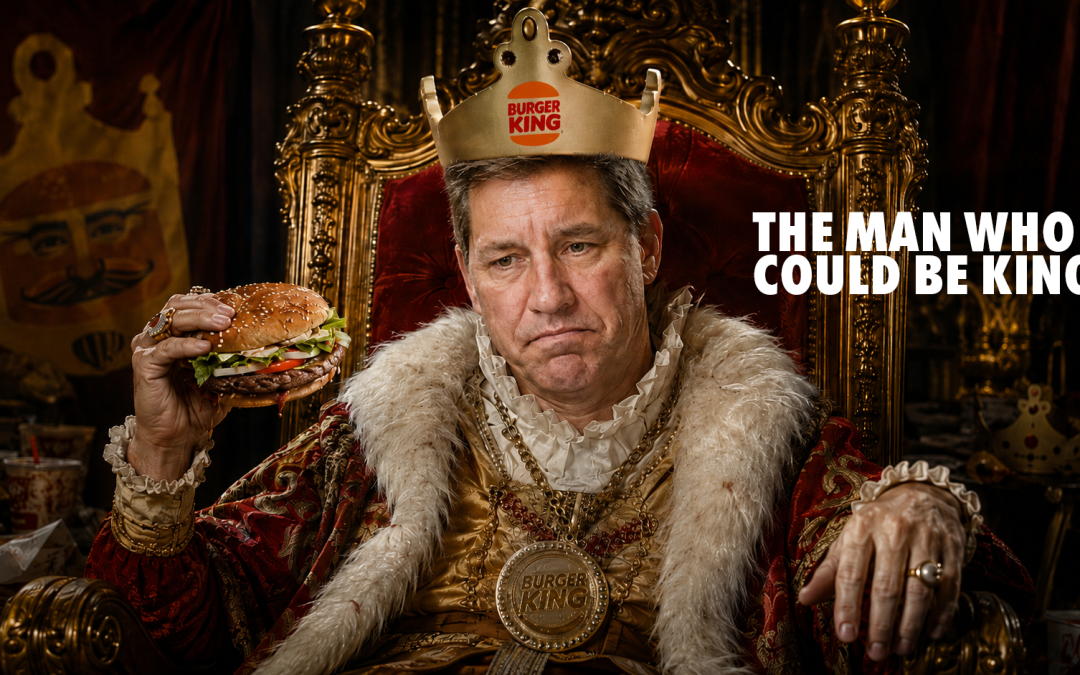
Burger King recently ran a 90-second spot during the Oscars to tell us that it knows it screwed up. The restaurants got old, service got slow, Whoppers got crushed in bad packaging and fast food generally “fell off - us included.” Then, as the big symbolic gesture, they fired the creepy plastic-headed King and announced that there is a new King - you, the customer.
I have news for them. The King wasn’t running the place.
He didn’t make the restaurants dirty, slow down the drive-through, underinvest in equipment, crush the Whopper, kill good products or replace them with cheaper ones that weren’t as good. Burger King admits that the King had already been largely missing from its advertising for years. Firing him now is theater - a convenient way for the people who made the bad decisions to blame a guy with a plastic head who wasn’t even in the room.
What makes the new spot particularly insulting is that the whole thing is a watered-down copy of Domino’s “Pizza Turnaround,” one of the most successful restaurant turnaround campaigns ever created. Domino’s showed actual customers saying the pizza tasted like cardboard, admitted they were right, changed the crust, sauce and cheese, then took the new pizza back to the people who had hated the old one.
The agency that did Pizza Turnaround? Crispin Porter + Bogusky - the same agency Burger King is now mocking by ceremonially firing the King.
Burger King’s current president, Tom Curtis, and RBI executive chairman Patrick Doyle both came out of Domino’s, (Doyle starred in Pizza Turnaround as Domino’s CEO) so they know exactly where this playbook came from. The new BK spot isn’t accidentally reminiscent of Pizza Turnaround - it is Burger King stealing CP+B’s playbook to apologize for CP+B’s Burger King advertising.
That takes balls - or an incredible lack of institutional memory.
Burger King has had a revolving door of advertising agencies for most of the last 30 years. By my count, nine different lead or principal U.S. creative agencies have had a turn, with the seven-year CP+B relationship and the later DAVID 8 year run being the exceptions. Every new management team seems to arrive convinced that the last agency was the problem, hires another hot shop, changes the voice, changes the strategy and then wonders why consumers don’t know what Burger King stands for anymore.
This is what happens when companies confuse changing the advertising with changing the business.
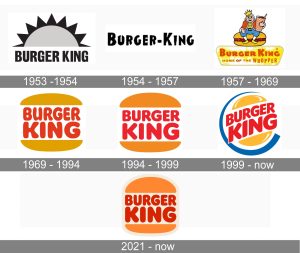
Burger King’s strategic amnesia wasn’t limited to advertising agencies. In 1999, it replaced the simple burger logo it had used for decades with that tilted, pseudo-three-dimensional thing wrapped in a blue swoosh - the logo you might design if the United States Space Force decided to open a hamburger stand.
This wasn’t just changing the letterhead at corporate headquarters. Thousands of restaurants had exterior signs, roadside pylons, menu boards, drive-through graphics, packaging, uniforms and other branded material that had to be changed as the new identity rolled through the system.
I haven’t found a published accounting of what Burger King and its franchisees spent. But even a very conservative $10,000 per restaurant across a global system of roughly 10,000 locations puts the bill around $100 million - and anyone who has ever purchased and installed illuminated commercial signage knows that $10,000 doesn’t go very far.
Did the Space Force logo sell one additional Whopper?
There is no evidence that it did. Burger King was already struggling when the logo arrived, kept struggling afterward and eventually needed Russ Klein and CP+B to make the brand relevant again.
Then, in 2021, Burger King announced another complete rebrand and essentially returned to the burger logo it had abandoned in 1999. The design community praised the new retro identity - and, to be fair, it is much better - but the new version was introduced gradually, leaving restaurants displaying two different Burger Kings while packaging, uniforms, signs and remodeled stores slowly changed over.
So Burger King and its franchisees spent a fortune replacing a recognizable logo with a trendy one, kept it for more than 20 years, then began spending another fortune to return to something close to where they started.
Meanwhile, the beef was still frozen.
That may be the perfect summary of Burger King management: spend money changing the sign while avoiding the harder and more expensive job of changing what is served underneath it.
When Russ Klein quietly hired CP+B in 2003, Burger King had suffered through seven straight years of sales declines and a 22% drop in foot traffic while the fast-food category was growing. The brand was known, but not loved - which is marketing speak for everybody knows who you are, but nobody cares enough to come see you.
Instead of trying to be all things to all people, Klein and CP+B figured out who could move the needle fastest. Publicly, Burger King called them “Superfans.” Internally, CP+B called them “Meatheads” - and no, I didn’t make that up. They were mostly younger men who liked big burgers, games, the internet, irreverent humor and eating out constantly.
The interesting part wasn’t that they were young or male. It was that they were already eating fast food all the time. The research showed that the average Superfan visited Burger King about five times a month, ate away from home 43 times a month and went to other fast-food restaurants another 11 times. Burger King didn’t have to convince a vegan to eat a Whopper - they had to get a prolific fast-food eater to make one more visit to BK instead of Taco Bell, Wendy’s or McDonald’s.
The math around one additional monthly visit was gigantic. It’s called finding the low-hanging fruit - something every marketing textbook talks about and very few companies are brave enough to actually do, because somebody in the room always wants the campaign to appeal to women, children, grandparents, vegetarians, dog owners and left-handed actuaries at the same time.
The resulting strategy was described as “provocative, not pleasant.” CP+B gave Burger King the voice of the cool uncle - the guy who told you how it really was and occasionally did something your parents wouldn’t approve of.
We got Subservient Chicken, the creepy King, Whopper Freakout, Whopper Sacrifice, Whopper Virgins, the Xbox games, Flame cologne and all kinds of other things that people willingly talked about and passed along. Alex Bogusky used to tell his people not to write him a campaign - write him a press release. In other words, come up with something interesting enough that people would choose to talk about it instead of spending the entire budget forcing them to watch it. We wrote about many of these campaigns, and sadly, so many of the links and videos are gone. One that knocked us out was Ugoff- a very different spot that demanded attention.
The franchisees weren’t always happy. As I remember the story, around year three there were plenty who wanted Crispin gone because the work was too weird, too male and too far outside their comfort zone. One of the agency’s answers was the glorious “Manthem” spot for the Texas Double Whopper - a mob of men rejecting tiny portions of “chick food,” ending with a minivan being tossed off an overpass and a giant banner reading “EAT THIS MEAT.”
Subtle? No. Forgettable? Not a chance. “Eat like a Man, Man!”
More importantly, CP+B did something almost unheard of for an ad agency - it helped invent products Burger King could sell. The idea for Chicken Fries was to make something that fit in a cup holder for kids- and our recollection credits CP+B with coming up with the idea. We’ve done the same thing at The Next Wave helping clients develop new products from pizzas to binoculars.
Chicken Fries are still on the menu today because customers wanted them. Burger King actually discontinued them and eventually had to bring them back after customers kept asking for them. That is the difference between creating an ad people notice and creating a product people miss when it’s gone.
The Xbox promotion was just as brilliant. Burger King sold three different games featuring its advertising characters for $3.99 with the purchase of a value meal. They sold 3.5 million copies and reported a 9% year-over-year sales bump during the quarter. People drove to Burger King, bought food and then paid extra to take Burger King advertising home with them.
Subservient Chicken set the internet on fire, and the geniuses at BK now have that domain pointed to their home page- instead of keeping their freak flag flying. If you don’t know Subservient Chicken, here’s a “case study” video about it.
Find us another agency that can put ideas that big on their timesheets.
By the end of 2008, Burger King had record worldwide revenue of $2.46 billion and its 18th consecutive quarter of positive sales growth. In-store traffic was reportedly the best it had been in a decade. No, an ad agency doesn’t deserve all the credit - ownership, operations, menu changes, franchisees and management all mattered - but it’s pretty difficult to argue that CP+B was hurting the company.
Burger King may still exist without CP+B, but there is a reasonable chance it wouldn’t have nearly as much brand equity left to squander.
And CP+B clearly still had horsepower after Burger King. Domino’s hired them in 2007, while they were still working for BK, and together they helped turn a tired pizza delivery company into what was arguably the most innovative restaurant and technology company in the category.
Pizza Tracker launched in 2008 - long before every delivery service decided customers should be able to watch a little icon crawl across a map. It answered the question every pizza customer had: Where the hell is my pizza? Domino’s already had the operational data inside its system; CP+B helped turn that invisible information into something customers could see and value.
Then came Pizza Turnaround. Domino’s didn’t make a vague apology about how “pizza had fallen off.” They admitted that their pizza wasn’t good enough, changed the actual product and showed people what they changed.
First fix the pizza. Then advertise the fix.
Burger King’s new ad takes the opposite approach. It talks about old buildings, slow service, packaging, mistakes, mayonnaise and the King mascot - but doesn’t offer one defining product change that gives me a compelling reason to drive past another restaurant tomorrow.
Burger King is spending real money on its Reclaim the Flame program, updating restaurants, replacing equipment and trying to improve operations. Good. It was long overdue. Customer satisfaction is reportedly improving, and U.S. comparable sales were up strongly in the first quarter of 2026.
But the central product strategy still looks like it is being ruled by people who would rather simplify operations and cut food costs than give customers something worth making a special trip to buy.
The Ch’King dethroning.
The Ch’King may be the most obvious example. Burger King spent years developing a large, freshly hand-breaded chicken sandwich on a potato bun that could compete with Popeyes and Chick-fil-A. Burger King even advertised that it had refused to “half-ass” it. Note, Popeyes is also owned by RBI, same as BK.
It was very good.
At the time, Burger King had roughly 7,000 U.S. restaurants - vastly more distribution than its RBI sister brand Popeyes. That gave them an incredible opportunity. One person in the car could get a Whopper, another could get a genuinely competitive chicken sandwich, the kids could eat Chicken Fries and everybody could be satisfied without making two stops.
That is how restaurant decisions actually get made. The person who wants the burger doesn’t always pick the restaurant - the group picks the place where everyone can find something they want.
Burger King killed the Ch’King after about 15 months.
Tom Curtis later admitted that it was a fantastic product when made correctly, but that it required 21 preparation steps and was difficult for restaurants to execute consistently. Fair enough. Twenty-one steps is too many in a fast-food kitchen.
The answer should have been to redesign the process while protecting the product. Take out five steps. Change the equipment. Simplify the variants. Use what RBI had learned from Popeyes. Certify restaurants before allowing them to sell it. Do whatever had to be done to keep the reason customers wanted the sandwich.
Instead, Burger King replaced it with the Royal Crispy Chicken sandwich - a cheaper, easier-to-make substitute that tastes exactly like the decision behind it.
Domino’s changed its operation to support a better product. Burger King made the product worse to accommodate the operation.
The Whopper Decision they refuse to make
While Burger King was busy changing agencies, Five Guys, Shake Shack, Smashburger, Culver’s and a host of smaller burger chains trained customers to associate fresh, never-frozen beef with higher quality. Five Guys doesn’t even have freezers in its restaurants. Culver’s proudly says every ButterBurger is made to order with fresh, never-frozen beef. Shake Shack built an entire premium burger business around fresh beef and better ingredients.
Burger King owns something none of them can honestly claim at national scale - flame broiling.
The answer has been staring them in the face for at least 15 years:
Fresh beef over a real flame.
Instead, the new improved Whopper gets a better bun, creamier mayonnaise and a box that keeps it from being crushed. Those are improvements, but the frozen patty remains unchanged.
Burger King put the Whopper in a nicer suit and left the same cheap meat underneath.
McDonald’s managed to move its Quarter Pounder platform to fresh beef across most of the country, and McDonald’s operates on a scale that dwarfs Burger King. BK didn’t have to convert every hamburger in the system overnight. They could have introduced one fresh-beef premium Whopper, tested it regionally, certified restaurants that could handle it and then expanded.
Fresh beef plus flame broiling would give Burger King a product story no competitor could copy.
DOH.
The same goes for shakes and desserts. Culver’s has made fresh frozen custard, Concrete Mixers, malts, shakes and a rotating flavor of the day into a completely separate reason to visit. Five Guys offers a ridiculous number of shake combinations. The small Florida Chicken brand, PDQ makes hand-spun shakes that are good enough to make you consider going there even if chicken wasn’t your first choice.
Burger King has thousands of restaurants, plenty of refrigeration, beverage equipment and a brand built around indulgence. Coming up with a shake people would actually drive to buy should not require McKinsey, artificial intelligence or another $50 million rebrand.
A great Whopper, a great chicken sandwich, Chicken Fries and a killer shake would give four different people four different reasons to choose Burger King. That’s a strategy. A 90-second apology is an ad.
DAVID did create some very good work after CP+B. Whopper Detour was insanely great - go near a McDonald’s, unlock a one-cent Whopper on the BK app and then get redirected to Burger King. It generated app downloads, restaurant visits and actual sales. It was a stunt with commerce built into it.
Moldy Whopper was the opposite. It was a beautiful Cannes case study featuring Burger King’s flagship product decomposing in front of us to prove that it no longer contained artificial preservatives. Ad people loved it because it was brave, disgusting and impossible to ignore.
Independent testing found that purchase desire ran far below restaurant-ad norms and that more than a quarter of viewers said it discouraged them from buying Burger King.
Who could have possibly predicted that showing moldy food wouldn’t make people hungry?
Somewhere along the way, Burger King began confusing making the advertising famous with making the restaurant successful. The company currently has fewer U.S. restaurants than it did five years ago, and its average restaurant still generates far less than a Culver’s. You can’t blame all of that on marketing - in fact, you can’t blame most of it on marketing - but you also shouldn’t keep changing agencies and expecting a different logo, jingle or brand manifesto to fix decisions being made in purchasing, operations and the test kitchen.
The new Burger King commercial claims that the customer is finally the King. If that were true, would they have killed the Ch’King instead of fixing the preparation process? Would they still be using frozen beef while competitors build entire brands around fresh meat? Would Chicken Fries have disappeared until customers demanded them back? Would they have waited years to fix the bun and packaging? Would their shakes still be an afterthought?
“Have It Your Way” apparently means have it your way - as long as your way isn’t too difficult or expensive for us.
The creepy King was never the problem. He was one of the few things Burger King had that was instantly recognizable, impossible to confuse with a competitor and capable of generating attention without another celebrity endorsement.
Burger King doesn’t need to fire the King. It needs to stop being cheap if it really wants to be better, stop changing agencies every time management changes and stop asking advertising to cover for inferior product decisions.
And, if the customer is really King, it might help to start listening before killing the things we actually liked.
When it comes to advertising, every single client wants great advertising. The problem often is, great advertising ideas often scare the pants off clients. “Has that been done before?” or “Can we test it?” are usually the first lines of defense. If you are asking questions like these it should make you wonder why you hired the agency you did in the first place.
There are “hot agencies” in the business where desperate clients line up trying to make up for their other failings with a hail Mary ad campaign that will push them back into profitability. Often times, the old adage that nothing will put a bad company out of business faster than great advertising comes to mind. The reason Burger King can’t compete with McDonald’s has more to do with how clean the parking lot and bathrooms are, and not the quality of the food. Remember, flame broiling beats frying? Burger King’s burgers may taste better, but the rest of the delivery is lacking. Burger King has also been through more ad agencies than any other fast food feeder, other than a 7 year stint with Crispin Porter + Bogusky, it’s been a revolving door.
There are also some people in advertising who are idolized in the industry for doing ground breaking award winning work. We’re lucky enough to know quite a few of them at the Next Wave. We’ve done work for Sally Hogshead, Luke Sullivan, Ernie Schenck, and have open connections with some other big hot shot names. But, there’s one guy who we don’t know, but we know his work. He’s broken all kinds of rules in advertising and made music videos that were unforgettable, his name is Mark Fenske, and he’s been teaching advertising at VCU Brandcenter in Richmond VA (much like our friend and client Luke Sullivan was at SCAD for over a decade). On the front page of his personal site, he has an ad he did for a stock image library, Ibid, around 2004. Its headline, “How to know when you’ve done a good ad.”
And, well, we couldn’t leave it alone, because “good is the enemy of great.” So you can flip between how to do a good ad, and “how to know when an ad is great” seems a lot more important to folks like you who may be searching for the holy grail of advertising genius.
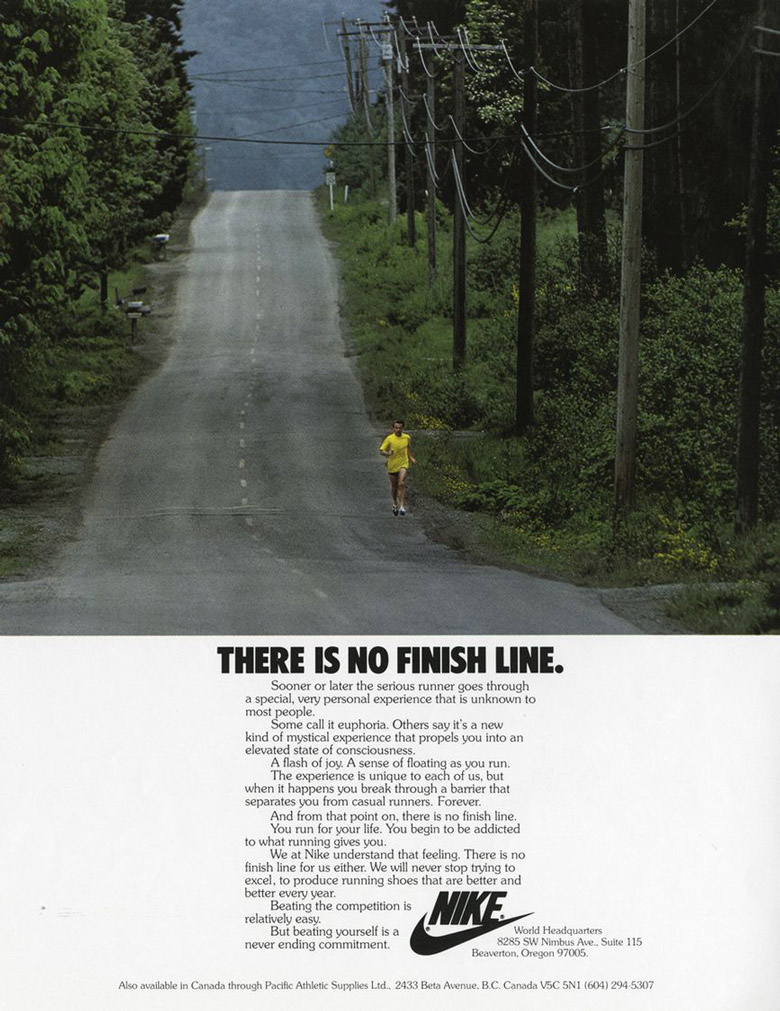
We strongly believe that the best advertising isn’t accidental. It depends on both the agency and the client, being able to work together, to trust each other, it’s more like a marriage than just a transactional one-night stand. When Bob Knight hired two guys and an office manager in Portland to do work for his budding shoe brand, Nike, he’d already been working with an agency in Seattle (John Brown and Partners) that had done an epic ad in 1977 that changed his business - “There is no finish line” but decided to make a switch.
It took W+K all the way until 1999 to come up with “Just do it.” And the rest they say is history.
In your search for great advertising, just remember, almost every amazing campaign wasn’t done by committee, just two people sitting in a room spitballing ideas until they hit the motherlode. The guys who came up with “The Most Interesting Man in The World” for Dos Equis hit the jackpot 20 minutes before the presentation. That the client was willing to run a campaign that begins with “I don’t always drink beer, but when I do I prefer Dos Equis” is that squirm/cultural tension that propelled the campaign into the stratosphere. (For the whole fascinating story of how this campaign came to life, we highly recommend listening to the “Tagline” podcast about this campaign)
If you are looking for an agency that can give you great advertising, and you’ve read this far, maybe you should take the next step and schedule a call with The Next Wave Marketing • Innovation. We’re the agency that understands our job is to make you more money than you pay us- and create lust • evoke trust, and we were also smart enough not to name our agency after our founder.
Great advertising can do amazing things for a company. The size of the ad spend has nothing to do with results if you understand this. In fact, if you have to spend millions to get the word out, you are probably putting your budget in the wrong place.
While we are an ad agency, our name is The Next Wave Marketing Innovation for good reason. Marketing encompasses the entire brand strategy to connect with customers, and advertising is only a small part of that. Innovation is making you different from your competition, a better mousetrap so to speak. Because we’re students of the craft of advertising, we can pull stories and ads that showcase when Marketing Innovation triumphs over big ad budgets to help illustrate this point. Because we’re also consumers, we can share experiences where companies don’t have a clue on how to keep customers happy- which will undo all hard earned brand equity in seconds.
There is the old adage that a happy customer will tell 3 people, an unhappy one will tell hundreds? That’s kind of changed with the advent of the internet, everyone can tell everyone anything- even if it’s not true. That’s why from the beginning of the rise of Google as the database of human intentions, the algorithm scored results by credibility, which was built by links from those with more links (hopefully from credible sources). So, every customer interaction counts, every response by your customer service people is a test, how you treat your customers is more important than what you advertise. Actions, speak louder than words.
To start off with a positive example, Mike Dubin had an innovative idea- to become “the netflix of razor blades” when he started Dollar Shave Club in 2012. A single, low budget TV spot, that he starred in, went viral. Overnight, Dollar Shave Club was overwhelmed with orders and when he sold out to Unilever in less than a decade for a billion dollars, he was still laughing all the way to the bank. The ad was brilliant, the products passable, and the customer service exemplary (once they got over the initial slam of viral popularity).
Sometimes an ad agency can come up with brilliant ideas for their client to build a buzz. Between 2000 and 2010 Alex Bogusky and his renegade firm out of Miami did it over and over. But, the most noted campaign ideas were for Burger King, a client that had a history of switching agencies every 2 years before going a whole 7 with CP+B. For a case study on their successes see our “Bogusky Freakout” site post on their milestones. They generated more buzz worthy campaigns than any agency known to man, but, when it came right down to the true marketing problem for Burger King- service, cleanliness and consistency, BK could never compete with McDonald’s or even Chic-fil-a. One of our first hires was a customer service evangelist of epic proportions who beat this into our culture at The Next Wave. She went on to a career that took her all over the globe with Starbucks and now as VP of Operations at Shake Shack. You build businesses through positive customer touches- not just sales. It’s “My Pleasure” did more for Chic-fil-a than the cows campaign telling you to “eat mor chickn.”
It doesn’t matter what your business is, you are being measured every time a customer interacts with your brand- from watching an ad, to visiting your site, to mentions on social media to seeing trash with your logo on it. So, when an existing customer contacts you, this is your chance to shine.
Florida Tile makes ceramic tile. It’s a commodity. Most people looking at a wall of tile have no idea what brand of tile it is, it doesn’t have your brand on it, and when they go to the tile store, more than likely, they don’t have a preference for your brand over another- even if they saw an ad with Florida Tile in it. Unless the tile style isn’t like any other on the market (innovation) the tile ad you spent so much money on, could actually prompt them into a store, where they buy a competitors product. Not so when you have an existing customer calling for replacement for their shower tile cove base- that customer wants Florida Tile- to match their bath. This is the moment where your brand has an opportunity to shine. Unfortunately, Florida Tile failed miserably in helping me locate a piece of plain white cove base to match my 30 year old shower install. Last I checked square white tile is always in style, but, their unique size 4.125″ square, their white- and their cove curve- is now going for $15 a piece if someone has it on Ebay (they don’t right now).
Let’s contrast that with Lego, the children’s toy with millions of little unique pieces. A call to Lego gets a totally different response from a company that has decided that making customers happy is their most important marketing tool.
“We have something that we call freaky,” Lütke-Daldrup told me. “Freaky stands for FRKE, which is short for
fun
reliable
knowledgeable, and
engaging.
And those four words are something we’ve built our customer service on for probably more than 15 years.”
It isn’t just that Lego Group believes strongly in each of those four words. The reason the company is able to consistently delight customers, even when they’re having a bad day because they just opened a new Lego set to discover it is missing pieces, is that the company keeps these words in balance.
Hannah Quill, the company’s head of writing and tone of voice (which, by the way, is an amazing job title that alone tells you what the company thinks about engaging with customers) explains it this way: “One of the reasons that it works so well is that, yes, it’s fun and engaging, and we encourage people to be creative and have fun when they’re writing, but it’s also reliable and knowledgeable. It’s very important that you’re giving the customer the correct information, and that any promise that you’re making, you are committing to deliver that customer service. Freaky doesn’t solely mean fun and engaging, it also means following through, reliable, customer service.”
The proof is in the results. For example, the company’s net promoter score (NPS), a measure of customer loyalty and satisfaction, is 77 — one of the highest of any company. That means that being good to your customers is good for business. That should be obvious, but sadly, it too often isn’t.
“It’s essential that no matter the inquiry, the team provides the best possible answer and service while also reflecting our core values — and in doing that, they play a very important part to how people feel about our brand,” Christiansen says.
While Net Promoter Scores are nice metrics, they can only really be calculated for mega-brands, not necessarily small business. But, rest assured, the echo chamber of social media, where unhappy customers tell their friends about how crappy your service was, or how great you are, will have real bottom line results. Lego isn’t a huge advertising power in the toy space, however they have a product that has no direct competition- like the Burger giants, or lodging options.
AirBnB is a category disrupter in the lodging space. Hotels, resorts, destinations are now competing with individual “Hosts” who have a technology to level the playing field. I’m an AirBnB superhost and until recently- an evangelist to other hosts. Now, any recommendations to host come with a caveat- the brands vaunted “AirCover” host insurance plan with up to $1M in coverage, isn’t insurance at all, it’s marketing babble and a hoax. I had a guest who needed a place for 4 days while they were waiting for their new house to be ready. Turns out- the new house wasn’t for the guest- but for his friends- at which point I should have kicked them out- but the family was polite- and they were African- and I didn’t want to be caught in the middle of being called a racist. When they left- late, the house was more messy than normal. They also had more people in and out than the 1 bedroom cottage was built for. They cooked extensively- which is a rarity among my guests who stay less than a week.
About 8 weeks later a guest tried to turn on the oven. The knob just spun. It had been jerryrigged in place with superglue and paper wadding. I filed a claim for the $400 for parts and labor to replace the control and order new knobs. Airbnb told me I had to blame a guest- and had to do it within 2 weeks. This isn’t insurance, this is a guest blaming service. Had the guests just told me they’d broken it- it probably would have been covered, or at least the problem would be between AirBnB and them. Now, according to AirBnB it’s all my problem. Yet, here they are spending millions to attract new hosts to the platform.
Word to the wise, take care of your stakeholder partners first, advertise second. The cost of reimbursing a superhost for minor repairs is way less than the revenue you earn from their being on the platform.
I reached out to support twice and was rebuffed. I reached out on Twitter- and was ignored. Maybe this post will wake them up. Next up, a video, that could go viral, about the failings of their “AirCover” false advertising- oh wait- here’s Nightline with 8M views. Your ad on Youtube only has 52K views.
Size of the claim is irrelevant to the promise of coverage, it’s how you treat your partner. No matter how much you advertise, word of mouth will negate your expensive commercial message.
If you are trying to decide on how much to budget on your advertising each year, the first thing to do is to go out and look at your customer reviews. Make sure you’re delivering happiness first, then, work on delivering a message.
If you need help delivering marketing innovation for your brand, you’re in the right place. We help our clients create lust and evoke trust, the keys to happy customers.
On the front page of our site it asks why are you here? Either to do great advertising and make a lot of money, or, because you work for the competition and want to figure out how we do it.
The funny thing is, we’ll tell you how to do it, but most of you will still fail. Because, we’ll make you uncomfortable. You’ll ask, “has anyone done this before” or “show us a case study” to somehow soothe your rankled idea of what works. And by the time you are able to rationalize, to knit pick, to quiet that little demon on your shoulder saying “are you willing to bet your career on this idea”- that idea has sailed. It’s done. It’s too late.
Lee Clow has disrupted the ad world and done some of the most iconic advertising ever. He’s also failed spectacularly- but, after bringing Apple back from near death to be one of the most valuable companies on the planet- maybe, you can trust him just a bit. At TBWA\Chiat\Day they call that discomfort “Disruption” and here’s their little manifesto:
People couldn’t stop complaining about the tagline “Think Different” for not being grammatically correct, while they showed a whole rogues gallery of people who were told that they were trying to do the impossible. They made those people, or the idea of rising to their level, to be associated with Apple. Never mind that Mohamed Ali, Mahatma Gandhi, Picasso, Einstein never touched an Apple product on their rise to fame.
That this video isn’t on an Apple official YouTube channel is proof that even with the best advertising agency and smart people, some companies still don’t get how to do this right.
So when CP+B suggested to Domino’s to tell the world their pizza sucked- and that they were going to change it with “Pizza Turnaround”- was the only reason they allowed it- because Domino’s were either at rock bottom- or the people selling the idea rock stars? You decide.
The crazy part is everyone thinks they know the secret to great advertising, because they can identify it when they see it, but, even when they see it- sometimes, they still don’t understand it. Ryan Reynolds isn’t an ad guy- but his Superbowl worthy ad for Match.com is great advertising- even if it breaks all the supposed taboo’s of dating site ads- suggesting you may end up with a sociopath for a date- or worse- Satan.
If it makes you uncomfortable, it’s probably going to make you remember it, share it, think about it, have some kind of emotional response. If it’s just funny, snarky, or cute- it probably doesn’t have a real basis to convert thoughts into an action. The real question is if Match knows how to make this more than a one hit wonder- will it keep doing what it’s supposed to do- after the 2020 dumpster fire is over?
The true skill in advertising is finding an insight, a universal truth, a way to connect your product or service to something the customer already believes, or knows, and wants more of- and getting the client to trust your skills enough to be brave, to disrupt, to evoke trust and create lust. To do this- you start with truth. It’s authenticity that’s the currency, not the size of your budget.
On the last day of 2020 I sat down with my favorite former intern, who left us to get a masters at BIC, and went to work in a NYC agency. He was a bit disillusioned with the business- because so many people are too timid to greenlight work that will work. And that’s a part of the business too. You come up with great ideas- and then the client kills them. Over and over. He was in the first meeting we had with the following client- there’s a funny story that had us both wondering if we were going to get shot on the spot to the answer I gave to a question, but, that’s a story for another time. Instead, the client tortured a big idea to a slow death soon after we started on the account.
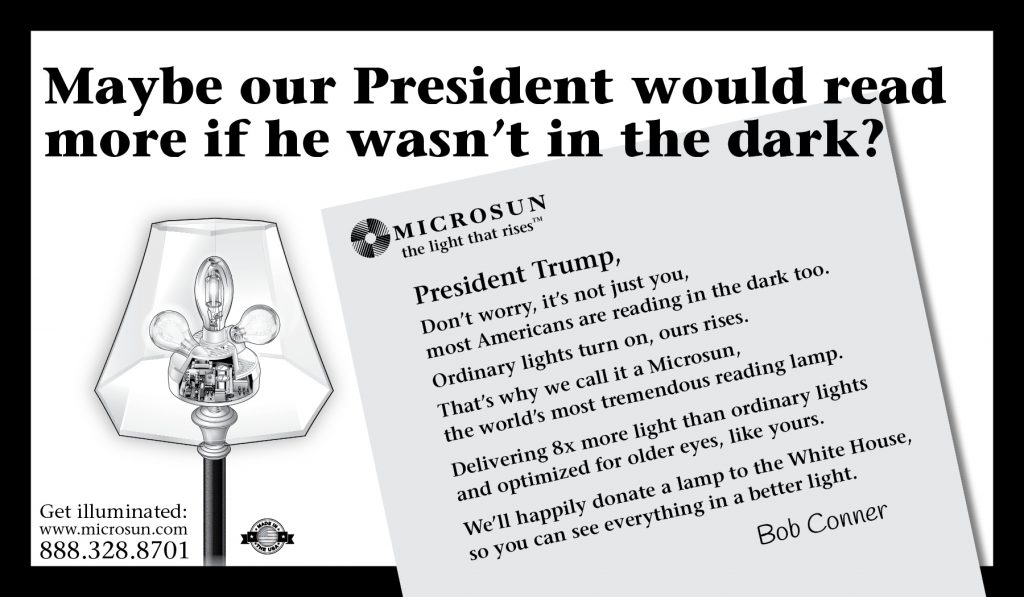
At the beginning of 2016 we had a client who made a light that was optimized for old people who loved to read- and we had a new president who was elderly and proud of his not-reading. We quickly put together an ad for the Washington Post- that the president supposedly did read.
To the brave, can go the spoils. Unless you pick it apart
By the time, 4 months later, the client was done picking it apart and re-writing it, Trump had started to perfect his “Squirrel!” strategy of distracting people daily. The days to contemplate the idea of actually reading his daily brief was long gone- and the client stripped out the address line. And, then, it only ran once, as a remaining space ad. C’est la vie. BTW- the “Get illuminated” line was contributed by the one and only Alex Bogusky. Yes, I ran it past the Creative Director of the Decade for suggestions and he liked it.
A Public health anti-covid campaign that doesn’t suck
Star power, a big idea, digital activation and talk value
Just before the second spike of Covid in the fall of 2020- we responded to a public health RFP to reach out to minority communities to get them to be smart about Covid- to warn them of the dangers of not wearing a mask, not washing your hands, not gathering. It had a fixed budget. The RFP was written by people who had no idea of how to write a brief or an RFP (see this post). They asked for the moon- on a shoestring budget. As part of our activism, we’d uncovered them as crooks 6 months before- handing out a no-bid contract for even more money to the agency that would do a county officials political campaign. Needless to say- we knew we wouldn’t get the contract- but, with good ideas and good connections- we decided to pitch them the moon. We came in dead last on the score sheet. Why? Maybe because we’d embarrassed them- or maybe because they have no idea or tolerance for a great idea. Here it is:
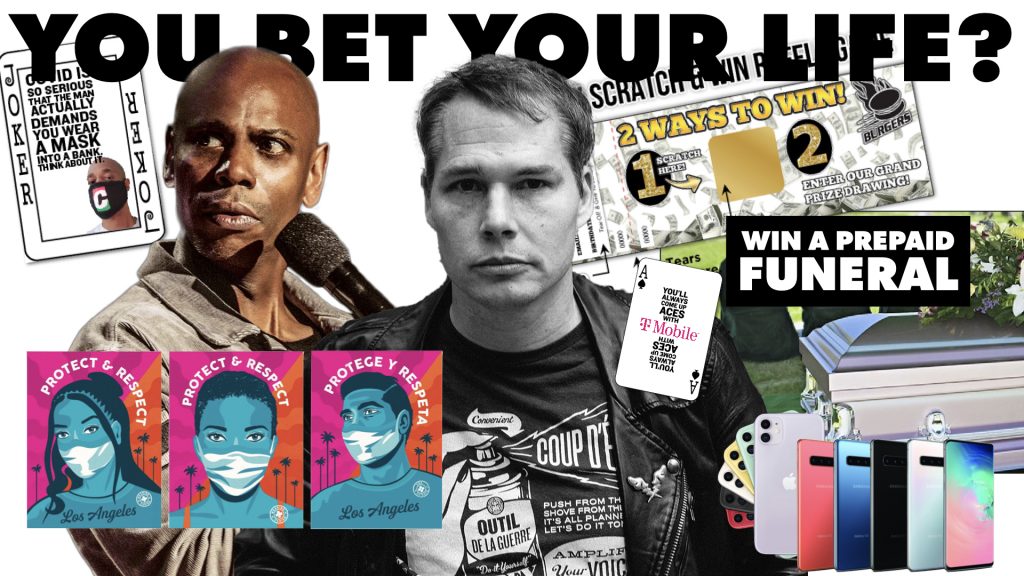
Strapline: Don’t bet your life.
Idea: Groucho Marx used to host TV show- You Bet Your Life. We will have Dave Chappelle talking to people about betting their life on Covid- in a very Dave way.
Action: We’ll have scratch off lottery like tickets to win in a sweepstakes. The scratch offs will be distributed in gas stations, corner stores, minority businesses, churches. They will be supported by a poster by Shepard Fairey and Studio No 1.If you don’t think you know Shepards work- you missed the whole Obama Hope and Change poster thing.
First round prizes- 1 in 4 chance is to win a deck of washable playing cards. 56 chances to share messaging- and lots of room for sponsorship. You can play solitaire with yourself- and take no chances- or you can play cards with friends and engage in risky behavior.
By filling out an online form- and allowing us to continue to message you via text or email- you can register to win a top of the line phone and service for a year- from T-Mobile who was signed on to sponsor. 10 prizes available
To get pastors into the act- they were to do short video sermons against gambling- either *wink* lotteries and scratch off- or with the virus. The top ten in shares and views would be randomly eligible to win a complete video streaming system.
And- the grand prize- sponsored by a local funeral home- for if you gamble and lose, a complete pre-paid funeral. Because if you bet your life with Covid- you stand the chance of needing one.
The last part- well, it made the “evaluators” nervous. Talk about death, oh, no. As if it’s not something everyone will face?
We pitched it to the State as well. The former newspaper reporter who runs public health communications, and knows nothing about advertising said “At first glance, I don’t think it strikes the right tone that we are trying to convey.”
And there you have the death of a big idea that would have made a difference.
A US Army recruiting campaign- for your mom and dad
Here’s one more. The US Army is a huge marketeer, it’s hard to get people to sign up to risk dying for their country. The account, worth $4B over 10 years recently went to DDB. They had some brilliant insight in their pitch to the Army and their new tagline, “Tomorrow takes an Army” was a huge departure from the gung-ho video gamer campaign the Army was running- “Warriors Wanted.” As a former soldier and disabled veteran, I understand the dilemma of teens on deciding to join the service- and their expectations, better than most people in advertising (very few minorities and very few veterans in the field). Unable to get in at the last agency or current one- we went to Ft. Knox in November of 2019 to pitch our idea based on a key piece of insight: a higher percentage of recruits come from families that have veterans in them.
We pitched a reality TV show called “Back to Basic” where old veterans went back through basic training to finally dispel the eternal myth of “It was harder back in the day” and compare the experiences- and the wisdom gained by serving. We had hoped to get parents with their kids at the same time. We had the perfect host- a celebrity MMA star who had served- and we knew it would do blockbuster ratings.
The Army rejected us- saying “We’ve done reality TV” and it didn’t work. Hate to tell you, Mark Burnett has done a lot of reality tv- and some has worked out just fine, others have bombed, but that doesn’t stop him from continuing to try.
Well, last month we found the vindication for our pitch. AARP posted a video about a 59 year old veteran who had to go back through basic training so he could serve with his kid. In less than a month it had 750K views, it’s at 847,411 in 50 days. That far exceeds the views, shares and discussion of anything the Army is producing right now.
If an idea doesn’t make you uncomfortable, it’s probably not big enough.
And, the size of your agency, the size of your budget, has nothing to do with the size of your agencies ideas.
Karl Lieberman and his creative partner, Brandon Henderson, had been working on the brief for Dos Equis beer for months and had work in production, when they were told to come up with more ideas, a mere two hours before a meeting with the client.
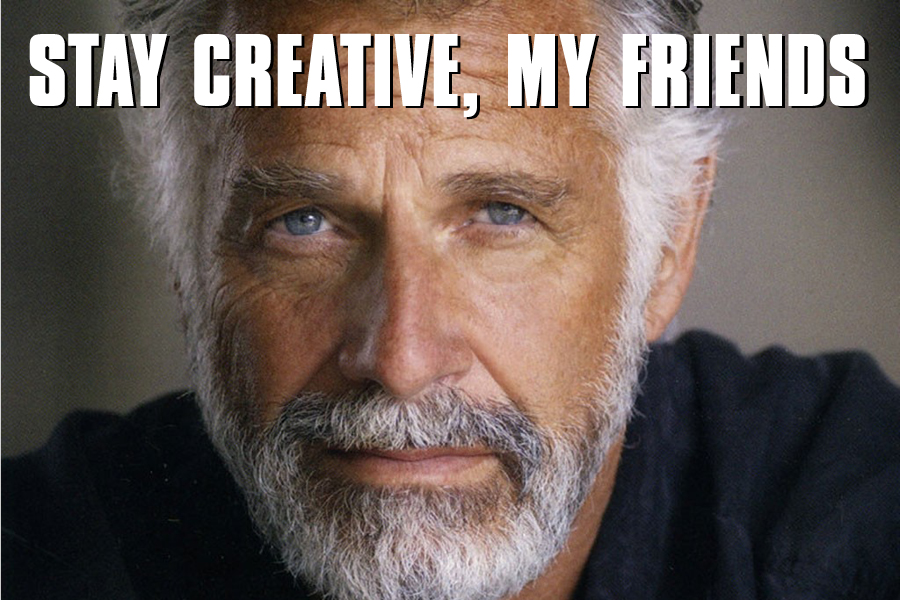
With 30 minutes to go, they landed on “The Most Interesting Man in the World” and his famous line, “I don’t always drink beer. But when I do, I prefer Dos Equis.” The spots close with the signature sign-off: “Stay thirsty, my friends.” They were actually taking the brief, which they didn’t like, to an extreme- they didn’t believe that drinking beer made you interesting, but, that’s what the brief was searching for.
It also sold a lot of beer, and made the actor, Jonathan Goldsmith, famous.
Luckily, Lieberman and Henderson weren’t just working on a project for time and materials pricing. The value of that idea and the amount of beer it sold, priceless (to steal another tagline from another great campaign.)
The creative brief was pretty similar to all beer briefs- brands make a statement about the drinker, young folks still lean on these brand identifiers to help project their own personal brand. The same type of brief led Crispin Porter + Bogusky to devise “Twin Label Technology” for Molson- an ad campaign that was more than just a campaign, for Molson and one of our favorite examples of true Marketing • Innovation. This is the beauty of creativity in solving business problems. Do research, develop insight, and then find new ways to connect, often using what we call a “fundamental truth,” to create an emotional response that evokes trust and creates lust.
It was years before Nike had “Just do it.” Yet to many, it defines the brand. Three words took years to come up with. Those three words changed the brand forever.
For BMW, many would say “The Ultimate Driving Machine” was the perfect tagline- yet, for a few years, brand management moved away from it- before bringing it back.
When advertising is done right, it looks easy, it feels comfortable, and it immediately makes a connection with a consumer. That’s the value of creativity, and it should never be valued by time and materials.