We at The Next Wave consider ourselves students of the craft of advertising. We continuously seek out and study the best thinking in the business and then, share it.
Two of the greats in advertising recently were interviewed in podcasts; Alex Bogusky and Lee Clow. Lee gets his own show- which is a bunch of shorts. Alex gets a longer interview than most in the series of one hour interviews that you may find informative and enjoyable. We’ve included links to Apple iTunes for these free podcasts, but they are widely available on other platforms.
The first podcast is called Talking to Ourselves which is produced by Omid Farhang who is now Chief Creative Officer at Momentum. It’s a bi-monthly podcast that he calls his “selfish excuse to get the marketing industry’s most admired leaders to share advice, reveal process and routines, maybe tell a few stories, hopefully uplift a few cynics, and divulge secrets to a fulfilling career.” It’s produced in partnership with The One Club, and JSM Music.
Really, you could call this Omid goes to career coaching class, but he is a pretty good interviewer, especially after he gets a few of these interviews under his belt. Before you listen to it though, I’d recommend learning Omid’s story, by listening to him being interviewed by Tom Christmann of “The A List” podcast.
While there are a bunch of episodes, the one that got us started was the 75 minute interview of Alex Bogusky. The best gem was that he tried leaving his own firm a few times when he grew exasperated with Chuck Porter. Things were lining up for him with Wieden + Kennedy to run the Amsterdam office until supposedly Dan Wieden saw his book and put the kibosh on it. Bogusky also is a recurring theme through many of the interviews- because Omid keeps sharing the story of when Bogusky asks him if he had seen the Dudley Moore movie “Crazy People” where Moore is an ad exec in a psych ward who gets the patients to work up ad campaigns that are brutally honest. His takeaway- working in advertising should be a lot like that movie.
He’s just wrapped up season 1- and the list of advertising superstars is impressive including David Lubars, Gerry Graf, David Droga, Rob Reilly, Andrew Keller- note, the list is heavy on Crispin Porter + Bogusky alumni.
One of his favorite things to say is how creative work ages in dog years- what was fresh 5 years ago- often feels ancient, especially after everyone has copied the big idea. Almost every episode he ends with the same two questions:
What was the most horrific response you’ve ever had from a client at a presentation?
“What was the one big idea that you loved- that never got made.”
The answers are varied and insightful.
Almost every guest has worked at one of these five hot shops:Fallon, Wieden + Kennedy, Chiat\Day, Crispin Porter + Bogusky, Goodby Silverstein at one point in their career.
Andrew Keller talks about his being in a band as the thing that most prepared him for being in advertising. Working together in a small group and putting things together so that they are interesting.
John Norman, partner and Chief Creative Officer at Translation (They parted ways after this podcast was recorded and before we posted).makes a unique distinction between design and advertising: Design is to make something worth keeping, beautiful, useful - and advertising is what slos it down on the way to the trash can. Not an exact quote- but- it stuck- so it must at least be advertising…
David Lubars tells the story of how his father worked in advertising and he caught the advertising bug when his father solved the business problem Listerine was facing once Scope came out, with the line “The taste you hate twice a day” which he called a smart way to say that what made the stuff taste bad is what made it work well. That’s what great advertising does.
John Mescall, global ECD at McCann Worldgroup tells the story of the birth of one of the most awarded campaigns ever: Dumb Ways to Die. Considering it was a PSA client that nobody every heard of, the way they arrived at the strategy, the execution, is an amazing story. Mescall also shows his respect for the work of CP+B talking about how it changed the game, and it wasn’t necessarily with perfect craft- but driven by a great idea.
The discussion with Gerry Graf of Barton F. Graf, turns to awards shows and CMO’s and if any of the work that wins actually sells stuff. Makes Graf a hero in our book. Graf also gets a lot of mentions in “The A List” podcast- because he was a teacher at AdHouse NYC and- he also worked with a bunch of the people who make it onto these shows. Put him at the top of my list of folks I want to sit down with at some point.
Jaime Robinson, co-founder of Joan, may win an award for the foulest mouth, yet, since her agency is the newest, you get a sense of wonderment at some of the questions about time allocation and following your gut, even as far as to go with something that comes up right during a client meeting. They are so new, they don’t even have a site up as of this writing.
Rob Reilly talks about how a term “delusional positivity” as a phrase from his Crispin Porter + Bogusky days has made it over to McCann. He believes that they can do anything- which is how incredible work gets done.
Susan Credle, CCO of FCB talks about work life balance. Her answer was to quote something she’d written- and was one of the best I’ve heard for people who might be defined as workaholics: “I’m writing for you, Huffington Post, on a Sunday afternoon. The sun is shining and I want to take a walk in Riverside Park. But as I sit typing and reflecting on these questions, I realize that my work is my life. When I separate them, I resent the work. When I adjust my thinking and realize that this work fulfills me, being asked to answer questions about work on a day off isn’t a frustration but a privilege.”
The Chief Creative Officer of Anomaly, Mike Byrne is almost too self-deprecating. He seems to put a lot more effort into relationships- within the agency, than outside of it. His discussion of his daily journaling and having lunch with someone somewhere other than the office as highpoints of his day are poignant, as are his gritty truth-telling about the fact that his daughter is shooting video and editing it right on her iPhone- and timelines have compressed. He says he’s not as talented as others- but willing to work twice as hard. Anomaly is a different kind of super agency- probably because his DNA is a bit different than other folks.
Susan Hoffman at W+K started out horribly, making a really bad joke about her parents profession and sounding very uncomfortable, but quickly redeemed herself with stories about how the Beatles/Revolution spot got made and the bullets they sweated when the agency was sued for it. The key insight she shared was that hiring people with “a voice” got them honesty, reality and truth. Which is critical to advertising. The Nike campaign for women (If you let me play(- was Charlotte Moore, Janet Champ and Stacy Wall- talking, not just ad people trying to sell you something. It’s not just the mantra “Fail Harder” that makes W+K great- it’s that the people have passion for their craft.
Jeff Kling shares his insight on W+K: “Dan and David believed and still believe in the power of the individual voice to do something special. It’s because they have a real philosophy and approach that believes in that. They’re essentially renting individual voices, visual and verbal voices, they’re renting those voices to brands, and in the process letting people do wildly special, unique and individual things, and making the brands on whose behalf of those people who express themselves, very human, very relatable. That’s why Wieden creates brands.”
One of the most interesting interviews for young creatives looking for career advice comes from Justin Gignac, the co-founder of Working Not Working. In a gig economy, building a body of work requires some investment in real, long-term relationships, and the long term growth potential in a real job vs a gig job is exponential.
The second podcast we’ve been enjoying is “Lee Clow will only say this once” which comes with the following description: “Listen up. Lee Clow is only going to say this once. For the 50th anniversary of storied advertising agency TBWA\Chiat\Day, legendary advertising savant Lee Clow answers 50 questions from colleagues, industry leaders and industry newcomers. Talking with Clio editor-in-chief Tim Nudd, Lee shares his wealth of knowledge and experience, discussing topics both personal and professional. From from his early years at Chiat\Day, to the agency’s celebrated partnership with Apple, his personal creative process, the industry’s future, and even his favorite Twitter account, there’s no shortage of wise words from an even wiser man.”
One Clow gem is what he thinks makes someone good at advertising: arrogance and insecurity. Arrogance in that you believe you can change the world and insecurity that you may be fooling yourself. He also talks about having to lead clients through the idiot forest- ain’t that the truth. That phrase is also talked about in several episodes of “Talking to ourselves.”
We’re always looking for resources to expand our knowledge of advertising. It’s part of the reason we’ve always had our Booklist on this site. If you have some recommendations for podcasts, video channels or other resources, we’re all ears. Leave your suggestions in comments.
(a few months later) Another podcast we’ve since started listening to is “The A-List” (link to iTunes) which comes from our friends at DiMassimo Goldstein. It’s their Executive Creative Officer, Tom Christmann. It’s much more raw, unedited and sometimes the sound quality is so bad it’s painful. If I had a dollar for every stutter, uh, ah, or time he said “the kids” I’d be buying the Washington Post and divorcing my wife.
It’s supposed to target young creatives, to introduce them to the old guard, and sponsored by Ad House NYC. Yet, making jokes about how kids won’t understand what paste up is, or pre-internet advertising isn’t really helpful or interesting. Neither is Tom’s habit of talking over his subject, interrupting frequently and name dropping- Dan in Portland, Rich in San Francisco, Lee in LA, uh, yeah, I know who these people are- but don’t assume your target market of young listeners do. (update- many episodes in) Christmann gets much better as he gains experience and slows down.
That said, he also feels it’s very important to talk about where he worked with the person in the past and sometimes wanders off into what could be considered office gossip. A good editor could cut these in half- and still have a lot of good content- except because of his “interview style” of talking over people- it’d be edit hell. He has some of the some people “Talking to Ourselves” has- and between the two, I’d always prefer Omid’s interviews so far, but because he’s so unstructured sometimes he gets lucky and gets a few extra tidbits. He’s also more likely to interview people Omid wouldn’t- so you get to hear from some journeymen instead of just the stars. Calling it “The A-List” may not be truth in adverting, but, if you are looking to expand your horizons or learn more about how folks rose to prominence- this works. Hopefully, Tom will read this, write a brief for his podcast so he stays on point, and works on both audio quality and his interview style and this podcast improves to actually warrant its lofty title. (again- it does improve over time. I think later episodes are really good).
Update: Aug 20, 2021- The A List featured our founder, David Esrati on an episode. Tom’s learned a lot about Podcasting- he no longer interrupts or talks over his subjects- and he’s now the dean of AdHouseNYC - and working freelance. Take a listen.
If nothing else, think of these as a kind of time capsule of the industry- interviews of people who made a difference in Advertising- at the start of the internet era. Much like StoryCorps- but for advertising.
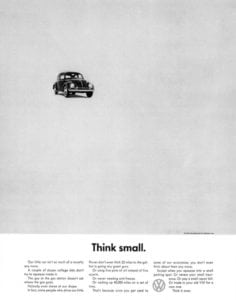
Very few agencies get to launch an automotive brand. Cars are special. They’re expensive, they are an outward representation of their owners personal positioning (at least in America), and automotive brands have a special place in advertising folklore. It was VW with DDB that launched “the creative revolution” with the iconic “Think Small” ad.
Notable brand launches have mostly been new luxury nameplates from Japanese companies, Honda with Acura, Inifiniti with Nissan (which had to make the change from Datsun to Nissan before this) and Toyota with Lexus. Others were GM’s creation of the short lived Saturn, Toyota with the even shorter launch of Scion, and then Tesla.
Crispin Porter + Bogusky was asked around the turn of the 21st century to relaunch the Mini Cooper in the USA- now that it was owned by BMW. They thought they had a monumental task with a relatively small budget.
In early 2001 American roads were dominated by SUV’s – the fastest growing segment – and light trucks was the most popular segment in the category. Japanese and German brands dominated the import segment and gas was $1.25. Bigger was better. Small car sales were at their lowest point in 15 years. MINI’s heritage was British, which was synonymous with unreliability in the car category.
The deck was stacked, and to top it all off, there were only 2 cars in the line, the Cooper and the Cooper S. The first step was to identify what makes a brand a brand:
We did an exhaustive study of iconic brands across a variety of categories and discovered six characteristics common to iconic brands. 1. A defining signature look 2. An ability to elicit a physical or emotional reaction 3. A tendency to take on characteristics outside their category 4. A tendency to own a unique benefit within a category or create a new category altogether 5. An ability to connect with and reflect the attitudes and values of a broad user base 6. A tendency to break conventions and reinvent to stay salient
ibid
From there- sort of work backwards to find the mojo. With Mini there were several clues.
The car doesn’t look like any others- it’s funky. It also is a blast to drive. They worked that into the brief:
Showcase the defining look of the new MINI – its size and contrasting roof.
Create as many opportunities as possible for people to come in contact with the new MINI so they could experience its smile generating magic.
Subtly anthropomorphize the new MINI.
Communicate our unique benefit – life-affirming exhilaration at an attainable price.
Emphasize customization and individual self-expression.
Use non-traditional media and traditional media in very non-traditional ways.
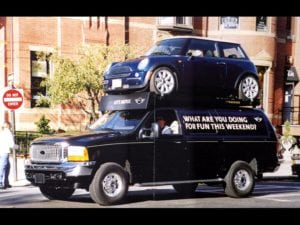
“What are you doing for fun this weekend?”
ibid
CP+B took this insight and did some testing. They created an “exhilaration scale” to clarify the price to WOW factor. And, then, they started looking for the definition of that experience.
At first they called it “going”- as opposed to driving, which was the operative industry word. Then, someone stumbled onto “Motoring” - it was driving- with a British twist- and “Let’s motor” was born. That, along with the badge, and distinctive non-traditional media, lead to a launch that out-lived some other small car brands (Scion) despite the car not excelling in the reliability or cost of ownership like the other newer brand launches.
Once they had a tagline, there were ads, and then there were stunts. Lots of stunts.
The ads were out of the box. Literally. Like putting a Mini Cooper on top of an SUV and driving it around a city.
“hello”
The key takeaway from this post are things we at The Next Wave preach in our tagline, Create Lust • Evoke Trust. To do that, we look at those six characteristics everyday. We search for universal truths that build easy inroads to consumers psyches, and then find a way to elicit emotion that sets your brand apart from your competition. It’s what Steve Jobs did at Apple with ease of use, putting the customer first- and creating “Bicycles for our minds” - something simple- and easy- and loved, to move people from thinking of computers as distant machines that spoke an arcane language, to “hello.”
There are other iconic brands that found a powerful voice through better positioning. We’ll list just a few.
“Just do it” from Nike
“The Ultimate Driving Machine” from BMW- which they walked away from, and have recently started edging back.
What would make your list.
If you’d like to discuss crafting your iconic brand, we’re here to help you find your insight and give you the tools to own your position in your industry.
Imagine your company gets swallowed up by a larger competitor. I know, that will never happen to you, but, when was the last time you went to a locally owned bank, a hospital that wasn’t part of a network, or checked into a hotel that wasn’t part of a conglomerate?
The New York Times wrote about Virgin Airlines customers lamenting the loss of the Virgin brand personality when Alaska Airlines finishes the takeover- the comments, the insight into what made Virgin flights different, coming from customers are a lesson for brand marketers:
“I like Alaska, I don’t love Alaska. But I love Virgin,” she said. “I think of it as a young, hip airline. Alaska is more of a friendly aunt.”
Travelers like Ms. Bansal are wondering what to expect from Virgin America under its new parent company: skinny jeans and stilettos, or sweatshirts and sneakers. After all, Alaska started in 1932 with a single three-seat plane owned by an Anchorage furrier, while Virgin America was founded by a flashy British billionaire less than a decade ago with a goal of restoring glamour to flying…
Although Alaska has been a perennial leader in best-airline rankings, its allure comes more from its reliability than mood lighting or funny safety videos. Like Virgin America, it inspires loyalty among customers, if not the same passion….
Alaska and Virgin have been ranked first and second in operational performance in a top industry list for two straight years, and Virgin America is a mainstay atop Travel & Leisure and Condé Nast Traveler’s readers’ choice rankings of the top domestic airlines…
If you have any question about why Virgin will be missed. Think back to the last time the safety video came on while you are crammed into coach. Did you want to watch it again? When Virgin did their inflight safety video, it had 5.8 million views on YouTube (in a dozen days) - by people, not strapped into their seats.
What’s interesting is that both Virgin and Alaska have worked with some superstar ad shops. Virgin with Crispin Porter + Bogusky and Alaska with WongDoody.
Note the origin stories for both airlines in the NYT piece- Richard Branson, the “flashy British billionaire” started an airline to “restore glamour to flying” as opposed to getting people from point a to point b. Maybe this is why Virgin is becoming another casualty of consolidation, but it shouldn’t be a deterrent to doing things differently than your competition.
For a while, it seemed like Apple wasn’t going to make it, but, now, even though it doesn’t have anywhere near a majority of the computers running their operating systems, they are doing quite well as the worlds most valuable company- in the mobile operating system space. They also were known to use a superstar ad shop- and the campaign that’s credited with turning them around- was “Think Different.”
Virgin thought different about air travel, and unfortunately isn’t going to stay with us- but, don’t let that dishearten you, is it better to go down with a crowd of fervent followers, or quietly and not really be missed? You decide.
Hopefully Alaska Airlines will try to assimilate the Virgin culture and attitude, so that when they get gobbled up, we end up with at least one airline you can love for more than cheap, easy or their frequent flyer program.
If you are spending money on advertising, and you don’t think you are getting your money’s worth, maybe it’s because your advertising is too conventional. Maybe, you think that your ads, should be like your competitors ads, only better.
Then you see what a young criminal defense lawyer did with his advertising and you start to understand that being like your competition just means you’re a commodity.
Daniel Buckley Muessig is a defense attorney from Pittsburgh, PA and yet he’s so much more. He recently uploaded an ad for his business, you know, like most lawyers might. But in less than 24 hours, the ad has gone super viral.
Why? Because if you’ve committed a murder or an arson or “even funny throwback crimes such as moonshining” and you live in Pennsylvania, he wants to be your lawyer.
“I may have a law degree,” he says, “but I think like a criminal.”The otherwise plainspoken 32-year-old Pittsburgh native and graduate of The University of Pittsburgh School of Law was formerly a battle rapper by the name of Dos-Noun. As Dos-Noun, he performed with the likes of indie rap heavyweights such as Slug, Atmosphere, before making the successful jump to a career as a criminal attorney a few years ago.
After uploading the video at 11pm Wednesday night, he’s been seeing his phone ring off the hook ever since.
The folks at Crispin Porter + Bogusky used to evaluate if an ad was just an ad- or something special- “how would this work as a press release?” If it isn’t press worthy- it’s almost not worth doing. CP+B launched a body spray for Burger King- called “Flame”. Do you really want to smell like a Whopper? Nope. But, every news outlet wrote about it.
Here is the raw footage of Mr. Muessig being interviewed by the local news- about his “unconventional” ad- which is also 7 times longer than the normal lawyer TV ad:
This was cut down to a 2.75 minute news segment.
Remember, Muessig didn’t spend a dime on media, he paid some professionals to create the ad- and posted it on Youtube.
We always remind clients, we can create interest, but it’s still up to the client to close the deal and follow up. The old adage that nothing kills a crappy product faster than great advertising still holds true.
If Mr. Muessig’s phone really did ring off the hook, he may never need to do another ad, since this ad will always be relevant. No sale, no call before midnight tonight (in fact, he’s ok with you calling him after midnight). People who don’t think it’s professional (other lawyers) or that he doesn’t looks “lawyerly enough” aren’t his target audience. He says he thinks like a criminal in the ad, and since thinking like your clients is one of the fundamental keys to good advertising he’s nailing his advertising since his customers are criminals.
Learn from the X-rapper lawyer. Don’t do ads that aren’t worthy of press coverage or watching twice.
Update- Mar 8 2022- apparently, not only did Daniel Muessig think like a criminal- turned out he was one.
A former defense attorney who became known for his satirical ads offering his ability to “think like a criminal” will spend five years in prison for his role in a large-scale marijuana ring.
Daniel Muessig, 40, of Squirrel Hill, was sentenced Tuesday by Senior U.S. District Judge Arthur J. Schwab to the mandatory prison sentence allowed.
He pleaded guilty in November to conspiracy to distribute marijuana and possession with intent to distribute marijuana.
As I sit at home, writing this post (too many interruptions at the office) I realize that when clients are choosing an ad agency, many have no clue on what they are really choosing. In most cases, the overworked and under-recognized copywriters aren’t given a whole lot of thought. One of the first questions for the creative director/CEO/President/Chief Creative officer is to find out where they started in the agency business? The answers should tell you a lot about the agency- if it’s a former copywriter or art director the agency focus will probably be on great creative, if it’s an account planner- strategy may be their lead strength, if it’s a finance person- run, and if it’s a account executive/bag man/sales professional- I’m sure the presentation will be charming.
When it comes to the giants of advertising- and the guy you would want running your ad agency, David Ogilvy belongs on the top of the list. Even though the book is dated, I required all employees to read “Ogilvy on Advertising” for the first 20 years of The Next Wave. I still recommend it- but instead want them to read the excellent “Hey Whipple, Squeze this” by my friend Luke Sullivan first. Ogilvy was a brilliant writer and a consummate ad guy. He understood that you had to eat, sleep and breathe your product in order to do it justice. One of the requirements for working at Crispin Porter + Bogusky according to their employee handbook is that you are an ad person. Ad people are tuned into everything about the business- what accounts are where- and who is doing great work. If you aren’t an ad person you have a job- if you are one- you have a career.
When I stumbled upon this letter from David Ogilvy I knew things hadn’t changed much in the world of advertising. Great ads comes from people who immerse themselves in the work. It may be your most important indicator of what kind of agency you are about to hire:
On March 22nd you wrote to me asking for some notes on my work habits as a copywriter. They are appalling, as you are about to see:
I have never written an advertisement in the office. Too many interruptions. I do all my writing at home.
I spend a long time studying the precedents. I look at every advertisement which has appeared for competing products during the past 20 years.
I am helpless without research material—and the more “motivational” the better.
I write out a definition of the problem and a statement of the purpose which I wish the campaign to achieve. Then I go no further until the statement and its principles have been accepted by the client.
Before actually writing the copy, I write down ever conceivable fact and selling idea. Then I get them organized and relate them to research and the copy platform.
Then I write the headline. As a matter of fact I try to write 20 alternative headlines for every advertisement. And I never select the final headline without asking the opinion of other people in the agency. In some cases I seek the help of the research department and get them to do a split-run on a battery of headlines.
At this point I can no longer postpone the actual copy. So I go home and sit down at my desk. I find myself entirely without ideas. I get bad-tempered. If my wife comes into the room I growl at her. This has gotten worse since I gave up smoking.
I am terrified of producing a lousy advertisement. This causes me to throw away the first 20 attempts.
If all else fails, I drink half a bottle of rum and play a Handel oratorio on the gramophone. This generally produces an uncontrollable gush of copy.
The next morning I get up early and edit the gush.
Then I take the train to New York and my secretary types a draft. I cannot type, which is very inconvenient.
I am a lousy copywriter, but I am a good editor. So I go to work editing my own draft. After four or five editings, it looks good enough to show to the client. If the client changes the copy, I get angry—because I took a lot of trouble writing it, and what I wrote I wrote on purpose.
Altogether it is a slow and laborious business. I understand that some copywriters have much greater facility.
The humility of Ogilvy’s letter is quaint. I’ve met other great copywriters and they’ve run the gamut in personality traits, but generally everyone of them is fascinating and perfectly capable of doing many different things. However, I’d beware of those who are really frustrated authors- because if you are writing ads to pay the freight while working on the “great American novel” you probably aren’t really an ad person.
The other key is to write daily. The day you run out of ideas is the day you die if you are a real copywriter. Blogs make it much easier than it was in David Ogilvy’s day to test your writing chops and get feedback. Real copywriters can’t stop writing- which may explain why I’m sitting at home, writing this post on a Saturday afternoon.
 The first podcast is called Talking to Ourselves which is produced by Omid Farhang who is now Chief Creative Officer at Momentum. It’s a bi-monthly podcast that he calls his “selfish excuse to get the marketing industry’s most admired leaders to share advice, reveal process and routines, maybe tell a few stories, hopefully uplift a few cynics, and divulge secrets to a fulfilling career.” It’s produced in partnership with The One Club, and JSM Music.
 The second podcast we’ve been enjoying is “Lee Clow will only say this once” which comes with the following description: “Listen up. Lee Clow is only going to say this once. For the 50th anniversary of storied advertising agency TBWA\Chiat\Day, legendary advertising savant Lee Clow answers 50 questions from colleagues, industry leaders and industry newcomers. Talking with Clio editor-in-chief Tim Nudd, Lee shares his wealth of knowledge and experience, discussing topics both personal and professional. From from his early years at Chiat\Day, to the agency’s celebrated partnership with Apple, his personal creative process, the industry’s future, and even his favorite Twitter account, there’s no shortage of wise words from an even wiser man.”
 (a few months later) Another podcast we’ve since started listening to is “The A-List” (link to iTunes) which comes from our friends at DiMassimo Goldstein. It’s their Executive Creative Officer, Tom Christmann. It’s much more raw, unedited and sometimes the sound quality is so bad it’s painful. If I had a dollar for every stutter, uh, ah, or time he said “the kids” I’d be buying the Washington Post and divorcing my wife.