When the “Get a Mac” campaign broke - we wrote about it, comparing it to the Burger King Manthem spot from Crispin Porter + Bogusky. We said one was a campaign, the other- a one shot wonder. One had brilliant strategy, the other a big budget. And for all the things we said, it turned true: TBWA Chiat Day is still churning out more of the simple spots- and Burger King is on execution 243.
Effie Awards : Effie Awards Press Release
June 8, 2007 (New York, NY) – Apple Inc.’s “Get a Mac” campaign, created by Media Arts Lab\TBWA was awarded the Grand Effie at the 39th Annual Effie Awards gala last night at the Metropolitan Pavilion in New York. The Effie Awards honor the most significant achievement in the business of marketing communications: ideas that work. Results from the “Get a Mac” campaign included market share growth of 42%, record sales and cultural influence.
“After much spirited discussion, the jury unanimously awarded Apple the Grand Effie for its portrayal of the Mac/PC rivalry. They managed to do it with humor, class, and honesty without falling into the trap of overtly negative competitive advertising,” said John Butler, Co-Creative Director of Butler Shine Stern & Partners and the 2007 Grand Effie Jury Chair.
There was a quote I heard at the 2007 AAF National Convention that summed the contrast of these two ideas up quite nicely:
“practice safe advertising: never do it without a concept”
Take note- a great concept wins an effie- and a stock price that’s climbed 50+ points- the other, continues to require extraordinary efforts to keep the brand fresh.
First things first: Louisville’s ad federation has the right attitude- seems to be connected to the community, realizes the value of bringing people in from all over the country- and showing them Louisville’s best.
The hotel, didn’t look like much on the outside as I pulled up on the motorcycle after a really hot ride from Dayton- but inside- the place is grand. Really amazing main ballroom- and a lobby that makes you think back to the grand hotels of the 30’s and 40’s. It’s 2 years old- and a Marriott- only complaint I’ve heard is no wireless in the rooms (you have to use a cable and pay for access- although access is free downstairs if you type in “Public Wireless” and then give your name). Even heard the chef came out and made a custom vegetarian meal for one of the attendees- that’s customer service.
The goodie bag from AAF was OK- the one from Louisville AAF- rocked- a box of girl scout cookies, Makers Mark Burbon Chocalates (I had one and got a buzz) a t-shirt, and their club magazine “Communique” which is awesome. I happened to sit with their board at lunch- and the people were friendly and firmly believe that Louisville has a shot at becoming the next Minneapolis or Miami. It’s that kind of winners attitude that needs to come to Dayton.
Got to see three student NSAC (National Student Advertising Competition) presentations for Coke. One was great- from SCAD (the Savannah College of Art and Design)- the other two were weak. Going back to my judging of Postal Vault in the districts last year- same issues in presentation: the client doesn’t need to know who you are, what your name is- let the work, the ideas, the analysis be the star. Even if you are David Oglivy, Howard Luck Gossage and Bill Bernbach, the people who will see your ad won’t know, they’ll just like it- or hate it. With the average CMO life expectancy dropping by the day (the Macy’s CMO just left after 13 months) the only people who care about the names of people working on the account are the ones trying to use the old “no one ever got fired for buying IBM” (or any other leading brand). Face it- if your ads are working the checks keep coming- it’s only when there is a hickup do people start thinking “Oh, we need Agency XYZ working on the account.” So, students- all your school branding, titles, etc- are moot- just start out with- “I’m Jason, and here is the account planning data to justify our strategy” and move into the meat.
I’m also hating the memorized speeches that, if one person loses their lines- the others all pipe in - face it, if you want to deliver lines- don’t be in advertising, go into theater (or hire actors to deliver your pitches)- now, more than ever advertising is about having a conversation with the customer- you wouldn’t do that from a script, would you? Feel confident in your ability to deliver- ad lib- it has more authenticity and that closes deals- not a push paly and off you go type presentation.
In a forum session “Digital Innovations & Social Networking” they had to expand the room to get all the people in. Great, but, the speakers were in chairs- where anyone sitting in the back couldn’t see them, some staging would have been great. Well moderated session by Murray Gaylord of the New York Times- and by all means, moderating panels is an art- and this was better than most. The scary part was that probably half the audience had no clue what “Second Life” is- which means a lot of clubs should be adding speakers on Web 2.0 to their speakers lists asap.
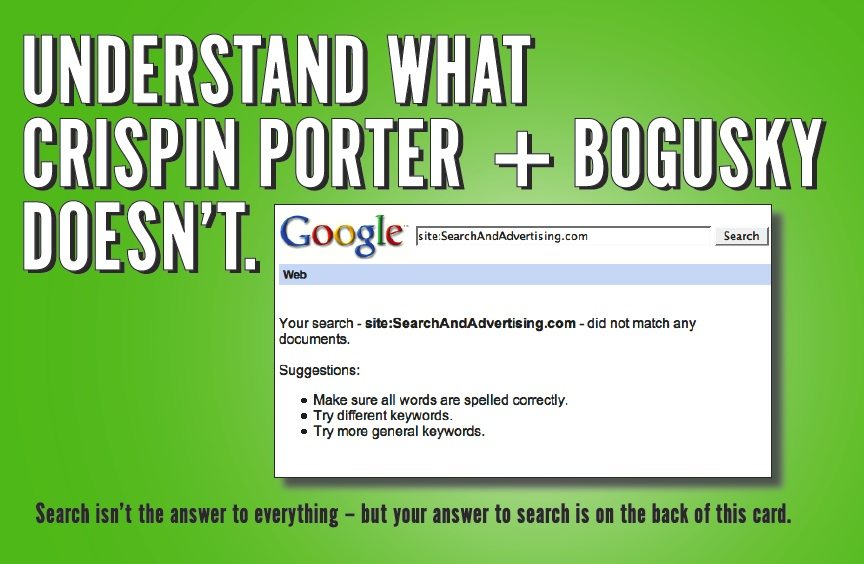
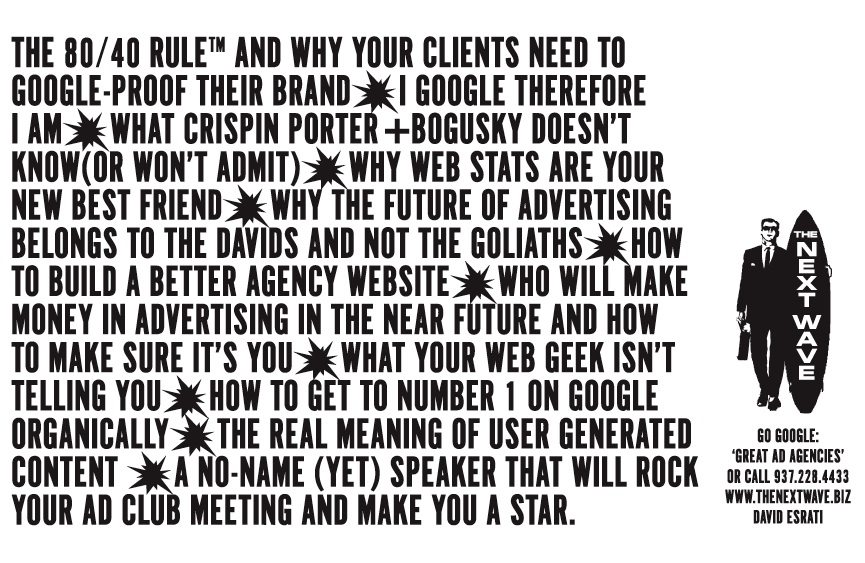
Which brings me to my last morsel of the day- I was dropping off my Understand What Crispin Porter + Bogusky doesn’t flyer (link is to a printable PDF) for club execs and schools to promote me as a speaker- and seminar presenter. Next thing you know- I’m being told to “Cease and desist” from my little guerrilla marketing effort. It’s unclear if it’s because I didn’t pay big bucks to be a sponsor, or because I said “Understand what Crispin Porter + Bogusky doesn’t” on the piece (apparently it’s ok to compare detergents in advertising- by name, but not ad agencies). This news was delivered by our club exec director who seems to feel that any kind of self promotion is evil- but, she gave me a card of an AAF executive that was the authority on this.
I’m almost surprised I wasn’t told to take off my Next Wave t-shirt. I’m tempted to wear my “I blogged your mom” t-shirt tomorrow- just to take the edge off these people. If you can’t have fun at a convention of ad people- what is this world coming to?
I’ll have more after Friday’s festivities. And, to any of you who are here- and have read this far- when was the last time you put some new content on your agency site?
And last but not least- If you are a student- and haven’t bought Steve Lance’s “The little blue book of advertising” yet- shame on you. It’s a classic- and well worth the $14 to have an autographed copy. Forget the mojitos- get some marketing mojo from someone who understands this new economy.
Volkswagen was a dying brand in the US. The culprit was poor quality. Customers had been fooled into buying a Jetta or Passat on the idea that they were getting “Precision German Engineering” at a bargain beerhaul price. When the cars didn’t deliver quality- they moved on to more reliable brands.
Enter Kerri Martin, the marketing exec that built BMW Mini’s success in the US with über hot agency, Crispin Porter +Bogusky.
All of a sudden, people are ignoring the fact that VW is still at the bottom of quality- at least their ads are interesting- showroom traffic picks up- and so do sales. But, alas, not enough for the big boss: Adrian Hallmark. He doesn’t understand the Crispin “Factory” approach to advertising- where’s the unifying tagline he asks- and fires Martin. All of a sudden, VW ads are once again boring.
Price and Product boring. Like a frickin laundry list- “Three V-dubs for under $17,000.”
And quickly- we’re back to talking about the wrong thing: price.
Once again, Mr. Hallmark is changing directions- now, hoping a feel good campaign with a tagline “When you get into a Volkswagen, it gets into you.”
Hmmm…. like under your skin, when you are taking it back to the dealer for the tenth time to get the same thing fixed (a former employee was constantly having problems with his Jetta).
Mr. Hallmark said the carmaker decided to “save our gunpowder” for national ads until the second part of the year.
VW spent just $19 million in measured U.S. media in the first two months of 2007 and $241 million in calendar 2006, according to TNS Media Intelligence. Volkswagen follows a winding ad road
February 2006: Introduces “Fast” doll online and in ads featuring lab-coated German “engineer” and the line “Unpimp mein auto.”
April 2006: Introduces jarring “Safety Happens” push, showing Jettas getting slammed into by other vehicles.
May 2006: “Low-ego emissions” for Passat shows drivers in other German cars shouting arrogantly into megaphones.
May 2006: TV spots feature a lederhosen-wearing spokesman next to a white Jetta, saying, “Stereotyping is stupid.”
June 2006: Rabbit spots show two cars — one white and one black — multiplying like bunnies.
October 2006: Free-guitar incentive for buyers of Jettas, Rabbits, GTIs and Beetles; TV spots feature Slash and John Mayer.
February-May 2007: “Three V-dubs for under $17,000” touts versions of Beetle, Jetta & Rabbit.
One thing is for sure: Crispin is being patient, but a $300 Million dollar client can do that to you. The only thing VW could do to guarantee an improvement in it’s marketing is take Hallmark out of the drivers seat and bring back Martin.
At least she has a track record of delivering sales.
note: we’ve written about almost every one of the above campaigns- except the Price and Product idiocy in past posts.
McCann trademarked this phrase in 1926, and it’s as important today as then: Truth Well Told ® and it should be a cornerstone of any ad, not just the great ones.
This TV spot from Element 79 Partners in Chicago, is actually one of a series called “Origins” and it will serve us well for an example of what makes great advertising.
https://youtube.com/watch?v=vpfzBMj8T58
Gatorade is a category leader, and may as well have invented the sports drink market. From a leadership position they understand they need to make a connection with their target market- but not beat their chests. This is a key ingredient that car companies would do well to learn. Nobody likes a braggart- and this applies to your advertising as well. They have taken the story of their products beginnings and turned it into a near mythological tale- if you have history, if you have a story, take it and use it.
Up until watching these spots, the connection between Gatorade and the Florida Gators wasn’t obvious to me, it was just a trade name that spurred a whole bunch of other ‘ades- with the exception of the original one- Kool Aid® which totally missed this market segment. (Right now, anything with the word “Gator” in it might hit a sore spot in our home state of Ohio- thanks to two national championship losses to Florida this year). Element 79 has managed to do several versions of this same story- and still keep them different. Unfortunately, I can’t find the other treatments to share with you.
But, the key to realize is that it tells the story, solidifying the category leading position, and can be done several different ways. Both good ingredients.
Another key ingredient is to play with the familiar. This spot uses both familiar music- and familiar sports stars, stories and even the announcer (sorry I don’t have his name).
While hit music, star athletes and well known personalities are all great to have in a campaign, this one does it without making them upstage the product. Although I love Michael Jordan in so many of the ads he did- they often ended up being more about him than the product.
Which brings up the next trick to making a great tv spot: cool by association. In and by itself, Gatorade is just a drink. Once you connect it to the mythos of sport, and particularly championships, you’ve planted a brand statement that speaks to the innermost desires in all of us: the dream of greatness. If you can make someone believe that your product will make them great, better looking, smarter, richer, sexier etc. you have done your job.
Telling your story in :30 or :60 seconds is a major accomplishment. Most TV commercials can’t do a fraction of what this spot does- typically a spot is good if it hammers home one salient point- this one is coup de grace for the category of sports drinks. If you can’t tell your story in your spot- can you at least get their attention and make them curious enough to go to your website?
Budget also plays a part in your formula for a great tv spot. Some of this was archival footage, other parts were shot to look that way- but, always remember, if you don’t have a big budget, go for a big concept (I’ve been told that this is a mantra at Crispin Porter + Bogusky).
The last secret to getting the best results for your TV commercial- put it on your site, put it on YouTube, let as many people have access to it as possible. Let your customers talk about it- discuss it- analyze it (just like what we’re doing here) the days of “controlling” your message are over- your customers are now at the helm. When you post it- remember to add a lot of descriptive text, since search engines have no idea what a video file contains. For this spot we would suggest: The history of Gatorade, Gatorade tv commercial, origins of gatorade, the story of gatorade and how gatorade was part of the Florida Gators sports success - get the idea?
If you have more questions about how to make great tv spots on a big or little budget, or on how to get them seen by the most people- ask us. We’ve got plenty of good ideas on how to make your brand stand out and your message heard.
The next person who says branding doesn’t count in business to business advertising should be shot. (Not that there are many nay-sayers when it comes to branding- but there are a few).
There are thousands of ad agencies in this country- and all of them would love to be able to take a stab at work for the premier consumer brands- like Nike, Apple, Burger King, Dominos, BMW, Ford etc…
But, when it comes to choosing an ad agency- Chief Marketing Officers seem to have tunnel vision. The list usually looks like this:
Crispin Porter + Bogusky, Wieden + Kennedy, TBWA Chiat/Day, Fallon, Arnold, Martin, Deutch, Goodby + Silverstein, GSD&M - you get the point. Maybe 50 agencies make the list- the rest, fight for the scraps.
Considering it can take at least a year before an agency can (or should) be comfortable enough to take a client in a new category (ad people don’t know everything there is to know about the shoe business- unless they’ve worked in it before) to a new place, with an on target strategy, changes like the following one, make me wonder:
Advertising Age - Nike Moves Running-Shoe Account to Crispin
Nike has officially transferred the creative work for its running-shoe business, as well as the Nike Plus and its Nike ID Web site accounts, to Miami-based Crispin Porter & Bogusky, a Nike spokesman said.
Nike’s running-shoe business was the first account expected to move from Wieden. ‘Proven track record’
“Crispin Porter & Bogusky has a proven track record for delivering creative, breakthrough ideas and we are excited to begin working with them to support these areas of business,” said Dean Stoyer, Nike’s U.S. director of media relations.
Mr. Stoyer said Nike will “continue working with our longtime creative partner Wieden & Kennedy to support the majority of our Nike business.”
Nike has been talking with Crispin for several months, and finally confirmed last month that it planned on moving pieces of its business to agencies other than Portland, Ore.-based Wieden. The running-shoe business was the first account expected to move.
While Crispin Porter + Bogusky is great at making noise, they have yet to take a brand the full course from a nobody like Nike was when Wieden + Kennedy started with them- to the power house they are now.
To abandon the date that brought you is a mistake of major proportions for Nike. If Wieden could afford it- telling Nike to take a walk on the whole shooting match would be the right move. Kudo’s to Roy Spence for rejecting WalMart’s invite to rebid the account after the Draft debacle. Loyalty and longevity in a client/agency relationship are valuable business assets, a part of the “goodwill” number on a balance sheet that shouldn’t be ignored.
The thing that baffles me is that both W+K can have the pick of ad talent (hiring)- if anything has stopped Nike from getting the work they think they are going to get from Crispin- it’s been on their side- not on the W+K side. However, if W+K had moved into a bunker mentality- worrying about losing the account (since it is a major part of their business) and the relationship changed from one of trust- to one of uncertainty, and stopped presenting the riskier, more volatile ideas because they thought that Nike wouldn’t be happy? Nike should look internally for their answer here- because from my perspective- they are trading down for an agency.
Crispin Porter + Bogusky is the über hot ad agency of the last few years. We write about them, other people write about them, and everybody has an opinion. While celebrities have their paparazzi, the hot agencies have their armchair quarterbacks.
We write about them, because we know there are people searching for great, smaller, independent agencies- and hope they take a look at us (we think we understand web 2.0 better than CP+B and can help our clients get bigger bang for their buck)- but also because, well, the ads are interesting to us.
So, while Seth Stevenson writes in Slate why he hates Crispin ads- (and we have a few we detest too)- we thought this section was worth discussing:
Why I sort of hate the hottest ad agency in the country. - By Seth Stevenson - Slate Magazine
Strong reactions. But that’s not necessarily a bad thing. In fact, a vigorous response is precisely what Crispin wants. As CEO Jeff Hicks told me, “We make a conscious effort to have our brands commented on and talked about.” It’s his feeling that in a world supersaturated with content—video games, Web clips, text messages, etc.—to “break through and be noticed is a huge victory.” Crispin is the master of breaking through, getting attention with its provocative TV ads and also with smart viral projects (remember the Subservient Chicken?).
But is all attention good attention? This is an age-old question at the heart of the ad game. And there’s really no right answer. Sometimes a provocative, attention-getting ploy is just what a brand needs. Other times, the tactic falls on its face.
You see, local car dealers have been doing the same thing for years (as did a really obnoxious carpet dealer named Buddy)- they did ads that people talked about- that “broke through” - and that drove our community nuts. Yes, they all have top-of-mind awareness, but, no, it wasn’t the most effective way of advertising. David Ogilvy suggests that you create ads that your mother would be able to like, understand and accept- screaming, being obnoxious, etc. isn’t the answer.
When we were challenged with changing the image of Mendelson’s Liquidation Outlet, we refused to put the owner on his own spots- screaming “I’m crazy Sandy, I’ve got deals” (which of course he did after we ended the relationship)- instead we created the “explorer dude” and his “shopping safari” concept- coupled with the tagline “The first place to look for every last thing”- which cut through the clutter, yet didn’t annoy.
As the industry leader, with everyone scrambling for competitive advantage, Crispin is able to sometimes dicatate to their own detriment. The Haggar Dog Crap spot- while entertaining, may loose the pants in the joke. And while we enjoyed the “Unpimp your auto” campaign for VW- it alienated an audience that could one day be potential VW buyers.
Creating an emotional response is critical in advertising- but, when given a choice, go for something your Mom would enjoy.