by Next Wave Team | Jul 25, 2006 | Advertising, Brand Relevancy, Careers in Advertising, Creativity, Crispin Porter + Bogusky, Everything You Want to Know About Advertising, Great Ad Agencies, Marketing & the Web, Viral Marketing, Web strategy
JS Online:Miller Lite Man Laws rewrite the book on beer commercials
 Our stud intern, Jeff Swartz is now in the ranks of quoted ad critics- all from the Blog we require our interns to keep. Jeff’s favorite topic is beer ads- and his comments about the “Men of the square table” campaign for Miller Lite got him quoted in the Milwaukee Journal Sentinel.
Then there’s blogger Jeff Swartz, a Dayton, Ohio, college student whose age and gender land him squarely in Miller Lite’s targeted demographic.
“The commercials are funny and effective,” said Swartz, 21, who’s pursuing a career in advertising. He posted an item about the campaign on his Web log, www.swartzonmedia.wordpress.com, after repeatedly hearing friends quote lines from the TV spots.
Although Jeff didn’t know it when he wrote about it- it’s another campaign by Crispin Porter + Bogusky. Once again there is a website to go along withi it: www.manlaws.com that allows the consumer to write their own manlaws.
While some critics have questioned the selection of the men at the table- Jeff has his own opionon:
Swartz, the University of Dayton student, said the ads stand out in a crowded advertising landscape. He also said critics of the ads are off base when they claim Burt Reynolds, 70, is too old to be relevant for 20-something beer drinkers.
“People my age know who Burt Reynolds is,” Swartz said. “Our moms had crushes on him, and stuff. He’s a man’s man, and that’s what (Miller) is going for.”
And so far- he’s already got a call from Miller marketing guy trying to get him to switch brews (Jeff prefers Bud light).
At this point there are 27,990 Man Laws on the site- which says to us, it’s doing the job:connecting drinkers with Miller Lite in a way that isn’t “advertising.” Other beer companies should take note: no chicks wrestling in the mud- no “drink this beer- get a babe” etc.
We were also huge fan’s of Crispin’s “Twin Label Technology” campaign for Molson which actually made the beer packaging more valuable than the beer. No matter how you look at either campaign- Crispin shows insight into connecting with beer drinkers- including- our intern Jeff.
So, here’s to you, beer blogging Intern-
congrats.
by Next Wave Team | Jul 25, 2006 | Advertising, Brand Relevancy, Change the world, Creativity, Crispin Porter + Bogusky, Everything You Want to Know About Advertising, Future of advertising, Great Ad Agencies, Guerrilla Campaigns, Marketing & the Web, Media, Practical Marketing 101, Search and Business, Viral Marketing, Web strategy
So the client looks at the proposed budget for the TV spot- and swallows hard. Those are big numbers- especially on the FX (effects) – green screen, miniatures, models etc- big cast- and then- they see- almost as much cash to make a “Making of the spot” documentary- and the clients says “Over my dead body.”
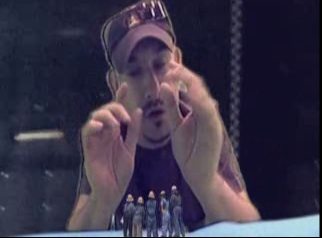 So the agency account exec whips out a pistolo, shoots the CMO and off they go to make the spot- plus the documentary- which by the way- is only available online (not even on the clients site- click image on right to view in a new window)- and you have what Ad Age calls the most liked spot of the month: The Burger King Stackers spot- made by the hottest shop on the planet: Crispin Porter + Bogusky.
So- was this little documentary a wasteful indulgence? Not if it gets people to sit through 3.5 minutes of entertainment featuring your brand.
Would this have happened on a conventional compensation plan- where no media is bought to run this bit of agency extravagance- no. Would the brand have the buzz that BK is enjoying now? No. Is there hope for other fast food feeders to still own a piece of the “Meat head” market segment of men, aged 18-25 who are likely to eat fast food 3+ times per week? Not if you play it safe, and worry about offending some segment of the market. I can just hear a brand manager at P&G worrying about offending small people with this spot. Hence, P&G hasn’t been able to master the buzz machine of the Internet.
There is a burning question on my mind about Crispin’s Internet delivery strategy:
- Are they purposefully avoiding putting work onto the client site so that it doesn’t seem to be delivered by the client (as a sort of distancing mechanism) and forgoing the measurement tools from the site stats-
-or-
- is it that they don’t care about utilizing the information that can be gleaned from having the customer on their own server- watching where they go- and what they do?
To someone who believes in the power of webstats to provide insight into customers minds- the first option seems reckless. However, if the focus is on velocity of concepts- which seems to be a key to Crispin work (the factory concept)- measurement doesn’t matter- until they have a client that is actually selling online (like Gateway- who didn’t listen to their advice to streamline their product lines).
Either or- how a client justifies the expense of these can only be by one method- have sales increased – and word on the street is that Burger King is seeing results at the registers. Was it worth the extra money- absolutely, would most clients spend the extra money- no.
What do you think? Is Crispin missing out on opportunity to connect with customers by using Google video to distribute content instead of their own site?
by Next Wave Team | Jul 23, 2006 | Advertising, BMW Advertising, Brand Relevancy, Everything You Want to Know About Advertising, Future of advertising, Marketing & the Web, Search and Business, Web strategy
bmw motorcycle advertising - Google Search
 If you search for “BMW Motorcycle Advertising” in Google- we’re the first hit- out of a lot (1,400,000) of search results. It’s not something that we write a lot about, but it showcases how we can get our subject matter to the top of Google- something that can be critical in being part of the evoked set for a buyer shopping for your product category.
If your company wants to get to the front page of Google- even when people are searching for your competitors- and, are interested in great marketing/advertising- instead of just search engine optimization, you would do better hiring The Next Wave than one of those big NYC agencies that BMW’s motorcycle division chief Laurence Kuykendall hired.
These days- brand relevancy is often accompanied by a lot of chatter on the web- and having people find your site, before finding someone who is not so kind to your products or service is one key to staying competitive.
by Next Wave Team | Jul 22, 2006 | Advertising, Brand Relevancy, Change the world, Creativity, Crispin Porter + Bogusky, Everything You Want to Know About Advertising, Future of advertising, Great Ad Agencies, Practical Marketing 101, Retail
Welcome to Room 116: Alex Bogusky says…
Alex Bogusky says…
- To creatives: “This is your company. What are you going to do to make it famous?”
- On approach: What’s really going on here?” If you can step outside your own culture, you can get an angle on what’s going on inside it.”
- “We always say, ‘Have faith in the process, even though you have to go through a period where you’re confused,’”
- “We don’t really believe in advertising”
- Bogusky uses a visual analogy to describe CP B’s methodology. At the center of his schema is the product destined to become famous, and around that are concentric circles that represent different means of marketing and advertising. The outermost circle–the one that takes the most effort to align with the essential brand message–represents traditional advertising. “We push the marketing toward the product,” Bogusky explains. “We spend all our time in the center: the product.”
- “The process is finding the questions first and coming up with answers,” says Bogusky. “After you come up with the questions, that leads you to finding the core [strategies].”
- “With MINI, it’s less about doing an ad and more about making it a part of the culture,” says Bogusky. “If we can come up with a lease that matches the personality of the car, that’s probably better than advertising.”
- Not from Alex, but still interesting: “[CP B] helped us look at all these consumer touchpoints, [and] mass marketing is just one of them,” Martin says. “The agency doesn’t call their work advertising, they call it creative content. They don’t call it media, they call it creative-content distribution.”
From Creativity, Print, Business 2.0, and Adweek.
Thanks to Brian Chiao for gathering these. This isn’t really supposed to be an all about Crispin Porter + Bogusky site- but, if the idea is to stimulate a discussion between our potential clients and The Next Wave- they need to know what interests us.
We used to require all clients to read “Ogilvy on Advertising” to have a common ground to begin discussing their brand evolution through advertising- now, we hope they read our site.
Is “Product focused Brand culture” the secret of great marketing?
One of the things Chuck Porter shared at a Cincinnati Ad Club meeting is that anyone can do a better price and product ad- just by having a lower price. Seems so obvious- but try telling that to every local car dealer, grocery store or window salesman.
If you think competing on price is a solution- you don’t need better advertising- you need a lobotomy.
Advertising and merchandising as a entertainment? Nothing that hasn’t been talked about before. Tom Peters showcased Stew Leonard’s grocery store in “In search of Excellence” in the early 80’s- the problem was- most in advertising never bothered to read many business books.
So- is Bogusky and company formulating the next eveolution of advertising or not?
What do you think?
by Next Wave Team | Jul 22, 2006 | Advertising, Brand Relevancy, Careers in Advertising, Change the world, Creativity, Crispin Porter + Bogusky, Design, Everything You Want to Know About Advertising, Future of advertising, Great Ad Agencies, Guerrilla Campaigns, Marketing & the Web, Practical Marketing 101, Retail, Viral Marketing, VW advertising, Web strategy
Welcome to Room 116: Crispin Copies itself
It’s long- it’s full of off topic comments- and it focuses on the darlings of the ad world “Crispin Porter + Bogusky.” It started with an observation that some of the VW outdoor- looked a lot like the mini campaign.
I placed a comment at the end- that probably deserves reposting here- so here you go:
Ripping off oneself isn’t illegal- it used to be called “having a style” and- if something is proven to work- and the client is in deep shit- do it.
Some of you seem to have missed bothering to read the CP+B site- they build advertising like Detroit builds cars- not for long lasting practical lives- but like throw aways, planned obsolecence. It keeps them in business- and it keeps audiences entertained. They don’t strive for “Just do it” or “Got milk” - they are like a comedian on tour- each show has to evolve- or the audience won’t laugh.
Ad people and CMO’s are the only people who know what agency did what- most consumers just want to know who did that catchy little ditty on the Rabbit- “multiply” spot. Most consumers aren’t stupid enough to go out and buy a VW because of it- they still know that the cars suck.
Which brings us to a major point about CB+P- they actually go outside the halls of advertising- into the brand world the product lives in- and work on the touchpoints- that’s more than advertising and pretty pictures- that’s real marketing- something lost on most advertising students- I still believe CB+P thinks about actually selling things- as opposed to creating pop-culture (which from reading this thread- seems waaaay more important than discussing how to sell crappy cars).
For all of Crispin’s strengths- they still make mistakes- esp. with how they use the web to connect with their customers- they still are using it as a broadcast medium instead of a 2-way exchange.
And on BK- no one mentioned “subservient chicken” or “Ugoff”- both of which were brand changing positioners.
What do you think?
by Next Wave Team | Jul 17, 2006 | Advertising, Brand Relevancy, Creativity, Crispin Porter + Bogusky, Everything You Want to Know About Advertising, Great Ad Agencies, Guerrilla Campaigns, Low Budget Advertising, Marketing & the Web, Search and Business, Web strategy
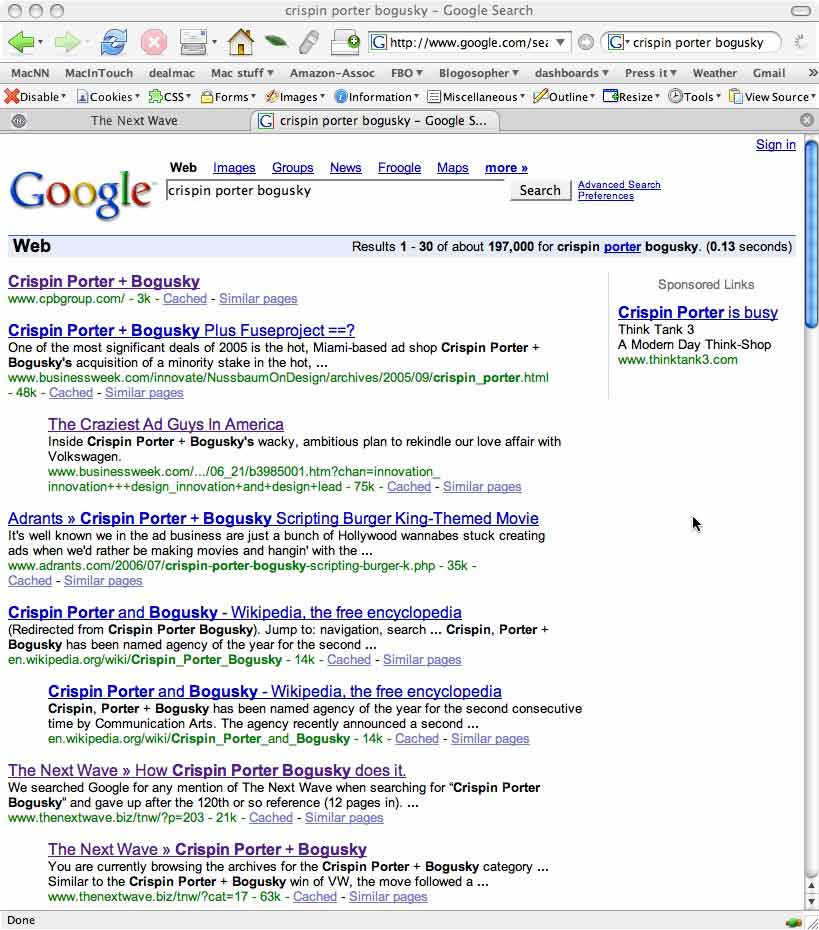 We just took a look on Google for Crispin Porter + Bogusky, we are now ranked 7, that’s from not in the first 120+ search results last week. Found this interesting article from the Miami Herald about the growth of CP+B that’s worth a read:
MiamiHerald.com | 02/13/2006 | Crispin Porter + Bogusky’s rise to the top
Our favorite quote from Chuck Porter: ‘When we were small, we learned to use imagination — not money” - well, not that they are big- they sometimes use a lot of money (not always bad) like for the Burger King Manthem spot that we compared to the Apple Campaign in “Is your agency ego in line with your budget”
Crispin Porter + Bogusky is now over 400 employees, and in two offices (Denver and Miami)- and while the quality of their work continues to be spectacular, the question that Guy Day and Jay Chiat once asked may become relevant one day: “How big can we get before we get bad?”
With the demand so high for CP+B’s magic, they have the opportunity to pick and choose their clients, and to dictate what their clients should do. Gateway didn’t like the advice to scale back their offerings to a simplified product matrix- and now Gateway isn’t a client. Compare the Apple store to the Dell store, and you will quickly see that Apple has a far easier site to navigate and sticks to a simple “Good, better, best” type matrix- Crispin was absolutely correct in their advice to Gateway, and it’s this type of advice that clients should be willing to pay more for, instead of bigger ad budgets.
Another quote from this article stands out:
”They’re really vested and interested in our commercial objectives,” says Chris Rossi, vice president of sales and marketing for Virgin Atlantic Airways North America. ‘You don’t just go in and say `give me a print concept.’ I have a conversation with Alex [Bogusky] about sales and market share. You don’t usually have a conversation with the creative director like that.”
Our first meeting with clients almost always includes the question: “what is your most profitable part of your business- and how can we jump start that” - it’s not about doing advertising for advertising’s sake, it’s about building a relationship on mutual growth and profitability. If your agency isn’t asking these kinds of questions, maybe you should be looking for a new advertising agency.
As the old quote goes “it’s not creative, unless it sells.”
And if you can’t get Crispin Porter + Bogusky to talk to you about growing your business, we know a small shop that would love to talk to you.
We can get you to the top of search, create relationships with your clients, and get people talking about your brand- using more imagination, not money.