Insights
Why newspapers have lost their usefulness to advertisers and value to their community
A few friends on Facebook (a walled garden- a wasteful place to have meaningful discussions) had a discussion about the end of newspapers. Most of them had been in the business or still are. There were lots of repeats of the standard sky is falling misconceptions about why newspapers are dying:
- young people don’t read newspapers
- giving away content online is a mistake
- releasing breaking news before publication devalues the print edition
- advertisers aren’t advertising in them because they’ve moved to more trackable methods
- the economy is bad
- local businesses don’t advertise anymore
- how can newspapers compete with aggregators and bloggers who steal their content
The problem is, all of them are missing the core issue- newspapers were never the best way to distribute news, they were just the best solution when there was no internet. Stop thinking of news as content to go in a “paper” and you begin to solve your problems.
Let’s look at the limitations of the original newspaper:
- There is a deadline for “publication” that was fixed. If the story was going to be covered it had to be in process before 7 or 8 pm to make the midnight press time.
- Newspapers have limitations on space- with additional costs to run longer stories. They can’t run video, audio, or most importantly update after the publication or engage in 2 way discussion.
- A huge part of the expense of creating a paper was in physical equipment- and supplies. Printing presses, ink, paper, distribution had to be covered by advertising and retail sales, before the cost of content creation was even factored in. It lead to exclusivity and a monopoly in most communities.
- Because of the costs of distribution- and the length of the supply chain, you didn’t have to compete with other papers in your community- unless people wanted to read day old or two day old news. Only a local paper could get the content to you quickly and keep it relevant.
Reaching back to a brilliant book from 1996, “Being digital” by Nicholas Negroponte, there is a single axiom that must be understood: “Bits not atoms.” In other words, things that are created digitally, shouldn’t be converted to atoms- paper with ink unless it enhances their utility. Very few things fit this axiom when it comes to news or advertising.
The only value proposition a local news outlet has anymore is to connect a community and to be able to really know each of their readers well. Since we’re no longer creating a one size fits all general newspaper- with a fixed size and lifespan, we must become the go-to resource for local advertisers selling atoms (physical goods) that people in the community want and need.
Even here- the problem becomes that everything is one click away to be bought from someone else online. Showrooming, the practice of going to stores to see the product and then ordering it online from someone cheaper is a major problem for those that sell commodities that don’t have a short shelf life (fresh groceries) or are too big to ship inexpensively (furniture, weight sets, car engines). So the market for advertising locally has become smaller- services, local restaurants, the arts, hospitals and health care, sports teams, they become the people who need local advertising the most- but, most of them have caught on to building friends and followers via social media - and can’t afford the newspapers overhead to be included- this includes the legions of sales people that news outlets employ to sell space in their finite paper or finite TV commercial space. Outdoor has seen a resurgence since it can’t be ignored, skipped, missed or requires a subscription.
Note: Google lets advertisers buy their own ads without the help of a legion of salespeople- and, Google knows their readers/users really well by tracking behavior, serving up custom content.
Getting back to local news organizations, they’ve been acting as the anti-social media for so long: one way communication, highly controlled, exclusivity, monopoly in their media space, that they’ve become irrelevant. That’s a big part of why newspapers have lost their value to advertisers. But, there is one big factor that many in advertising forget and don’t like to acknowledge- the fallacy of composition: just because you are online and all your friends are online- doesn’t mean everyone is.
There is a digital divide. Besides being a country with pathetically slow internet connections, we’re not universally wired. We’re not even close- and to the people who don’t have a connection, they still depend on the printed edition. The problem is, they are generally not in the key demos advertisers want. This is why the idea of running community newspapers as a non-profit community service is becoming more relevant and interesting to those who think about the value of a well informed public- from everything to the important decisions on who to vote for, to understanding the issues of the day.
Advertisers who want to be considered good neighbors, who believe that a healthy, well informed community is good for their business may begin to have a reason to advertise and support a publication that improves their community if it is also able to serve as the community hub/forum that set the agenda for the community.
Civic pride and civic duty are the keys to journalism of the future as well as community building. The monetary value will follow the utility of the content, not the other way around. Seth Godin has said over and over that he’s made more money by giving away his ideas and that the widest dispersion is the best when it comes to his content. He’d rather sell you 10 copies of a book for a buck each and have you give them all away, than sell you one for $20. The value is in the connection and the value the journalist adds with that connection- that inspires patronage and pride in the product, not because the ads are useful or the coupons save the reader money.
In Dayton Ohio, we’ve been watching the experiment by Cox Media of trying to integrate TV, Radio and Newspaper under one roof since late 2011. TV and Radio are both facing the same fates, except broadcast TV has been giving away its content for free since TV’s inception as has radio. In the UK they paid for these services with a tax on TV sets and for the longest time independent broadcast wasn’t possible. The same thing that’s happened to newspapers with the net has happened to TV- now anyone can distribute video, on demand, and not have to own a transmitter or a license from the government, enter YouTube, Vimeo, Ustream etc.. Radio has been made irrelevant by iPods, Pandora, Spotify, etc.
Once again, the key to being relevant to local advertisers is local content. The non-profit public radio station understands this and has local people on the air, talking about local issues and events. For profit radio doesn’t even have to have a person in the studio all day anymore using voice tracking and programing from Texas.
What’s most funny about Cox is that they still think there is a difference between print, radio and TV- not realizing all of them can be engaged on a single device called an iPad. Yet, they maintain different sales forces, different rates and different websites- all adding costs and no benefits to the end user. Integrate and refine your messages to a simple, single stream and engage in the old One-to-One marketing idea and you may become relevant to your advertiser again.
Local advertisers need local media. Local media needs to have and know it’s local audience. Only then, will the two connect again.
And, just as Seth Godin says you make the most from giving away your insight, I’ve given my local media a gift in this post, I just don’t think they are ready to accept that their way is D.O.A.
AMC’s The Pitch 6 Muse vs. Bozell Predictions for JDRF the diversity episode
The upcoming episode of The Pitch features Muse Communications and Bozell as the agencies working on a pitch for client, JDRF that’s used to stand for the Juvenile Diabetes Research Foundation- but they broadened their brand to drop the Juvenile to expand their appeal- and changed their name to the meaningless initials making sure to make the brand meaningless, you can read their excuse for their poor branding on their site.
If the show had viewers, there would probably be some controversy surrounding Muse’s cpot that will appear during the episode to those that watch it over the air on AMC (that means no one watching it on iTunes like us, or on torrents, etc or over on Sky Atlantic where the Brits seem to think the show would be better with brit firms instead of those crass, craftless yanks (from various twitter comments).
The Muse spot is called “White Space”.
The spot points out that, so far, The Pitch has been primarily white people talking to other white people. Read the video description:
As the only diverse-segment agency featured in AMCs “THE PITCH,” the men and women of Muse saw an opportunity to amplify the ongoing conversation about the need for more diversity in the advertising industry.
And here’s what we’re talking about — the excuses, the empty intentions and the quiet arrogance that allows for old white men to sit around a table with young white men and feel that everything is as it should be.
Yes, we have diverse-segment agencies, which come with diverse-segment budgets and diverse-segment control over creative. And despite all the challenges we face, our work continues to shine.
But understand this: Saying you want to do more about diversity is not the same as getting something done.
And we say to those who have the power to change the face of this industry — the time to do what’s right is always right now.
Muse plans to air the ad on TV during the episode on Sunday
An advertising agency that is to be featured on the AMC reality competition series “The Pitch” plans to run a commercial during the episode, but not on behalf of a client.
Rather, the agency, Muse Communications, which is led by an African-American, Jo Muse, will devote the spot to a frank discussion of the subject of diversity in the ad industry.
From NYTimes.com
We hope they got the space cheap, because the ratings are zip.
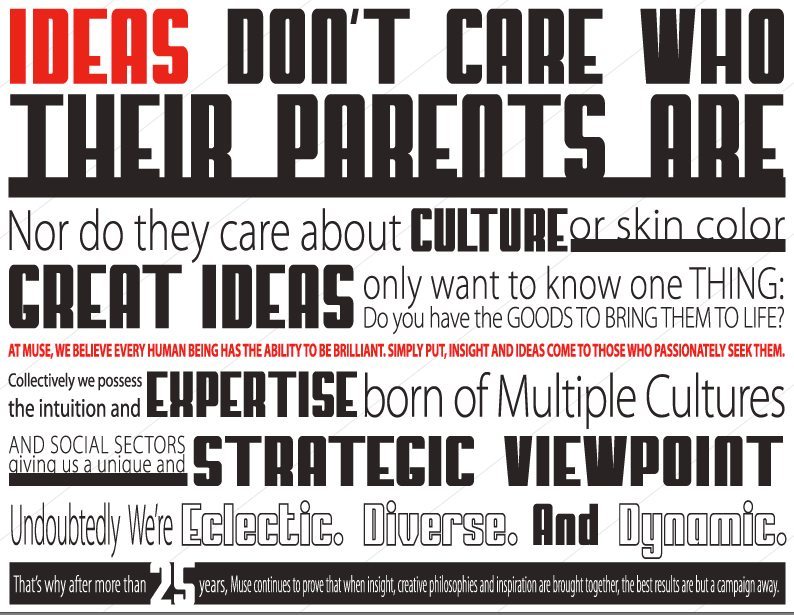
The Muse About Manifesto
It’s a bold move by Muse to stake a claim about diversity in a show where the “creative” is supposed to be king. How AMC and Studio Lambert feel about this might be interesting, but the reality is the lack of diversity in advertising is our industries dirty little secret. We’re a Service Disabled Veteran Owned Business- which is a diversity classification by the Federal Government- which “requires 3% participation” on every government contract- and yet, we’ve only had a few inquiries in over 14 years of being listed on CCR (soon to be SAM)- and oddly enough, one was from Bozell, when they were still in NYC and big. We’re also eligible for SBA HUBzone contracts- an SBA classification for businesses in “Historically Underutilized Business Zones” but it hasn’t generated a contract either.
Could the early release of this spot and the PR around it be an indication that Muse didn’t win? Trying to deflect the reason they lost? At least a few on our staff think maybe, but comparing sites gives us some other insights.
There are differences between Culver City CA based Muse @muse_USA and Bozell of Omaha NE @Bozell. Reviewing their work, Muse has a handful of big-time clients. Their website features a number of big-budget commercials for clients such as Honda and Wells Fargo which feature cutting-edge special effects and camera techniques. They appear to be the larger agency, and they aren’t worried about SEO with their Flash based site. Bozell, based in Omaha now- they bought the brand after one of the major holding companies did their Moby Dick moves and swallowed a Mad Ave stalwart, appears to have smaller clients. One of the most interesting of them is Letter-Photo, a company that lets you create custom framed sayings with sleek black and white photographs. Muse’s work is a bit more refined in execution, but they are also dealing with larger clients with larger budgets. On Twitter, Bozell has been tweeting for a while- Muse seems to have just discovered the twitterverse, not a good sign.
We’re picking Bozell as the winners. We haven’t been right yet, either in our predictions posts or when we stop the show right before “the call”- best indication of who will win is whichever agency has the problems in their presentation in the edit, sends the “rookie” in (ringer or not) or shows the client frowning or not responding. But we don’t feel too bad; judging by the “Who Should Have Won?” Polls on AMC’s website, post-show audiences generally prefer the loser.
Here’s the teaser for the episode:
The Pitch Review: Episode 5 Frangelico buys "Creative over Strategy"
The poll picks the right agency: The Ad Store
We’re now 0 for 5 on picking the “winning agency” on “The Pitch.”
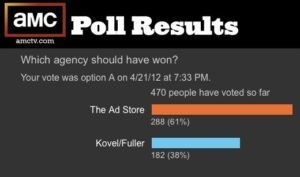
However, the viewer poll agrees with us once again. 61% chose The Ad Store over Kovel/Fuller’s 38% to win the Frangelico account.
If you watch the online “Why they won” segment on the AMC site the Chairman/CEO of Campari America Gerry Ruvo says “we really wanted to work with the company that came with the best creative.” He then went on to say that “We thought that the Ad Store did good strategic work”. At least this time, the client explicitly said that they went with the flashier agency rather than the agency with the best strategy.
The best marketing Frangelico will get out of this show was the show itself. The problem is that the viewership is tiny, and generally the viewers don’t agree with the client choice in any episode. During this episode, Frangelico got exposure tying it in with better known products from Campari America, including SKYY vodka, Wild Turkey and the company namesake Campari.
The reality is, Frangelico is a brand needing a major makeover, not just a campaign. The brief presented here was narrow and limiting to begin with; women aged 25-44, defined by the brand manager as “Molly.” The problem was, the brand manager was defining herself as the ideal target and trusting her judgement on what was best for the brand without listening to the strategy that the Ad Store presented.
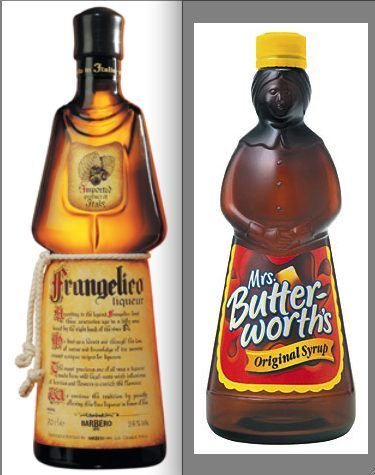
Maybe they should be married?
Maura McGinn, the “Global Head of Spirits” for Campari America proved that she was in over her head when she was impressed by the sideshow fake phone call in the presentation which she called “the little gem of a moment, when Mary presented… in the middle of the pitch, Mary pretended to call me” - really? That beat the strategic positioning of Legend, and “Think again” with it’s Renaissance reference as well as the dead on the money realization that your bottle looks like Mrs. Butterworth’s? A simple Google search proves that people were talking about this years ago, including this post from 2009)
Once again, we saw two different agency cultures and approaches. This time, Kovel/Fuller recognized The Ad Store’s Cappelli and Richard Sabean as competent competition and there was a level of respect shown for the opposition. Big egos are the norm in this business, but some are earned while others imagined. Even though many in the business cringed when Cappelli said The Ad Store was the best in the world in Episode 2, most would agree he ate SK+G’s lunch with his brilliant “Trash Can” line and positioning. In this episode he also built a strong strategic foundation for a potentially long running campaign putting Frangelico into a class of its own. Unfortunately, the client just didn’t get it.
It was refreshing to watch The Ad Store go out and informally test and survey women in the target first with Sabean’s wife’s firm “WomanK!nd” (which will be on The Pitch in a future episode) and when Paul and his partner, Steven Crutchfield, were marketing their own products from “Villa Cappelli” in a shop.
Once again, the dramatization and the editing by Studio Lambert was designed to mislead the audience, although from a pure strategic sense we were sure The Ad Store had won, we knew when we saw smiles in the presentation of their pitch that they were doomed. If there were two things we could change about this show, one would be for a pitch consultant to help supervise and the second would be to tell the story like a documentary.
There should also be the very real option to say “no thanks to both agencies” just like in the real world, but in this case, The Ad Store was the better agency for the client once again.
Interview with Steven Crutchfield from The Ad Store
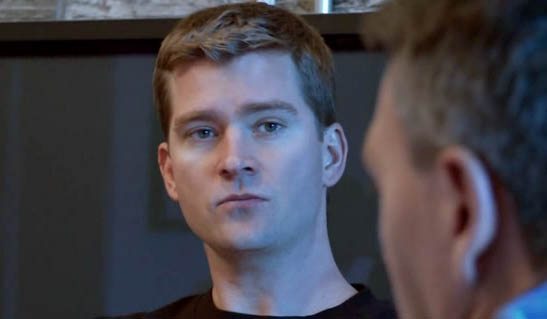 Steven Crutchfield from The Ad Store was nice enough to sit down and answer a few questions for us regarding his agency’s involvement with AMC’s The Pitch. Crutchfield was featured in episode 2 of the show, and will be featured in episode 5 that will be airing Sunday.
How authentic was the show?
Everything you saw was real. Nothing was scripted or staged. The most we’d do anything “staged” was helping the crew get the right kind of exit or entrance shot when we were coming and going from the agency. You know, so they could have one camera inside, then be able to cut to the outside to see us lock up, or what have you. They asked us a bit just to include them in meetings and make sure they were aware if we were having a meeting as to when and where it was so they could be sure to be there. That probably pertains much more to big agencies, but it was still applicable to us as well.
Do the participating ad agencies get compensated for being on the show?
Again, because it is real, the agency is not compensated. They did help cover travel for two people to the Pitch.
How complete was the brief? Was there solid research provided? Were you able to have any choice in the client?
The brief was pretty complete in both of our cases, with the client having provided solid research. You only have about a week, and both agencies are filmed at the same time. You have no say in the client (again, all “real”). The week (which is not normal) is due I’m sure to help with the entertainment value (pressure makes for interesting TV) and cost of production (only have to pay to have crew at some place for a week). And agencies are hardly ever briefed at the same time.
How did the Ad Store end up with 2 episodes?
You’d have to ask the producers why we ended up with two episodes. I’d like to think it was because we were entertaining.
Have you been recognized after being on the show? Has it brought more work to the firm?
We’ve gotten lots of fans from the show. It has been surprising and fun to see so much passion about the idea. It was surprising and fun to see so much passion about the idea. The show hasn’t really changed anything about us. Again, it was a “documentary” really of us. So, for us, nothing’s changed. Hopefully can get some business out of it, but we’ll see.
Do you think this show is helping the advertising profession?
Not sure if the show is helping the advertising field. I think it’s pretty accurate and shows the reality of dealing with an unknown client and frustration that happen along the way. I think for big agencies, the show isn’t such a good idea, and it’s why you don’t see them on the show. It reveals there really is no reason to have so many people on your business. It also reveals that there is no “secret sauce” that agencies claim. It all comes down to who the people are who are working on your business. Their minds, their inspiration and their creativity solving problems for the client. An agency can’t mass produce that sort of thing.
The show hasn’t really changed anything about us. Again, it was a “documentary” really of us. So, for us, nothing’s changed.