by Next Wave Team | Jul 30, 2006 | Advertising, Everything You Want to Know About Advertising, Future of advertising, How To Select An Ad Agency, Practical Marketing 101, Search and Business, Web strategy
You’re here because you want to do great advertising, or at least are interested in it. That’s why we’re here- to help business create positive connections and community with people who may want to buy or use their product or service-
so- low and behold, there is a site called, ready:
Commercials I Hate!
And the owner of the site says:
Hi, welcome to Commercials I Hate.
I started this site in 1997 because the advertising industry thinks we’re stupid.
Commercials assume the worst about us.
Commercials use ugly stereotypes to appeal to the lowest common denominator.
That’s nasty and insulting. Lucky for you, my reader, so am I.
Enjoy,
Nathan Alexander
This is where you don’t want your ads to show up. Luckily, for advertisers- Nathan hasn’t fully discovered the power of web 2.0 and outside of the message boards- there are no RSS feeds.
If you start seeing inbound links to your site from his URL- you may want to consider hiring a new agency (but that would only happen if you follow our rule and have all your spots online, with complete searchable text, and a unique URL which rules out most companies).
In case you are wondering if your ad agency is presenting work that may possibly end up on “Commericals I hate”- Nathan provides a list of cliche’s to avoid here:
http://www.commercialsihate.com/offenses.html
Luckily none of our TV spots are on his site, and hopefully, none of yours are.
What other industry has websites like this?
by Next Wave Team | Jul 27, 2006 | Advertising, Change the world, Everything You Want to Know About Advertising, Future of advertising, Marketing & the Web, Practical Marketing 101, Search and Business, Web strategy
This “news section” of our site is a blog about advertising- it’s our way of letting clients and potential clients what’s on our minds when it comes to advertising. It also gets us to the top of Google and improves our search results and brings a lot of visitors to our site. Can’t beat that.
We are students of advertising- we pay attention to what is happening in the business. We believe it’s essential for us to know what leading thinkers are thinking about, who did what campaign, what the strategy is, and if it’s working. To do that- we read other advertising blogs- and often, we’re disappointed- not in the content- but in the tools they use.
Web 2.0 depends on “building community” with your readers. That’s what the little comments section at the bottom of each post is all about. It’s a way to become part of a discussion- and to build connections with people who share your interests. Unfortunately, many of the ad blogs don’t include tools to keep those conversations going- and it frustrates me no end.
Example: Ernie Schenck, co-founder of Pagano Schenck & Kay, winner of all the big ad awards, and now a freelance creative, has an insightful blog Ernie Schenck calls this advertising? He has a ton of bright readers, who comment often- however, Ernie uses a hosted TypePad solution- and has no way of notifying commenters that there have been additional comments on their thread. In WordPress, this is the subscribe to comments plug-in, and it can help your comment count (user generated content) grow considerably- fostering long discussions on a subject (we have one post with 109 comments at last count). Alas, Ernie is another great creative- with minimal understanding of the technology. Room 116 at VCU suffers from this same issue.
Same can be said of Mark Silveira’s “Ordinary Advertising” blog- again, using a non-wordpress platform, the site almost never is able to post comments without an e-mail to Mark. He doesn’t post that often, but I keep it in my feed reader because I liked his book “Ordinary advertising – and how to avoid it like the plague.” WordPress has an excellent plug-in called “Spam Karma II” that allows you to make sure you aren’t being comment spammed- and post immediately (without moderation) to keep your site discussions humming without requiring your attention to every comment (you can still blacklist bad words, or go back in and edit comments easily).
Some sites use Blogger- like “The ranch”- the University of Texas ad blog. Blogger ticks me off because to comment- they want you to set up your blogger blog. Just like good advertising, a good blog back-end shouldn’t force you to do something you don’t want to do (or make it difficult to contact you).
Luckily- all these sites can switch to WordPress- since there is a built in import and translate function for Blogger, Dotclear, LiveJournal, Moveable type and Text Pattern- there is also a way to import via RSS – which could be used for importing from some other arcane solution. See more about importing on the codex.
While there are successful blogs using tools other than WordPress- the key to good open source software is the size of the development community. The bigger the community- the more developers, bug testers, bug squashers, theme developers, plug-in writers etc. WordPress seems to be the technology with momentum- and, it also allows for a pretty simple translation to Drupal if you need your site to do much more (although the commenting functions in Drupal still don’t work as well as WordPress- see D’Arcy Normans site for info on making the change).
WordPress also has an amazingly simple, yet powerful interface- and allows for multiple authors on the same blog- with different levels of access- making it a great tool for any agency to get their entire staff into the content creation process. We’ve been so successful with results for our clients with WordPress that we now offer a seminar called Blogosopher, but soon to be rechristened “Websitetology” (due to the Midwest’s fear of the word “blog” it’s not considered a serious business tool by the local Luddite community). We’re available to come speak to your Ad Club chapter with an abbreviated version of the seminar- and/or to give the seminars (a basic and advanced course- each 3.5 hours long) to your membership- contact us for details.
Using the right tools to blog is like using the right media to reach your audience. The creative types who have taken the leap to use a blog to communicate their message to the masses are all smart people- just not all are tech savvy. Hopefully, this post will lead them to a better blog- and a larger audience.
Comments anyone?
by Next Wave Team | Jul 25, 2006 | Advertising, Brand Relevancy, Change the world, Creativity, Crispin Porter + Bogusky, Everything You Want to Know About Advertising, Future of advertising, Great Ad Agencies, Guerrilla Campaigns, Marketing & the Web, Media, Practical Marketing 101, Search and Business, Viral Marketing, Web strategy
So the client looks at the proposed budget for the TV spot- and swallows hard. Those are big numbers- especially on the FX (effects) – green screen, miniatures, models etc- big cast- and then- they see- almost as much cash to make a “Making of the spot” documentary- and the clients says “Over my dead body.”
 So the agency account exec whips out a pistolo, shoots the CMO and off they go to make the spot- plus the documentary- which by the way- is only available online (not even on the clients site- click image on right to view in a new window)- and you have what Ad Age calls the most liked spot of the month: The Burger King Stackers spot- made by the hottest shop on the planet: Crispin Porter + Bogusky.
So- was this little documentary a wasteful indulgence? Not if it gets people to sit through 3.5 minutes of entertainment featuring your brand.
Would this have happened on a conventional compensation plan- where no media is bought to run this bit of agency extravagance- no. Would the brand have the buzz that BK is enjoying now? No. Is there hope for other fast food feeders to still own a piece of the “Meat head” market segment of men, aged 18-25 who are likely to eat fast food 3+ times per week? Not if you play it safe, and worry about offending some segment of the market. I can just hear a brand manager at P&G worrying about offending small people with this spot. Hence, P&G hasn’t been able to master the buzz machine of the Internet.
There is a burning question on my mind about Crispin’s Internet delivery strategy:
- Are they purposefully avoiding putting work onto the client site so that it doesn’t seem to be delivered by the client (as a sort of distancing mechanism) and forgoing the measurement tools from the site stats-
-or-
- is it that they don’t care about utilizing the information that can be gleaned from having the customer on their own server- watching where they go- and what they do?
To someone who believes in the power of webstats to provide insight into customers minds- the first option seems reckless. However, if the focus is on velocity of concepts- which seems to be a key to Crispin work (the factory concept)- measurement doesn’t matter- until they have a client that is actually selling online (like Gateway- who didn’t listen to their advice to streamline their product lines).
Either or- how a client justifies the expense of these can only be by one method- have sales increased – and word on the street is that Burger King is seeing results at the registers. Was it worth the extra money- absolutely, would most clients spend the extra money- no.
What do you think? Is Crispin missing out on opportunity to connect with customers by using Google video to distribute content instead of their own site?
by Next Wave Team | Jul 23, 2006 | Advertising, BMW Advertising, Brand Relevancy, Everything You Want to Know About Advertising, Future of advertising, Marketing & the Web, Search and Business, Web strategy
bmw motorcycle advertising - Google Search
 If you search for “BMW Motorcycle Advertising” in Google- we’re the first hit- out of a lot (1,400,000) of search results. It’s not something that we write a lot about, but it showcases how we can get our subject matter to the top of Google- something that can be critical in being part of the evoked set for a buyer shopping for your product category.
If your company wants to get to the front page of Google- even when people are searching for your competitors- and, are interested in great marketing/advertising- instead of just search engine optimization, you would do better hiring The Next Wave than one of those big NYC agencies that BMW’s motorcycle division chief Laurence Kuykendall hired.
These days- brand relevancy is often accompanied by a lot of chatter on the web- and having people find your site, before finding someone who is not so kind to your products or service is one key to staying competitive.
by Next Wave Team | Jul 20, 2006 | Advertising, BMW Advertising, Change the world, Creativity, Crispin Porter + Bogusky, Everything You Want to Know About Advertising, Future of advertising, Great Ad Agencies, Guerrilla Campaigns, Low Budget Advertising, Marketing & the Web, Media, Practical Marketing 101, Retail, Search and Business, Viral Marketing, Web strategy
As many of you know, we run a seminar on using a blog (specifically WordPress) as a content management system for a business website. The news section of The Next Wave site (where you are now) was added in January of 2005 and now accounts for most of the traffic on our site.
Although we got an early start on having a website (our first site went up in 1994) and we soon figured (back while everyone was still on dial-up) that Flash wasn’t the way to build an entire site (later we looked really smart- since search engines and Flash don’t go together very well)- we were pretty slow to realize how important webstats are to providing customer feedback and marketing opportunities.
The reason: when our content didn’t change often, neither did our web stats. That all changed with the news/blog- and analyzing web stats has become one of the most important parts of our seminar. As you add content- people find your site using different search terms- and link to you for different reasons- these are all opportunities to do business or learn about your customers.
It’s how we decided to begin the seminars- and it’s also taught us a lot about how to build websites for our customers- so they can get more customers. Just like there are keywords- or trigger words in print advertising (Free- being the “best” one), search terms can tell you a lot about your customers hot buttons. For us, guerrilla ad campaigns, viral marketing, and non-traditional advertising have been hot topics- as have low-budget ads. In a highly competitive media environment, it’s become obvious that just spending more on traditional media isn’t a cost effective solution. The flip-side is, many of these potential clients aren’t willing to pay for the services to get the “more bang for your marketing buck” to the agency for coming up with the “big idea.”
One of the places we find the big idea for a client- or at least get a start on the idea, is by searching through their well crafted website stats- where the search terms can show what’s on customers minds. Think of a website stats package as a way to eavesdrop on your virtual sales floor- as if you had a way to listen to every single customer that had an interest in your products.
When we land a retail client, we like to do site studies- where we observe customer interactions with our clients staff, the environment, the product, the sales process- and then make suggestions on improvements. We also visit the competition and do the same analysis. We want to discover what drives your most profitable customers to shop with you – and how to find more like them. We can do the same with visiting your sites backend- analyze, review, and build new strategies to connect and close the sale.
To repeat what we’ve said before- it’s imperative for a business to post all marketing materials online, in a place with a unique url link, and in a format that can be shared. Let the customer print your ad, own your TV spot, be able to listen to your radio spot over and over if they so choose. Even better- let them link back to your page, comment on the ad, be able to find out everything they can about it- because it most probably is what brought them to your site in the first place (isn’t that the reason you ran the ad in the first place).
One of our most popular posts was where we scanned and posted a BMW motorcycle ad, and placed the copy in a Google friendly format (remember, search engines can’t read flash- or the text in the contents of a jpg file) – another was where we compared an Apple TV campaign to a Burger King TV spot- which brought us mad traffic for information on the BK spot. For all the creativity Crispin Porter Bogusky showed in the BK spot and the strategy, they made it hard for people to find out where “I am man, hear me roar” came from.
So instead of driving people to Burger Kings site, where they could have been rewarded with a special offer, or discovered additional information about the product- like the exact ingredients in a Texas Double Whopper- they were on our site.
One of the outcomes of the BMW ad- is that when people search for “BMW motorcycles in Dayton” they end up on our site- and are disappointed that we were mentioning that our market has lost it’s closest dealer- partially because BMW hasn’t been successful at driving traffic to the shops- in our opinion, because of lackluster advertising and a poor web strategy.
We are now getting a lot of traffic on our site for people searching out answers to marketing questions- so we’re starting a new category: Practical marketing 101. We will be writing about ways to build successful marketing plans- utilizing well built websites as a basis for formulating sales plans that generate high traffic- especially for smaller businesses- independent businesses and our favorite type of client- the underdog.
We hope this helps you understand what The Next Wave means when we say we aren’t just an “ad agency”- but a source for marketing and innovation.
What do you think?
by Next Wave Team | Jul 17, 2006 | Advertising, Brand Relevancy, Creativity, Crispin Porter + Bogusky, Everything You Want to Know About Advertising, Great Ad Agencies, Guerrilla Campaigns, Low Budget Advertising, Marketing & the Web, Search and Business, Web strategy
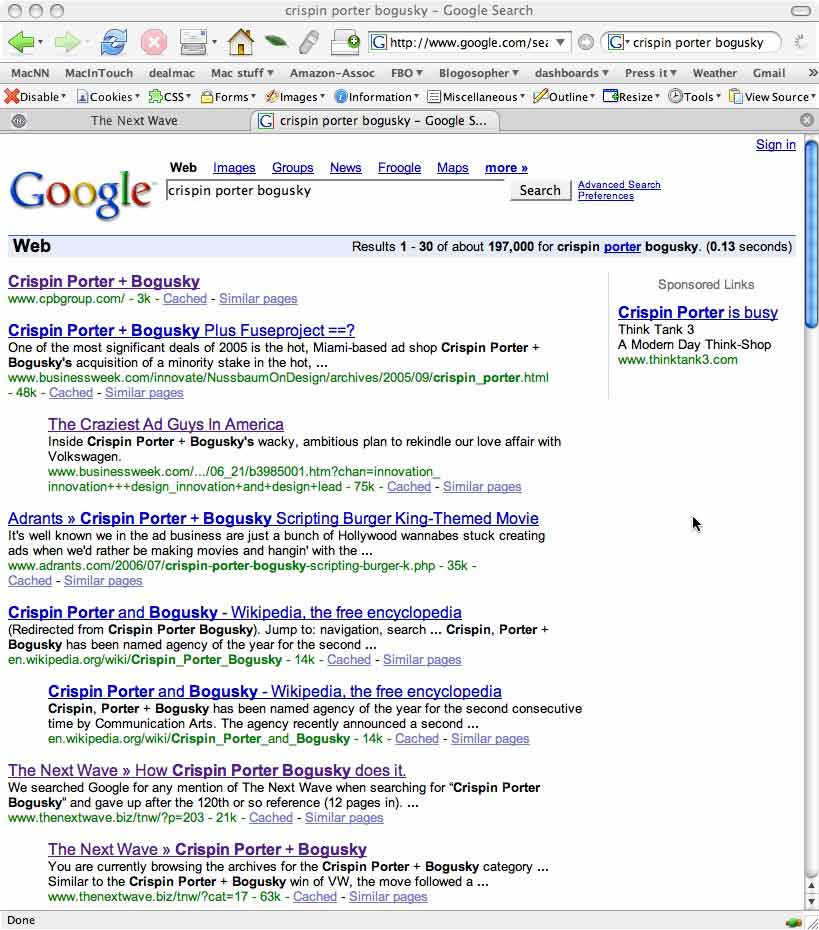 We just took a look on Google for Crispin Porter + Bogusky, we are now ranked 7, that’s from not in the first 120+ search results last week. Found this interesting article from the Miami Herald about the growth of CP+B that’s worth a read:
MiamiHerald.com | 02/13/2006 | Crispin Porter + Bogusky’s rise to the top
Our favorite quote from Chuck Porter: ‘When we were small, we learned to use imagination — not money” - well, not that they are big- they sometimes use a lot of money (not always bad) like for the Burger King Manthem spot that we compared to the Apple Campaign in “Is your agency ego in line with your budget”
Crispin Porter + Bogusky is now over 400 employees, and in two offices (Denver and Miami)- and while the quality of their work continues to be spectacular, the question that Guy Day and Jay Chiat once asked may become relevant one day: “How big can we get before we get bad?”
With the demand so high for CP+B’s magic, they have the opportunity to pick and choose their clients, and to dictate what their clients should do. Gateway didn’t like the advice to scale back their offerings to a simplified product matrix- and now Gateway isn’t a client. Compare the Apple store to the Dell store, and you will quickly see that Apple has a far easier site to navigate and sticks to a simple “Good, better, best” type matrix- Crispin was absolutely correct in their advice to Gateway, and it’s this type of advice that clients should be willing to pay more for, instead of bigger ad budgets.
Another quote from this article stands out:
”They’re really vested and interested in our commercial objectives,” says Chris Rossi, vice president of sales and marketing for Virgin Atlantic Airways North America. ‘You don’t just go in and say `give me a print concept.’ I have a conversation with Alex [Bogusky] about sales and market share. You don’t usually have a conversation with the creative director like that.”
Our first meeting with clients almost always includes the question: “what is your most profitable part of your business- and how can we jump start that” - it’s not about doing advertising for advertising’s sake, it’s about building a relationship on mutual growth and profitability. If your agency isn’t asking these kinds of questions, maybe you should be looking for a new advertising agency.
As the old quote goes “it’s not creative, unless it sells.”
And if you can’t get Crispin Porter + Bogusky to talk to you about growing your business, we know a small shop that would love to talk to you.
We can get you to the top of search, create relationships with your clients, and get people talking about your brand- using more imagination, not money.