by Next Wave Team | Mar 26, 2007 | Advertising, Brand Relevancy, Differentiating Your Brand, Everything You Want to Know About Advertising, Marketing & the Web, Practical Marketing 101, Public Relations in the Web 2.0 world, Search and Business, Web strategy
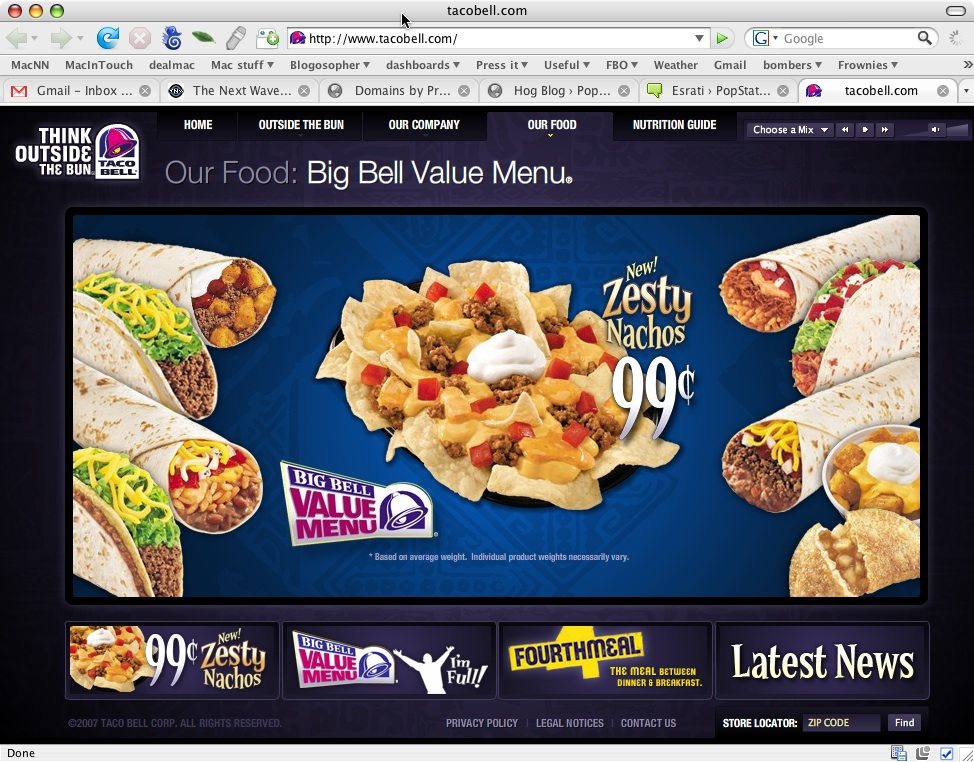
I wish my associate had kept the receipt, but, Taco Bell needs to work on their site integration with their stores: there’s nothing worse than a broken promise.
I text messaged Richard to pick me up three items off the “Big Bell Value Menu” where all items are .99- of course I can’t send a link, because they build their site in Flash- just like all the rest of the big chains- not searchable, not bookmarkable- and really, not that useful with it’s “pop-a-mole” navigation system. Never mind there aren’t actuall descriptions of what are in any of the items. There are so many things that a site for a national fast food restaurant could do- but unfortunately, none of them understand web 2.0
I ordered the Zesty Nachos, Grande Soft Taco and the Double Decker taco. When Richard got to the register- the girl had no clue. I ended up with three items that were similar to the items I ordered, but they came to $3.79.
Taco Bell just failed me over .82 cents- and now I remember why I don’t make a run for the border very often.
by Next Wave Team | Mar 21, 2007 | Change the world, Creativity, Everything You Want to Know About Advertising, Future of advertising, How To Select An Ad Agency, Marketing & the Web, Practical Marketing 101, Public Relations in the Web 2.0 world, Secrets of Great Advertising, Viral Marketing, Web strategy
Advertising is usually delivered in what we call “paid media” - which would include TV, Radio, Print, Direct Mail, Outdoor, Internet etc. It’s usually your company talking about yourself.
There is also what we’ve come to know as “unpaid media” which is usually described as Public Relations- where your press release, guerrilla stunt, amazing feat, etc. is actually newsworthy- and you appear in the media- usually print, radio, TV or Internet. This could be defined as others talking about you.
Then we have the new media form, and by that, I don’t mean web, Internet, etc. and it’s new name “earned media”- this is where something is so interesting that it gets circulated and watched out of fascination. It is the basic building block of a viral campaign. It is becoming the most valued form of advertising- but there is no price tag on it. You can’t just pony up money and get the eyeballs. Earned media is the result of the new currency in advertising (which really has always been the true currency) creativity. Creative solutions, creative executions, interesting, funny, informative and unexpected messages can take your brand message places that conventional (paid and unpaid media) can’t and won’t.
This creates a huge problem in advertising agency compensation - are you as a client, willing to pay for the value of a good idea? Or are you still basing your compensation plan on the size of your media buy or on hours worked? If you want to earn eyeballs instead of pay for them, the first thing you need to eyeball is what you are trying to buy from your ad agency.
And then decide what kind of media is going to get you what you want.
by Next Wave Team | Mar 19, 2007 | Ad Agenices in Dayton, OH, Everything You Want to Know About Advertising, Future of advertising, Great Ad Agencies, How To Select An Ad Agency, Marketing & the Web, Practical Marketing 101, Public Relations in the Web 2.0 world, Search and Business, Web strategy
In our effort to bring you the best, most useful, and interesting insight into advertising, ad agencies, and getting the most for your marketing dollar- we stumbled upon this post by “Gerry McGovern” in a non-web 2.0 site- but was right on:
Web design: never let an ad agency near your website: January 19, 2004 issue of New Thinking by Gerry McGovern
The average advertising agency fundamentally doesn’t get the Web. Saatchi & Saatchi, BBDO Worldwide, J. Walter Thompson and Ogilvy are great advertising agencies. When it comes to managing their own websites, however, they are rank amateurs. They bring their print and TV thinking to the Web with embarrassing results.
Well worth a click over - where he rants about the stupidity of the Flash intro, and the innane copy which makes every agency sound- well- alike. He doesn’t actually give your real stats on why big ad agency sites suck (we do that quite aptly here: ad agencies seek diversity) but he does describe some sites- that when you visit today- will realize haven’t changed or updated content in 3 years (we just went to LeoBurnett.com the other day- only to leave totally frustrated with the most worthless web navigation ever- and no search function).
We’re not saying that all big advertising agency sites are boring, or ugly- just that most of them aren’t actually useful.
Here are some key ways to evaluate an ad agencies web competence:
- Is the text selectable- and copyable- so you could easily put together their brilliant ideas for marketing into a memo for your boss on why to hire them? (This also means you can read the content with a text-to-speech reader for blind people- and that the site will be indexable by google).
- Are there separate pages for each piece of content- in other words- can you send a link to the exact spot that you think is relevant to your boss- “Hey, look at this brilliant marketing strategy” - I think it applies to our company.
- Is the content current- and changing? Google rewards fresh new ideas and content. If thy don’t update their content, how can they suggest you do it? Practicing what you preach is important on the web.
- Can you view the site without having to turn off noise, or have video start without you telling it to? Good for not disturbing the boss- or letting him know that you are secretly looking for a new ad agency because your current one isn’t very web-savvy.
- When you go to Google and type in: site:bigagency.tld you actually get more than one page. Try it for this site- site:thenextwave.biz and look at how many pages are indexed!
- Another key to finding out if your prospective agency is web 2.0 compliant- look for links out, and links in. Although not perfect- going to Google and type in link:thenextwave.biz will show you a smattering of what links to us. We know many more link to us, because we watch our web stats- a very informative tool to gather information about who is saying what about you.
There are a whole bunch of other questions to ask before hiring an ad agency- but we try to cover that in our topic “how to pick an ad agency”- as opposed to here- where we’re just talking about web 2.0 web skills.
If you have questions on how to analyze your ad agencies web competence, feel free to give us a call.
by Next Wave Team | Mar 4, 2007 | Advertising, Everything You Want to Know About Advertising, Future of advertising, Low Budget Advertising, Marketing & the Web, Media, Public Relations in the Web 2.0 world, Search and Business, Web strategy
We’ve been working on a local film festival and trying to get materials to promote the films. This shouldn’t be too difficult- wrong.
Movie after movie has a site built in Flash- with no way to easily get the images or synopsis that would make promoting a movie easy. Even finding the films “Official site” is next to impossible- and that’s even with the amazing resource of IMDB.com
So- a few tips to independent film makers (and maybe even some major film distributors):
- Have searchable content- that means the viewer should be able to select and copy your text.
- Have your film logo available as an .eps, or .ai, or even in a pdf, in case someone wants to use it to promote your film.
- Have high resolution still photos from your film- for print articles about the film. Make sure you tag them so Google images can find them too- include names of stars, the name of the movie, not image001.jpg (it doesn’t hurt to have a stuffed/zip file for the complete press kit)
- Keep your site up-to-date with news and showings. Flash makes this more difficult- a blog makes this easy.
- Provide information that reviewers would find useful on the site: bio’s of actors, writers, the history that goes with your film.
- Have film clips and trailers available in multiple resolutions- in a universal format. We prefer Quicktime, but, what ever you do- don’t embed them so we can’t use them on our promotional site.
- Have your contact information available. If the film is available in subtitled form, make sure you have the site in each language.
- Make sure you update your IMDB.com entry with your official site link.
The Next Wave can build you a very effective site, for a lot less than what these fancy Flash sites are costing- and get you better search position. But, this really isn’t being written to be a sales pitch- it’s written out of frustration because we can’t get what we need to promote a film festival.
by Next Wave Team | Feb 14, 2007 | Brand Relevancy, Careers in Advertising, Creativity, Crispin Porter + Bogusky, Differentiating Your Brand, Everything You Want to Know About Advertising, Future of advertising, Great Ad Agencies, Marketing & the Web, Public Relations in the Web 2.0 world, Web strategy
If there is one thing the Internet/web 2.0 thing does, it makes connections.
The idea of six degrees of separation is so, like Web 1.0, now if it’s more than 2 degrees, you’ve got a problem. In fact, that’s the new job of marketers and ad agencies- reduce the gap between the consumers and the brand- make them intimate.
So, an official announcement of sorts: The Next Wave is working with Hogshead Media, the biggest small ad agency in the country. We’re helping Sally Hogshead do web 2.0 magic- and to create that intimate connection between her and her markets. For those of you who don’t know Sally, I highly recommend you bop over to read her bio. Besides working at Wieden + Kennedy, Fallon, opening the West Coast office of Crispin Porter + Bogusky, having her own shop: Hogshead & Robaire, and winning every award known to advertising, she wrote the book Radical Careering which is a great primer on how to jump start your career.
 Working with someone you idolize is one thing. But, to make it even sweeter, I got to write the headline for her post about her podcast with Seth Godin. (Note: If you don’t know who Seth is, and didn’t know who Sally is, you probably shouldn’t be reading this).
[update: Seth posted about Sally’s interview here]
Hog Blog » Bald head & Hogshead: An interview with Seth Godin
For those of you not familiar with Seth- I’ve included a picture at right. Yes, he’s bald.
For those of you not familiar with Sally: she’s sort of famous for writing a lot of headlines just to get one right. See her post about Luke Sullivan (another hero of mine) and the 800 headlines.
The post and podcast should be must reads for anyone in advertising. I particularly like this quote from the interview:
“Style and fashion spread through the ad agency business really fast. But they’re very bad at changing what they do for a living, they’re very bad at any form of new media, they’re bad at pushing clients to really dramatically, fundamentally reinvent themselves. What they’re very good at is adopting a new slogan or a new look or a new image. That’s deckchair re-arranging.”
The reason we’re called The Next Wave, Marketing • Innovation, is because we don’t believe that advertising is the solution to sales problems. While we can help with the slogan or image, what we try to do is reinvent the customer/brand experience. It’s one of the reasons we’ve been so enamored with the web, where you can establish meaningful relationships with your customers. That’s what we’re starting to do for Sally, and what we would like to do for you.
The best part of this collaboration: I only wrote 3 headlines to get to the winner.
Now jump over and listen to the podcast.
by Next Wave Team | Feb 5, 2007 | Advertising, Change the world, Creativity, Differentiating Your Brand, Everything You Want to Know About Advertising, Guerrilla Campaigns, Low Budget Advertising, Practical Marketing 101, Public Relations in the Web 2.0 world
Guerrilla marketing started out as a way to get attention when a business had no cash to buy traditional media. Now, it’s what big companies look for when they are trying to make up for bad ad strategies.
 Turner Broadcast Systems is probably reconsidering the cost effectiveness of a recent “guerrilla marketing” campaign for its Cartoon Network show “Aqua Teen Hunger Force” where NY agency Interference placed signs that were mistaken for bombs in major cities including Boston.
FOXNews.com - Turner, Interference to Pay $2 Million for Botched Cartoon Network Ad Campaign in U.S. Cities - Local News | News Articles | National News | US News
BOSTON — Turner Broadcasting Systems and Interference Inc. agreed Monday to pay $2 million for an unconventional Cartoon Network advertising campaign last week that caused a widespread bomb scare, Attorney General Martha Coakley announced.
This isn’t the first time that “guerrilla ads” for major corporations have caused more headaches than they were worth. Sony did a graffiti campaign for Playstation portable, and Microsoft plastered a city with static cling decals for a software product with similar bad PR results.
Chalking sidewalks, human billboards, street teams, PR stunts are all pretty harmless and effective tools. And while some may say that this botched campaign got lots of press, it didn’t end up being cheap or positive press for the client. Before considering a “guerrilla campaign” the question one must ask is: how would I feel if someone did this to my mother? My sister? Me? The golden rule applies.
Advertise onto others, as you would have others advertise onto me.
And, if you think you are getting a free lunch- here’s a tip: there is no such thing as a free lunch, just ask Turner Broadcast Systems.