Ad 2 is a subgroup of the AAF for young ad pros. Each club does a local public service campaign as a gift back to the community- and the winner was announced today.
When a campaign makes you teary eyed, you know it’s got something going right. The campaign from the Hawaii chapter, for Accesurfhawaii.org was one that you won’t forget.
What’s more incredible- is the total cost to the client was $0- yet the value was over a million dollars.
While the beaches are important to Hawaiians, there was a group of citizens who weren’t able to get to the beach- the disabled. AccesSurf Hawaii was a new organization that needed volunteers- and potential client awareness of their adaptive surf program. To see the effect that getting a wheelchair bound person not just out on the sand, or in the water, but actually riding the waves was inspiring.
George promised me he would get the spots up on youtube soon- and then I’ll post them here, but in the meantime- listen to these numbers- 4x the number of volunteers, 8x the number of clients to be served- basically fast forwarding the organizations plan ten years into the future.
We recently had a client who’s favorite refrain was “advertising doesn’t work”- well, this is proof that it works, that the people in advertising care about their community, and that advertising can change anyones fortune- if done right.
First things first: Louisville’s ad federation has the right attitude- seems to be connected to the community, realizes the value of bringing people in from all over the country- and showing them Louisville’s best.
The hotel, didn’t look like much on the outside as I pulled up on the motorcycle after a really hot ride from Dayton- but inside- the place is grand. Really amazing main ballroom- and a lobby that makes you think back to the grand hotels of the 30’s and 40’s. It’s 2 years old- and a Marriott- only complaint I’ve heard is no wireless in the rooms (you have to use a cable and pay for access- although access is free downstairs if you type in “Public Wireless” and then give your name). Even heard the chef came out and made a custom vegetarian meal for one of the attendees- that’s customer service.
The goodie bag from AAF was OK- the one from Louisville AAF- rocked- a box of girl scout cookies, Makers Mark Burbon Chocalates (I had one and got a buzz) a t-shirt, and their club magazine “Communique” which is awesome. I happened to sit with their board at lunch- and the people were friendly and firmly believe that Louisville has a shot at becoming the next Minneapolis or Miami. It’s that kind of winners attitude that needs to come to Dayton.
Got to see three student NSAC (National Student Advertising Competition) presentations for Coke. One was great- from SCAD (the Savannah College of Art and Design)- the other two were weak. Going back to my judging of Postal Vault in the districts last year- same issues in presentation: the client doesn’t need to know who you are, what your name is- let the work, the ideas, the analysis be the star. Even if you are David Oglivy, Howard Luck Gossage and Bill Bernbach, the people who will see your ad won’t know, they’ll just like it- or hate it. With the average CMO life expectancy dropping by the day (the Macy’s CMO just left after 13 months) the only people who care about the names of people working on the account are the ones trying to use the old “no one ever got fired for buying IBM” (or any other leading brand). Face it- if your ads are working the checks keep coming- it’s only when there is a hickup do people start thinking “Oh, we need Agency XYZ working on the account.” So, students- all your school branding, titles, etc- are moot- just start out with- “I’m Jason, and here is the account planning data to justify our strategy” and move into the meat.
I’m also hating the memorized speeches that, if one person loses their lines- the others all pipe in - face it, if you want to deliver lines- don’t be in advertising, go into theater (or hire actors to deliver your pitches)- now, more than ever advertising is about having a conversation with the customer- you wouldn’t do that from a script, would you? Feel confident in your ability to deliver- ad lib- it has more authenticity and that closes deals- not a push paly and off you go type presentation.
In a forum session “Digital Innovations & Social Networking” they had to expand the room to get all the people in. Great, but, the speakers were in chairs- where anyone sitting in the back couldn’t see them, some staging would have been great. Well moderated session by Murray Gaylord of the New York Times- and by all means, moderating panels is an art- and this was better than most. The scary part was that probably half the audience had no clue what “Second Life” is- which means a lot of clubs should be adding speakers on Web 2.0 to their speakers lists asap.
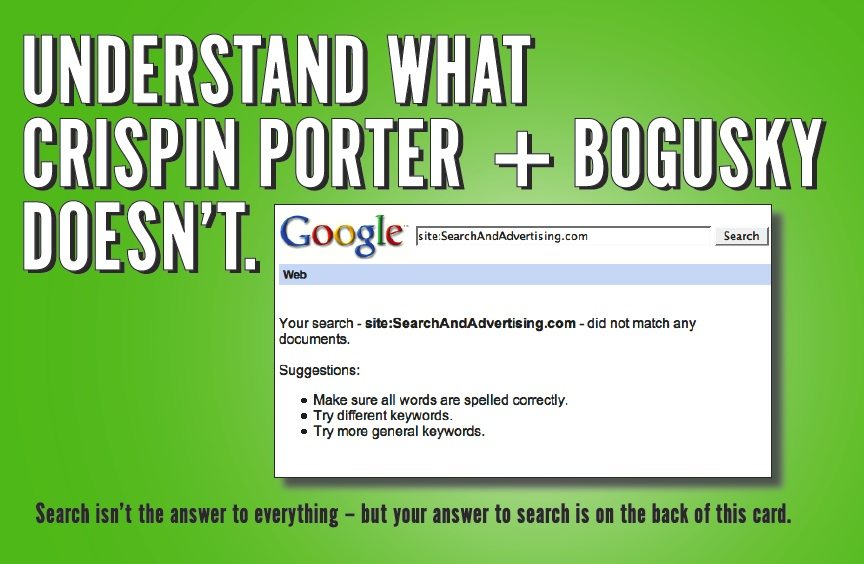
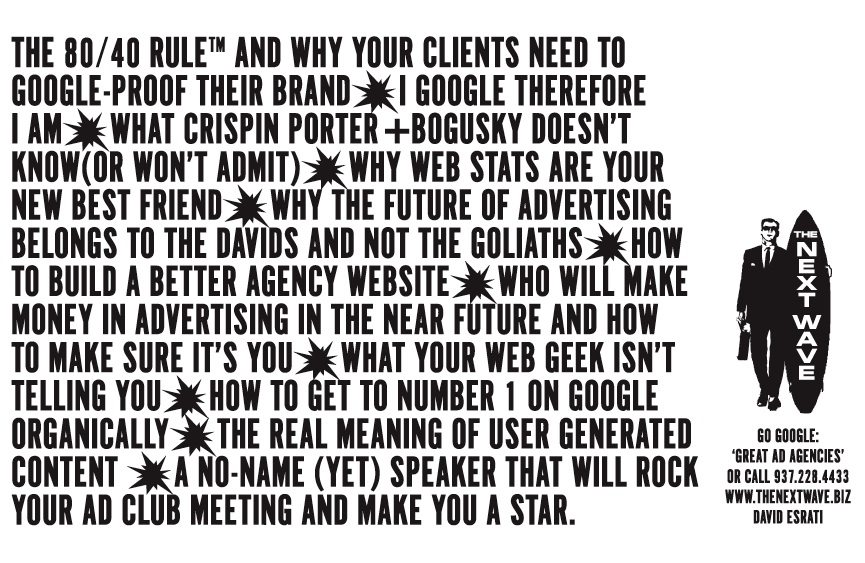
Which brings me to my last morsel of the day- I was dropping off my Understand What Crispin Porter + Bogusky doesn’t flyer (link is to a printable PDF) for club execs and schools to promote me as a speaker- and seminar presenter. Next thing you know- I’m being told to “Cease and desist” from my little guerrilla marketing effort. It’s unclear if it’s because I didn’t pay big bucks to be a sponsor, or because I said “Understand what Crispin Porter + Bogusky doesn’t” on the piece (apparently it’s ok to compare detergents in advertising- by name, but not ad agencies). This news was delivered by our club exec director who seems to feel that any kind of self promotion is evil- but, she gave me a card of an AAF executive that was the authority on this.
I’m almost surprised I wasn’t told to take off my Next Wave t-shirt. I’m tempted to wear my “I blogged your mom” t-shirt tomorrow- just to take the edge off these people. If you can’t have fun at a convention of ad people- what is this world coming to?
I’ll have more after Friday’s festivities. And, to any of you who are here- and have read this far- when was the last time you put some new content on your agency site?
And last but not least- If you are a student- and haven’t bought Steve Lance’s “The little blue book of advertising” yet- shame on you. It’s a classic- and well worth the $14 to have an autographed copy. Forget the mojitos- get some marketing mojo from someone who understands this new economy.
Volkswagen was a dying brand in the US. The culprit was poor quality. Customers had been fooled into buying a Jetta or Passat on the idea that they were getting “Precision German Engineering” at a bargain beerhaul price. When the cars didn’t deliver quality- they moved on to more reliable brands.
Enter Kerri Martin, the marketing exec that built BMW Mini’s success in the US with über hot agency, Crispin Porter +Bogusky.
All of a sudden, people are ignoring the fact that VW is still at the bottom of quality- at least their ads are interesting- showroom traffic picks up- and so do sales. But, alas, not enough for the big boss: Adrian Hallmark. He doesn’t understand the Crispin “Factory” approach to advertising- where’s the unifying tagline he asks- and fires Martin. All of a sudden, VW ads are once again boring.
Price and Product boring. Like a frickin laundry list- “Three V-dubs for under $17,000.”
And quickly- we’re back to talking about the wrong thing: price.
Once again, Mr. Hallmark is changing directions- now, hoping a feel good campaign with a tagline “When you get into a Volkswagen, it gets into you.”
Hmmm…. like under your skin, when you are taking it back to the dealer for the tenth time to get the same thing fixed (a former employee was constantly having problems with his Jetta).
Mr. Hallmark said the carmaker decided to “save our gunpowder” for national ads until the second part of the year.
VW spent just $19 million in measured U.S. media in the first two months of 2007 and $241 million in calendar 2006, according to TNS Media Intelligence. Volkswagen follows a winding ad road
February 2006: Introduces “Fast” doll online and in ads featuring lab-coated German “engineer” and the line “Unpimp mein auto.”
April 2006: Introduces jarring “Safety Happens” push, showing Jettas getting slammed into by other vehicles.
May 2006: “Low-ego emissions” for Passat shows drivers in other German cars shouting arrogantly into megaphones.
May 2006: TV spots feature a lederhosen-wearing spokesman next to a white Jetta, saying, “Stereotyping is stupid.”
June 2006: Rabbit spots show two cars — one white and one black — multiplying like bunnies.
October 2006: Free-guitar incentive for buyers of Jettas, Rabbits, GTIs and Beetles; TV spots feature Slash and John Mayer.
February-May 2007: “Three V-dubs for under $17,000” touts versions of Beetle, Jetta & Rabbit.
One thing is for sure: Crispin is being patient, but a $300 Million dollar client can do that to you. The only thing VW could do to guarantee an improvement in it’s marketing is take Hallmark out of the drivers seat and bring back Martin.
At least she has a track record of delivering sales.
note: we’ve written about almost every one of the above campaigns- except the Price and Product idiocy in past posts.
Extending the myth that great advertising can be produced on the fly- ignoring the hard work of studying the customer, the market and the clients unique selling position- we now have a new pimp for the creative superstars: thetalentbusiness.com
Comparing themselves to Creative Artists Agency- which is more of a rep firm than a placement company- brings a whole new level of sneer to the ad world. In an industry that already has proven itself unable to integrate, or provide pay equity, we now have another tip-of-the-hat to the good ol’ boy network concept.
Yes, bringing in top talent can help you refine a good plan, a good concept, or help you brainstorm- but, the idea that you can freelance a brand to stardom must end.
With the Internet making it really simple to share your skill set with the world- finding the right people has gotten easier, not harder. When was the last time you had to wait for a portfolio to arrive by FedEx before you knew what the person was capable of?
Advertising Age - Headhunting Has a Whole New Look
The former CEO of Bartle Bogle Hegarty USA has joined forces with Gary Stolkin, chairman-CEO of global recruitment agency Kendall Tarrant, to rebrand his business with no less an aim than creating the ad-world equivalent of the entertainment industry’s Creative Artists Agency — and, in the process, change headhunting as it’s been known.
Answer to industry ills?
Today the pair relaunches the London-based agency with offices in Shanghai, Hong Kong, São Paulo and San Francisco as the Talent Business, adding a 10-person New York office under the direction of U.S. CEO Lucy Meredith. As the name — a shift away from the stodgy legal-firm approach of putting the principals’ names above the door — may suggest, Ms. Gallop and Mr. Stolkin believe they can create a different type of talent agency at a time when the industry regards itself as being in a talent crisis.
“The industry is going through a big bang right now,” Mr. Stolkin said. “All the agencies say, or want to be able to say, that they can do everything: ads, digital, direct or whatever. But recruitment is typically done by recycling the same ad people. We wanted to create an agency that would cut across the silos of the different disciplines. We also wanted to come up with a genuinely global offering, so that we can find and provide a resource for talent all over the world.”
While silo-integration efforts always prompt industry skepticism, the Talent Business is backing its bluster with an internal fee structure that eschews the usual recruitment-agency model of paying each individual headhunter a commission on candidates placed in jobs. Instead, employees share 25% of the company’s pre-tax profit — last year Kendall Tarrant made around $3.5 million after employee bonuses were paid. By removing the focus on commission, Ms. Meredith said, the company will encourage sharing of candidates among recruiters and focus on clients’ best interests rather than on simply putting butts in seats.
Removing stigma
The Talent Business is hoping strong branding across its website — thetalentbusiness.com — and other communications efforts will help turn the shop into a destination for people interested in changing jobs and take away the stigma of knocking on a headhunter’s door. As one media-industry recruitment consultant admitted: “At some consultants, there’s a belief that the best candidates are the ones you root out, not the ones who come to you. Good candidates probably feel the same way.”
The consultant doubted that mind-set could be easily changed, but Ms. Gallop and Mr. Stolkin think candidates should be asking recruiters to show them the money. They envisage something akin to a firm of sports or entertainment representatives, offering life coaching and job advice throughout a person’s career. “The reason we focused so heavily on the branding here is that if we get this right, the candidates will come to us,” Mr. Stolkin said.
No matter how good thetalentbusiness thinks they are- they have no clue about one type of search that executives use now: Google.
Their site, built in Flash, doesn’t show up in Google at all:
Found this via Ernie Schenck- (who still has no clue what trackbacks are).
And while it’s hip jargon in the stratosphere of advertising to say something like “your strategy is showing” as if that’s a bad thing- I always fall back to Ogilvy’s famous line about the consumer not being a moron- but your mother. Mom understands she’s being sold to- she knows it’s an ad- and strategy or no strategy showing it comes to Howard Luck Gossages classic quote “People don’t read ads, they read what interests them, and sometimes it’s an ad.”
So, flaunt your strategy for all I care- just make sure it’s interesting. I liked the definition of what “creative work should” do- (and note- the spelling isn’t wrong- it’s just a Brit talking)
adliterate: Too damn right my strategy is showing
Creative work should engage people, provide an emotional connection, build memorability, invite people to join the conversation, absorb them in the moment, build emotional desire and all of those wonderful things that it does. But it should also dramatise the strategy.
I can’t for the life of me think why you wouldn’t want your strategy showing unless of course it is so lifeless and limp that 10,000 volts wouldn’t bring the bloody thing to life.
If that is the case then burying it under layers of creative artifice and never speaking of it again is the least you can do.
Our definition at The Next Wave of strategy is even shorter: Create lust • Evoke trust™ and that’s what drives us. No matter what you do in the realm of marketing- always remember, keep it interesting- no price and product laundry lists, or simple feature lists- not unless you want to pay for those 10,000 volts to keep it alive in the customers mind.
McCann trademarked this phrase in 1926, and it’s as important today as then: Truth Well Told ® and it should be a cornerstone of any ad, not just the great ones.
This TV spot from Element 79 Partners in Chicago, is actually one of a series called “Origins” and it will serve us well for an example of what makes great advertising.
https://youtube.com/watch?v=vpfzBMj8T58
Gatorade is a category leader, and may as well have invented the sports drink market. From a leadership position they understand they need to make a connection with their target market- but not beat their chests. This is a key ingredient that car companies would do well to learn. Nobody likes a braggart- and this applies to your advertising as well. They have taken the story of their products beginnings and turned it into a near mythological tale- if you have history, if you have a story, take it and use it.
Up until watching these spots, the connection between Gatorade and the Florida Gators wasn’t obvious to me, it was just a trade name that spurred a whole bunch of other ‘ades- with the exception of the original one- Kool Aid® which totally missed this market segment. (Right now, anything with the word “Gator” in it might hit a sore spot in our home state of Ohio- thanks to two national championship losses to Florida this year). Element 79 has managed to do several versions of this same story- and still keep them different. Unfortunately, I can’t find the other treatments to share with you.
But, the key to realize is that it tells the story, solidifying the category leading position, and can be done several different ways. Both good ingredients.
Another key ingredient is to play with the familiar. This spot uses both familiar music- and familiar sports stars, stories and even the announcer (sorry I don’t have his name).
While hit music, star athletes and well known personalities are all great to have in a campaign, this one does it without making them upstage the product. Although I love Michael Jordan in so many of the ads he did- they often ended up being more about him than the product.
Which brings up the next trick to making a great tv spot: cool by association. In and by itself, Gatorade is just a drink. Once you connect it to the mythos of sport, and particularly championships, you’ve planted a brand statement that speaks to the innermost desires in all of us: the dream of greatness. If you can make someone believe that your product will make them great, better looking, smarter, richer, sexier etc. you have done your job.
Telling your story in :30 or :60 seconds is a major accomplishment. Most TV commercials can’t do a fraction of what this spot does- typically a spot is good if it hammers home one salient point- this one is coup de grace for the category of sports drinks. If you can’t tell your story in your spot- can you at least get their attention and make them curious enough to go to your website?
Budget also plays a part in your formula for a great tv spot. Some of this was archival footage, other parts were shot to look that way- but, always remember, if you don’t have a big budget, go for a big concept (I’ve been told that this is a mantra at Crispin Porter + Bogusky).
The last secret to getting the best results for your TV commercial- put it on your site, put it on YouTube, let as many people have access to it as possible. Let your customers talk about it- discuss it- analyze it (just like what we’re doing here) the days of “controlling” your message are over- your customers are now at the helm. When you post it- remember to add a lot of descriptive text, since search engines have no idea what a video file contains. For this spot we would suggest: The history of Gatorade, Gatorade tv commercial, origins of gatorade, the story of gatorade and how gatorade was part of the Florida Gators sports success - get the idea?
If you have more questions about how to make great tv spots on a big or little budget, or on how to get them seen by the most people- ask us. We’ve got plenty of good ideas on how to make your brand stand out and your message heard.