by Next Wave Team | Apr 15, 2007 | Advertising, Apple Advertising, Change the world, Everything You Want to Know About Advertising, Future of advertising, Future of TV, Marketing & the Web, Media, Practical Marketing 101, Public Relations in the Web 2.0 world, Search and Business, Secrets of Great Advertising, Web strategy
Everyone knows the 80/20 rule, in fact an extension of this idea has become known as “the Long Tail.” However, the 80/40 rule might become the most important rule to marketers in the age of search engines and advertising effectiveness.
First- a reminder of what the 80/20 rule is:
Pareto’s Principle - The 80-20 Rule
n 1906, Italian economist Vilfredo Pareto created a mathematical formula to describe the unequal distribution of wealth in his country, observing that twenty percent of the people owned eighty percent of the wealth. In the late 1940s, Dr. Joseph M. Juran inaccurately attributed the 80/20 Rule to Pareto, calling it Pareto’s Principle. While it may be misnamed, Pareto’s Principle or Pareto’s Law as it is sometimes called, can be a very effective tool to help you manage effectively.
Where It Came From
After Pareto made his observation and created his formula, many others observed similar phenomena in their own areas of expertise. Quality Management pioneer, Dr. Joseph Juran, working in the US in the 1930s and 40s recognized a universal principle he called the “vital few and trivial many” and reduced it to writing.
In an early work, a lack of precision on Juran’s part made it appear that he was applying Pareto’s observations about economics to a broader body of work. The name Pareto’s Principle stuck, probably because it sounded better than Juran’s Principle.
As a result, Dr. Juran’s observation of the “vital few and trivial many”, the principle that 20 percent of something always are responsible for 80 percent of the results, became known as Pareto’s Principle or the 80/20 Rule.
Traditional media based advertising has a major flaw: all ads are temporary. The ad in todays paper is in tomorrows trash, the spot in the TV show is over and gone (or skipped by Tivo- or ignored the second time it’s viewed) and most importantly- the old John Wanamaker adage about half his ad budget being wasted- only he didn’t know which half- still, even in todays hyper-targeted media, is pretty close to true. I’ve seen many ads for feminine hygiene products- but will never need them.
The difference between spending your budget on old-school media campaigns and putting your best efforts into online strategy- is that only people interested in your product or service will be interacting with your site- and they are there actively looking for information to substantiate their buying decision.
This is where the 80/40™- rule comes into play- insight directly from The Next Wave: 80% of Internet usage begins in search, 40% of people using search- type your URL into a search, instead of a direct access to your site- and get search results- which could include people talking about your business negatively- or trying to steal your eyeballs- even after you have spent millions of dollars promoting your URL.
Once they get to your site- what do they get? If your site is in Flash, often times they get frustrated. Also- remember, since 80% of use begins in search- are they able to access the specific information they seek? Or just get to your site? Many Flash sites do not allow your visitors to link to interior content with an exclusive URL.
One of the new realities in advertising and marketing is that people are depending on the Internet more for researching purchases- even having access when mobile to the web through WAP enabled sites- or soon- to any site with the introduction of the Apple iPhone. Everything is changing rapidly- and if you don’t make your information search friendly- you won’t be relevant in the decision making process.
How do you solve the 80/40 rule™? Building sites to be search friendly is just the start. Also, remember, it’s not about chest-beating ego sites- it’s about delivering information to the consumer that answers their problem (and the consumer can be a B-to-B customer just as easily as a B-to-C consumer). Your site should be searchable as well. Make every piece of relevant data available- in a web friendly form- and don’t remove material- always update it with relevant news (since links shouldn’t be broken by your maintenance).
But most importantly- always be aware- that when someone is looking for you- 40% of the time, they may get search results instead of directly to your site and someone else may have the answer and steal your lunch- and that is a much bigger problem than the old 80/20 rule.
by Next Wave Team | Apr 10, 2007 | Apple Advertising, BMW Advertising, Brand Relevancy, Change the world, Creativity, Design, Differentiating Your Brand, Everything You Want to Know About Advertising, Great Ad Agencies, Practical Marketing 101, Product and Service Naming, Secrets of Great Advertising
One of the first design and advertising books that really spoke to me was Pentagram’s Living by Design (long out of print). Its basic premise was that design extended to more than graphics, architecture, advertising- but was the entire consumer/brand experience- long before people were talking about experiential marketing.
I was lent the book by a former employer, who had been given it as a gift by one of his professors. After I read it, I tried to talk to him about it, his response: “I don’t read books.” I didn’t stay at that job very long (probably because I did read).
I went to Pentagram’s London office to find a copy, several years later. They were nice enough to give me a copy- that had a section removed- and she copied the missing pages. I later got a complete copy from an art book store in Santa Monica- it’s one of my most prized books.
So, when I stumbled onto Pentagram’s blog- and saw this logo- I was instantly reminded of why I believe design does make a difference.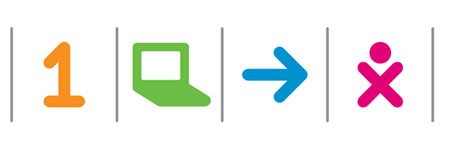
Take a look at this elegant logo- then read their description:
New at Pentagram: New Work: One Laptop Per Child
Pentagram has designed the identity and website for One Laptop per Child, the non-profit organization with the goal of providing laptop computers to all children in developing nations.
The identity is a hieroglyph, designed to be universally understood, that utilizes the icons of the OLPC laptop interface, also developed by Pentagram. The website design employs these symbols as the basis for navigation. Each icon leads to a corresponding section of information: the laptop to a section about hardware and software, the arrow to a section about participation, and so on. The site launched in English but is currently being translated into many languages.
For all the companies that don’t think they can afford to do a proper logo on start-up, just remember, you can pay now, or pay later. A well designed brand mark can make the difference between having a corporate identity- and becoming a lifestyle brand, ala Nike, Apple, BMW, Mini etc.
And, by the way, if you aren’t familiar with the One Laptop Per Child initiative, you need to read more about it- it’s truly something that could change the world.
by Next Wave Team | Apr 1, 2007 | Advertising, Apple Advertising, BMW Advertising, Brand Relevancy, Crispin Porter + Bogusky, Differentiating Your Brand, Everything You Want to Know About Advertising, Great Ad Agencies, Practical Marketing 101, Secrets of Great Advertising, VW advertising
I’m finally getting around to reading “Juicing the Orange” by Pat Fallon and Fred Senn. (btw- the site sucks if you are blind- or Google, or even a reader looking for the material they reference). I’m withholding my opinion till I finish, but I did note something- Fallon convinced Timex to go back to “Takes a licking and keeps on ticking” with some new executions.
So, before Crispin Porter + Bogusky brought back “Have it your way” for Burger King- other agencies have done the same thing. Which leads me to the question: Why didn’t Crispin bring back “Tastes Great- Less Filling” for Miller Lite? Especially once they were in trouble with “Man Laws?”
Is it because in taste tests Miller doesn’t beat Bud (I’m not a beer drinker)? That would make the strategy fundamentally flawed- and then the ads will actually hurt the brand.
When the VW marketing chief asked for a return to an umbrella theme- shouldn’t Crispin look back at “Drivers Wanted” and see if the connection can be made?
BMW hasn’t abandoned “The ultimate driving machine” through several agencies (although the motorcycle division isn’t smart enough to use “The ultimate riding machine”)- and the concept still resonates.
A well known brand is shorthand for a set of emotions and conditioned responses from the consumer. The tagline, if it is closely identified and well known with your brand- is equity that shouldn’t be thrown away just because you are tired of it. The real creativity comes from being able to keep creating interesting executions that connect to the brand.
Apple has stood for ease of use in the consumers minds for years- but until the “I’m a Mac, I’m a PC” campaign came, they had a hard time getting people to look at them as serious business computers (granted, being able to run Windows has also helped). Nike has “Just do it”- a tagline that could live forever and never be topped. (And to the person who called me on the phone and asked me who wrote it- and I drew a blank- it’s Jim Riswold).
The book “The Brand Gap” by Marty Neumeier covers branding better than any book I’ve read. The hand test and the swap test are probably two of the simplest, most obvious tools a marketer should pass.
The hand test asks if you cover the logo- can you tell who did the ad? And the swap test is equally cool- could your logo and someone elses swap and work better- he shows Polaroid and Nationwide Insurance (I should grab a scan and put it in here).
So- does your tagline instantly identify your brand- and no one elses? If it does, consider yourself lucky- and be really careful about changing it unless you have a really good reason and know it will work.
If you know of other resurected taglines- feel free to add them to the comments.
by Next Wave Team | Jan 10, 2007 | Advertising, Apple Advertising, Change the world, Creativity, Design, Differentiating Your Brand, Everything You Want to Know About Advertising, Future of advertising, Future of TV, Marketing & the Web, Public Relations in the Web 2.0 world, Retail, Web strategy
 Sell your stock in ABC, CBS, NBC and FOX, say goodbye to the cable companies, and look at Apple, Cingular, Yahoo and Google. Kiss phone books goodbye as well. Credit cards may go away too. The iPhone is coming this June, and it will change the world.
Already, Research in Motion (the Blackberry people), Palm, Motorola and other “Smart Phone” makers stock dropped, and deservedly so. My Treo 700 is a pain in the butt to use and it’s one of the “better smart phones.”
Steve Jobs has 30 years experience in changing the way people and computers interact and with yesterday’s introduction of the iPhone, he showed why Apple is the master of the GUI (Graphical User Interface). First came the mouse, then the click wheel and now- the scrolling gesture and MultiTouch interface (most touch screens can only read one point at a time). All, in all, it’s brilliant. A phone, iPod and Internet device- but, watch out, it may be way more than that.
When the video iPod was introduced, it wasn’t that the iPod could play video that was the groundbreaking news- it was that Apple was selling “free” TV programs for $1.99. The beginning of a la carte programming delivered over IP. Now, with the iPhone and the new Apple TV set top box, we have the “Remote” that pulls everything together, including a billing system (Cingular) and a whole new way for advertisers to reach highly targeted consumers. Just think, your cell phone bill could be subsidized for you agreeing to watch highly targeted content- based on several different criteria to begin with:
- Your geographic location- cell phones are mini GPS devices, and as Jobs demonstrated the iPhone integration with Google maps/Google local, he showed us the beginning of a brand new way to access advertising, custom crafted to your longitude and latitude.
- Your buying habits and payment processing might be handled through Google wallet, with you keeping your running account balance on your phone. Phones have been used in Japan to pay vending machines for years, the iPhone brings whole new levels of integration to your pocket.
- The end of “Sales” for bricks and mortar stores- if your price doesn’t match what comes up in Froogle, you won’t make the sale. The “true browser” with easy input, coupled with a camera that can probably read product bar codes will put so much power in the consumers hand that all retailers will be able to compete on is better service or immediate delivery. Will that be worth paying a premium? Take a look at what the iTunes store has done to the music industry if you need hints.
- With its superior interface and WiFi/phone system Internet access, the iPhone will allow users to access company websites on it’s small screen. Jobs didn’t show any Flash sites in the demo, but, by partnering with Yahoo and Google- and showcasing the New York Times- he did hint at the importance of CSS coded HTML which scales, and reformats to different screens easier than Flash. If you have a website that is in Flash come June, you will be missing many of the opportunities of true Mobile connectivity.
- Last but not least, with a real browser- and an 8 gig drive, consumers will be able to carry your ads, your product literature- right to the point of sale- or discuss your products or service over lunch with friends- complete with sound, motion and data. No more need for brochures- even PDF’s online that don’t easily fit the new screen won’t be as handy a well-designed web interface. Think of having infomercials on your site that entertain and allow 2-way feedback- as well as click to buy options- all accessible from anywhere- anytime, in your customer’s pocket.
There is much more to this iPhone than an iPod, Phone, Internet connectivity- there is the first step of the true 1 to 1 revolution.
Apple stock went up 8 points yesterday. Just wait until June and the full power of this new phone is realized- by developers and marketers.
If the phone works as promised, and the reviews are good, Apple’s stock will climb like Googles- and the web will be a whole new place for marketers to (re) learn.
by Next Wave Team | Jan 1, 2007 | Advertising, Apple Advertising, BMW Advertising, Creativity, Design, Differentiating Your Brand, Everything You Want to Know About Advertising, Guerrilla Campaigns, How To Select An Ad Agency, Practical Marketing 101, Product and Service Naming
 When we do our job really well- our clients get PR for free.
Dan Wolt was another window salesman, who knew the high-pressure business inside and out. He’d been at the top of a huge window mill- with 150 people setting appointments in a pressure cooker- and then he walked away and went solo.
But how to compete? How does a sole practitioner make enough noise to get noticed above the din of one of the most cut-throat industries known to man?
Our solution was “Zen Windows” a brand that was the antithesis of the standard positioning. His new slogan “Relax, window quotes in five minutes” opened a new conversation with customers who had already experienced the grueling three hour sessions of the competition.
So successful is his strategy, that About.com wrote about it. (unfortunately- the link died)
Replacement Windows - Profile of Zen Windows - Replacement Window Company
Zen Windows - Doing Replacement Windows Differently
If you think your business can’t compete with the Goliaths of your industry- consider what is accepted practice- and think about how you can differentiate yourself. BMW motorcycle dealers are different because they let customers ride demo bikes. Apple built it’s own network of Apple stores- that are as much an experience as a retail environment. Target asked it’s vendors to help them differentiate the product offering with high design products at a reasonable price. What makes your business different?
Can an ad agency like The Next Wave help? Ask Dan Wolt for a reference.
by Next Wave Team | Oct 22, 2006 | Advertising, Apple Advertising, Brand Relevancy, Design, Differentiating Your Brand, Everything You Want to Know About Advertising, Great Ad Agencies, Secrets of Great Advertising
As always- when the results are good, no one ever says “the ads did it”- but when the results are bad- it’s always the advertising that’s to blame.
When I first saw the “Get a mac” campaign- with the two guys chatting it up in front of a simple white screen- with “Hello, I’m a Mac” and “I’m a PC” I thought that Chiat/Day had hit a home run for Apple. Not only had they gone to a direct product comparison, they had captured the “user friendliness” of the Mac perfectly.
It was also an affordable campaign- with the potential for having legs. With a rumored 27 different executions already in the can- it stays fresh- and on target.
If there was any doubt that this campaign is resonating, Apple just released it’s latest quarterly results- and the news is great.
Apple Reports Fourth Quarter Results
CUPERTINO, California—October 11, 2005—Apple® today announced financial results for its fiscal 2005 fourth quarter ended September 24, 2005, reporting the highest revenue and earnings in the Company’s history. Apple posted revenue of $3.68 billion and a net quarterly profit of $430 million, or $.50 per diluted share. These results compare to revenue of $2.35 billion and a net profit of $106 million, or $.13 per diluted share, in the year-ago quarter. Gross margin was 28.1 percent, up from 27.0 percent in the year-ago quarter. International sales accounted for 40 percent of the quarter’s revenue.
Not to say all honors belong to Chiat/Day- Apple completed their move to Intel processors- making their computers capable of running Windows should you absolutely have to (and unfortunately- due to some bad web coding- there are still some sites that only work for a PC running Internet Explorer). Apple also introduced the new MacBook to replace the iBook giving them one of the sexiest laptops on the market, albeit at a higher price than most entry PC laptops- but here’s the difference- you really do get what you pay for.
A Next Wave teammate who likes to hack things bought a Dell laptop for $800. It had more ram, more HD and a DVDr drive and a 15″ widescreen- feature wise, it looks like a great deal compared to a similar Mac laptop. But, here’s the catch- it’s all plastic- designed like a kids Lego version of a laptop- instead of the sleek, sexy, smooth lines of the Apple product.  We’re comparing a Citroen 2cv to a Lotus Elise. If you need a hint- the 2CV is on the left in red- and the Elise is in blue on the right.
Apple is delivering a clearly differentiated product- competing on factors other than price, with a consistent brand voice, in a highly competitive market. Will they be number 1? No. Do they have to be? If being number one means you are delivering the most product- at the expense of profits, sustainability will be short lived.
Apple is working on expanding their brand to be central to the “digital lifestyle”- with the iPod being given more credit by stock analysts than it is due. The idea of making life easier for Apple users which is reinforced in every Get a Mac ad- is part of the strategy for Apple’s move into other areas like the delivery of digital content- with the iTunes store- and the much rumored iPhone.
Could these ads sell the new products- definitely. That’s the mark of great ads that bring brand voice, design and company strategy together for results.