We live in an attention society. Everybody wants it, few get it, and all of us give it.
Advertising legend Howard Luck Gossage said “People don’t read ads, they read what interests them and sometimes it’s an ad.”
In today’s marketplace, people watch and share the outrageous. The question is, is it outrageous in a way that extends your brand message? Is it something that helps you make your point about why brand X is better than brand Y?
Evian, a company that sells the most commoditized product in the world- water, gives us an entertaining ditty with babies roller skating to the track of “Rappers Delight”- anyone 40 and older- their core market, remembers this song, and thinks babies are cute. This ad will get a lot of positive spread.
Then, there is an ad, probably done by the bad boys of advertising, Crispin Porter + Bogusky for Internet Explorer 8 and it’s private browsing feature. You’ll watch this- go, eehhwwwwww- and then tell 10 friends. O.M.G.I.G.P. or “Oh, my god, I’m gonna puke”
If given the choice, which would you prefer represented your brand? And, if trends continue, the puking woman is outscoring the babies in views on YouTube by a landslide, so think carefully.
Shepard Fairey just got smacked on the hand in Boston. A $2000 fine is nothing compared to the national press this criminal proceeding brought him.
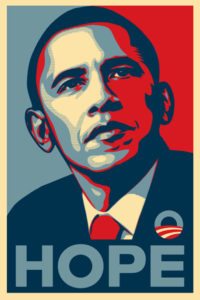
Fairey, a graduate of the prestigious Savannah College of Art and Design Rhode Island School of Design, was best known for his “Obey” campaign with the image of Andre the Giant- until he hit the big time with his Obama “HOPE” poster which may go down as one of the earliest iconic pieces of art from this century.
Before having a sponsored show in Boston, Shepard did what he does- and did some wild postings. That means putting up posters with wheat paste in places where he didn’t have permission.
One persons art, is anothers eyesore. This piece from the Boston Globe sums up the outcome of this high profile case:
Shepard Fairey, the street artist who for decades has plastered his stickers and posters on buildings and street signs, yesterday agreed to stop leaving his mark in Boston.
Fairey, who once told the Globe he had been arrested 14 times for tagging, apologized to the city and pleaded guilty to three vandalism charges.
“People should be responsible about sharing their art,’’ Fairey said after agreeing to the plea deal in Boston Municipal Court. “That is not a transition or an evolution in my philosophy.’’
Fairey said that now that he is an established artist - an ongoing show at the Institute of Contemporary Art has drawn 100,000 visitors - he does not need to tag like he did when he began his career.
“Fortunately, I am in a place in my career where I can get sanctioned places,’’ he said. “So, it’s not an issue I will ever have to worry about again. . . . There should be more public outlets for art.’’
It’s nice that Shepard thinks there should be more public outlets for art- in NYC construction barricades have long been places for posters. Other cities have created legal graffiti areas. However, there is a distinction between permanent paint and posters with wheat paste- I’d much rather deal with the wheat paste than spray paint. This doesn’t give anyone the right to place posters, ads, or tags anywhere they want.
Microsoft tried to cover NYC with static cling decals- and got caught. Is chalk on sidewalks OK for advertising? That too is up for discussion.
As we assault the public with non-stop advertising messages, the realm of outdoor ads is just too lucrative to ignore: they can’t be ignored, tuned out, skipped past. However, legal outdoor like billboards, vehicle wraps, mall signs are expensive when compared to the guerrilla style postings that got Fairey in front of the judge. For a $2,000 fine and a lot of publicity- Fairey came out ahead.
For the rest of us, it’s a warning. Future cases won’t be so easy or cheap.
The advertising industry has powerful lobbyists protecting billboards and other big media. The Next Wave believes that the industry needs to make a case for different access to local affordable outdoor- like bus shelters, legal posting areas- for local businesses as a part of making place and local wayfinding. Small business makes this country run- and yet, when trying to compete for space with powerhouses like Procter & Gamble, the little guy often gets squeezed out.
Shepard can afford to pay the fine these days. As he says- he now has access to galleries. Were all those arrests and court cases worth it? Obviously.
Guy Kawasaki once wrote that “Advertising is the plastic surgery of business,: a procedure to make ugly and old products look good” in his book Selling the Dream
However, the business of business has become corrupted by charlatans practicing what can only be called some kind of voodoo economics- be it in banking, insurance, or even selling cars. We’ve started taking our own economic buzzword driven drivel and packaged it into arcane business models- ones that suggest that selling “Credit Default Swaps” is actually business instead of grand theft.
I recently questioned if Venture Capitalists, as they practice their craft now are anything but parasites. With the casinoization of Wall Street- where stock prices can drop by half, even when a company hasn’t changed it’s products- business model or suffered from any change in demand (Google during the current financial meltdown), is there any reality attached to the very real and tangible ways to define and guide business?
Either you have solid financial goals, objectives and strategies- with real products and services that fill a need, or you don’t. Back in the dot.com bomb of 1999-2001 we had VC backed online companies opening only to go out of business the next day (www.bigwords.com ended up at a local liquidator- the breadth of the offering was amazing- Amazon like, when all indications that laser focus is the key to most online success).
I lay the blame purely on the shoulders of Wall Street and Bull Speak. You know, the ability of CEOs with no “skin in the game” who are able to “push the envelope” inventing new “ecosystems” for “profit optimization through….” while forgetting the basics of business, which is providing goods and services that fill real needs.
So, I was ecstatic to find this:
Bull has become the official language of business. Every day, we get bombarded by an endless stream of filtered, jargon-filled corporate speak, all of which makes it harder to get heard, harder to be authentic, and definitely harder to have fun. But it doesn’t have to be that way.
Also comes with a downloadable BullFighter software program, which allows you to analyze your Microsoft Word document for a BS quotient. If there is one thing that stops advertising from being able to do its job- making the “ugly and old products look good” it’s the clients inability to clearly describe the market, and the product without lapsing into bull speak.
Copy god, Howard Luck Gossage once famously said “people don’t read ads, they read what interests them- and sometimes it’s an ad.” If you try to read some of the horse hockey coming out of our corporations, talking about “making paradigm shifts” when what they really mean is we can’t clearly tell you why we do what we do, but you should still believe our CEO is worth $2K an hour- and we’ll be lining up for a bailout from the Federal Government as soon as we figure out how to explain what we’ve been squandering our stockholders money on.
Business and advertising both are easier without bullshit. So go get your Bullfighter now- and lets work together on selling stuff.
We won’t confuse you with anything that won’t directly impact your bottom line (translation- make you money).