There has been a movement to “marketing as a service”- where the customer is rewarded for their attention instead of bothered by it.
Good advertising makes fans/friends, good service makes customers for life.
Google decided to spend their marketing money giving customers something that is useful: free WiFi at airports (note- at least two on the list already had free WiFi- Las Vegas and Jacksonville).
When you’re traveling this holiday season, you can enjoy free WiFi at 47 participating airports and on every Virgin America flight. Just bring a WiFi-enabled laptop or mobile device and stay connected to family and friends for free while you travel now through January 15, 2010.
The real question is why most airports haven’t realized that business travelers, who are their bread and butter, would tell you that WiFi is more (or at least equally important) as toilet paper in the bathroom stalls. In the hyper-competitive market for business travelers there is no excuse for not having both free WiFi and plenty of charging stations/power outlets for the power traveler.
What can your business give away to build goodwill? What information could you provide that makes you not only the expert in your field, but invaluable to customers? Make every interaction with customers one where you give them value and they will value your business relationship.
“Because the purpose of business is to create a customer, the business enterprise has two–and only two–basic functions: marketing and innovation. Marketing and innovation produce results; all the rest are costs. Marketing is the distinguishing, unique function of the business.”
Yet, time after time we see companies trot out responses to competition that aren’t much different than the competition. Witness the box like car pioneered by the Scion Xb, then the Honda Element, and now the Nissan Cube. Honda misjudged the primary market so badly for the Element- thinking young hipsters would be the primary market- and it ended up being a car for the practical geriatric set (don’t worry, Chrysler had the same experience with the PT Cruiser).
And then there is a crazy inventor named James Dyson. The man who made 5,127 prototypes before coming up with the vacuum that doesn’t lose suction as it does its job. Not only did the vacuum work better- it also looked better- bright yellow, in a land of beige and brown. It also proudly displayed your dirt- something other vacuums were skittish about.
He was able to charge a premium for his product, not because of better marketing, but because he had built a better product. How many times would I rather get a better product than a better advertising pitch: it’s a no brainer, every time.
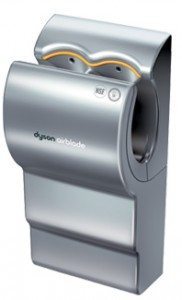
Dyson Air Blade hand dryer
But the key to the Dyson brand is that they’ve continued to offer products that don’t look or act like other products. Just adding a ball to the vacuum wasn’t enough, next came the hand dryer- the “Air Blade” the scraped the water off your hands with one simple swipe through a wall of super fast air. It cut the time to dry hands by a third compared to other air dryers.
Now, Dyson introduces a fan- like no other. And, while the fan looks different, works different, it also solves a major safety issue (which I only found out once I tweeted about it- and a friend instantly retweeted- kid safe, no fan blades).
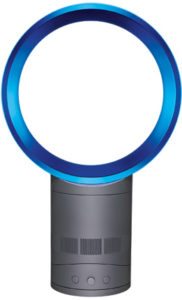
Dyson Air Multiplier fan
Sure it costs about 10 times more than the fan you can get at the local superstore, but, that’s what real innovation does- it gives a business a distinct competitive advantage. Here is the description from Dyson:
The Dyson Air Multiplier™ fan works very differently to conventional fans. It uses Air Multiplier™ technology to draw in air and amplify it 15 times, producing an uninterrupted stream of smooth air. With no blades or grill, it’s safe, easy to clean and doesn’t cause unpleasant buffeting.
Spend millions of dollars to tell us that they’re the Friendly skies- but break one guitar, try to deny a claim- for several years, and it all goes bye-bye faster than a rocketship.
One week after Dave Carroll, a relatively unknown singer in a band called Sons of Maxwell, released a music video called “United breaks guitars” he’s had over 3.3 million views. It was all over twitter the very first day of release, and United was finally making apologies two days later.
Companies can’t afford to tick off customers anymore- because customers can fight back.
Taylor guitars took the cue from the video- and posted an info video to talk to guitar players about how to travel safely with their guitar, and offered to repair their competitors guitars, should this happen to you:
Of course, while United has spent literally millions to associate themselves with Gershwin, I’m pretty sure that for the next few years- Rhapsody in Blue won’t be the first thing many people think of when they think United.
In fact, the total absence of information on the United site- about this, or on a response from United on YouTube, instead- having Dave Carroll telling folks that United decided to pay up after the release of the video, show United just doesn’t get it.
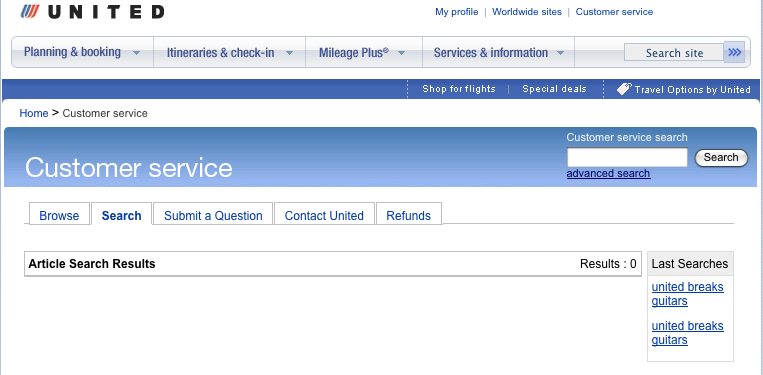
When you search on their customer service site- it says it all:
Screenshot from United Site for United Breaks Guitars
This is not how to respond to 3 million plus views on YouTube.
So, remember- next time a customer calls with a complaint- think of it as an opportunity to create a good news story, ’cause the bad news one will hurt.