Insights
How to Prep for a Conference: Lessons Learned from NVSBE 2018
This was our first National Veterans Small Business Engagement conference/trade show. We weren’t alone, there were a lot of people there for the first time and some were overwhelmed. This is a big event, with a ton of opportunities. We thought we’d put together a guide for next years attendees, (in Dallas) and we’re asking the people we met to contribute their tips and tricks as well.
This year, the VA decided to hold the SAME conference at the same time. This caused a little bit of confusion since each show was run under different contracts and had different ways to access data. The SAME folks had a smart phone app, the NVSBE team had a mobile friendly website. As developers, we think that the proper way to do this is with a mobile friendly site, but then again, we’re not the ones billing the government- apps cost more 🙂
We’re assuming your business is a going concern, and that you’ve done the normal dance of registering with the government and Dun & Bradstreet. If you need a checklist,:
- For small businesses that are beginning to market their services and products to government agencies, you can try local resources like SCORE or PTAC (Procurement Technical Assistance Centers) and your local SBA office.
- Obtain a DUNS (Data Universal Numbering System) Number from Dun & Bradstreet at https://www.dnb.com which is required for registration in SAM (see next item).
- Register on the System for Award Management (SAM) https://sam.gov/SAM, if your firm is registered keep the registration current by updating yearly. The FAR (see below) requires that a firm be registered on the SAM to receive a contract award.
- Know the North American Industry Classification System (NAICS) code and the Federal Supply Classification (FSC) code for your product or service. Most federal procurements are listed by their NAICS or their FSC code. Small business size standards vary by different NAICS codes.
- Complete any certifications which may be required (see Federal Acquisition Regulations (FAR) Part 19).
- If you are a Service Disabled Veteran Owned Business, register and get certified by the VA. If you are a HUBZone, do so with the SBA.
- If you have a GSA schedule, you are already ahead of all of us, and have completed all of the above. Start the process of getting a GSA Schedule here.
1. Pre-conference preparation
These may be the most important steps you take. I’ll cover conference tips in general first and government contracting tips second.
Go to LinkedIn and make sure your profile is up to date. Have a current photo, title, and most importantly make sure you have your contact info in place. Look spiffy and have a custom URL for yourself.
Set up a contact card on your phone that you can share with people via text or email. Here’s a great post from PC World on how to do this for both Android and iOS. Yes, we print business cards very inexpensively and think you should have them, but, contact cards are fast and easy, and make it easy to stay in touch with folks while they are at the show.
We’re not against you registering for a Gravatar, which attaches a photo to your email address online for CRM systems and guest posting, like on this site.
Check your website to make sure that it is both secure (https) and mobile friendly (look at it on your phone, if it looks like your desktop view and you can’t read it- it’s not). This is Google’s advice since 2014 and not only will it help you get better search results, it’s just good web practice. If you don’t see the little green lock or HTTPS at the beginning of your site, you can call us- we help build websites that work.
Search for your business on Google and find your Google local/Google my business listing. It will be on the right of the search results on desktop- and make sure that you’ve claimed your listing. Put your hours in, your business description, photos of your office, etc. Manage any reviews- and most certainly ask your clients for reviews. This mostly applies to businesses that aren’t global in scale- but, is still a critical practice. You want people to be able to find you on Google maps etc.
Click to download a reduced resolution PDF of our introduction brochure
Have some collateral materials, eg. brochure, flyer, handout. Something that someone can have in their hand that sums up everything they need to know about your business in a glance. Yes, your website can do this, however, people are going to meet so many folks their heads will be spinning. Something that’s unique, branded, clear, and preferably a good filing size is highly recommended. We can help you with design and printing. Depending on your business, these can be hard to craft, we highly recommend that you don’t create a laundry list of bullet points. Tell a story, make people feel good about working with your company, explain your successes. No one wants to read a checklist.
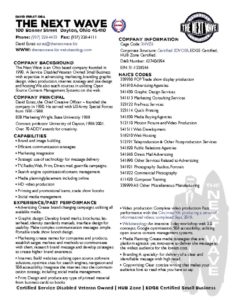
Click image to download David Esrati, DBA The Next Wave Marketing Innovation capabilities statement as a PDF
The government types want a “capabilities statement” and they want it in a very specific format. We’re including a link to a Word Doc checklist from the Department of the Interior, and a copy of ours, which has hyperlinks. The key is to have your critical government info in the top right corner- ie CAGE Code, DUNS number, what socio-economic programs that your business holds, and contact info. If you are a SDVOSB- make sure the logo is on it at the top, it’s like a bullseye for contracting officers. There is no logo for HUBzone, but there is for 8(a) and may be for others. We made ours a pdf (we never recommend sending word docs) and it has links built in. You should have printed copies of this, with your business card stapled to it so they don’t lose them (this from a contracting officer).
If you are going to go to a conference as an exhibitor, you’ll need to plan for a way to meaningfully capture potential customer information. The drop your business card in a fishbowl approach is one way, but, for conferences of this size you want to use the badge scanner to collect data of your booths visitors. And while promotional items are nice, most conference attendees have limited luggage space to haul your bounty back. Our advice is always to offer things that can be shipped to the “winner” and be valuable enough to make it interesting. Sure, that little spray bottle of hand sanitizer may be handy at a conference, but, do I need it once I’m back in my office? How many pens, bottle openers, small USB drives, pop-sockets (yeah, that’s an actual thing) do I need? Even the one useful item I brought back- a USB charging cable that had 3 different types of charge plugs, isn’t going to be among my favorite memories of a conference. Give me a trip to Hawaii- I’ll be forever grateful. Think about the value of customer acquisition- and make the prize equal to the cost of a major contract lead. Remember, these things aren’t last minute, and need real lead time to plan.
I saw a multitude of trade show displays at NVSBE. There were three hard hat dive helmets on display- I’m guessing each company did underwater construction work, but, what do I really remember about their organization? There was only one truly creative booth- where a group of businesses representing “The Space Coast” got together to create “Bourbon Street” as an area to interact with potential clients- without having a table in front of them. If you are doing banner stands, our prices can’t be beat, and if you want a more extensive booth, we can help with that too- but, remember the most important thing: your booth isn’t a brochure- it’s more like a stage set. Don’t put laundry lists of services on it. No one wants to read your capabilities statement in the middle of a busy trade show aisle. If you have video- have closed captions, because no one wants to listen to your 3 minute video repeating all day long. Even though the show started on Halloween, the days of trade show candy as a way to pull people in are over. We’re already eating too many rich foods thanks to the event catering. Unless you make or sell food- giving it away isn’t going to bring the kind of customers you want. However, one exhibitor had a keg of craft beer- which got them a great line, but, probably not great interactions.
2. Pre-conference planning
Visit websites of federal agencies that your firm is interested in doing business with to learn about what kinds of projects are needed by the agencies.
Look for their Forecast of Procurement opportunities and identify which opportunities best match your capabilities.
Attend agency Small Business Outreach events and agency sponsored Matchmaking sessions. Individual agencies Office of Small and Disadvantaged Business Utilization (OSDBU) websites will have a listing of the time and location of the events. Some of this is as simple as the conference registration software matching NAICS codes. This is why early registration is important- so you have time to pre-plan and research each agency you are going to meet with.
Visit FedBizOpps, https://www.fbo.gov/ , the Government’s single point of entry portal for contracting opportunities regularly. It will also send you alerts for opportunities matching your NAICS codes. However, the reality is, that most of the time, by the time an RFP hits FBO, there are people already in line for the contract and you probably are late to the party. Remember, contracting officers are usually turning to FBO after they can’t find a firm with a GSA schedule to do the work.
Pursue Subcontracting opportunities. There are various subcontracting opportunities that are available. There is not a single point of entry for subcontracting. SBA’s SUB-Net, is a resource for information on subcontracting opportunities. Warning: the SBA login functions are horrendous. Many small businesses come to these conferences not looking to land a federal contract, but to become part of a bid with a large prime contractor. When you’re a small business, almost every company there could be a customer, partner, or vendor to you. Make sure you come to the conference with an open mind and open arms. If you are an SDVOB or HUBZone business- large contractors have subcontracting goals. They can sometimes be very welcoming.
Look closely at the list of attendees, learn about other companies that you think you can work with. I had 2 meetings the day before the conference with CEO’s of companies with a lot more experience than me in the area of federal procurement
3. At the conference
If you go with a group of co-workers, don’t go to the same sessions, don’t sit at the same tables, and don’t talk to the same people unless you need to. The idea is to make as many contacts as possible. Introduce yourself at every opportunity, and if you stand up in a session to ask a question, state your name, business name and really fast elevator pitch- you have the microphone, use it.
When you sit down with Government personnel emphasize that your firm is able to respond quickly to solicitations and that your firm is ready to perform the work when and if you are awarded a contract. It helps if you know what they are in looking for in advance.
Build a positive working relationship with the Small Business Program Office of the agency you would like to do business with. This means try to sit at their table at a lunch, not just at the one-on-ones.
If you are in a session that’s not very good, get up and find another. Always try to have a plan B. You only have so many hours at the conference.
Many times large companies host evening events at nearby hotels. Try to wrangle your way into them. If you want to look like a large company- host one. Just be aware, this isn’t where business is first on the agenda.
Take notes on everyone you meet. If you have a CRM, this is the time to use it. Enter in the details of your conversations, and notes to help you build the budding relationship.
Be a connector. Try to bring people together that you think can benefit from working together. Karma is your best friend at trade events.
4. Post Conference
While you can start connecting on LinkedIn at the conference, it helps if you add some details to your invites about how you can help your best targets in your note with your invite.
Put together a package to email to your prospective contacts. For me, an invite to read and contribute to this post, and watch the video we put together is part of the way of building relationships. For you, rely on your notes to make things as relevant as possible.
Determine which agencies are the best fit for your company, and try to arrange follow-up meetings when you’re not part of a cast of thousands.
Write your own after-action report to help plan for the next year.
If you found this post valuable, please, take the time to comment, and add any other suggestions you may have for other first time NVSBE attendees.
6 easy steps to an iconic brand… you wish.
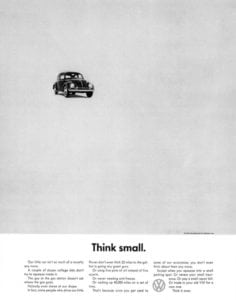
The ad that launched the creative revolution.
Very few agencies get to launch an automotive brand. Cars are special. They’re expensive, they are an outward representation of their owners personal positioning (at least in America), and automotive brands have a special place in advertising folklore. It was VW with DDB that launched “the creative revolution” with the iconic “Think Small” ad.
Notable brand launches have mostly been new luxury nameplates from Japanese companies, Honda with Acura, Inifiniti with Nissan (which had to make the change from Datsun to Nissan before this) and Toyota with Lexus. Others were GM’s creation of the short lived Saturn, Toyota with the even shorter launch of Scion, and then Tesla.
Crispin Porter + Bogusky was asked around the turn of the 21st century to relaunch the Mini Cooper in the USA- now that it was owned by BMW. They thought they had a monumental task with a relatively small budget.
In early 2001 American roads were dominated by SUV’s – the fastest growing segment – and light trucks was the most popular segment in the category. Japanese and German brands dominated the import segment and gas was $1.25. Bigger was better. Small car sales were at their lowest point in 15 years.
MINI’s heritage was British, which was synonymous with unreliability in the car category.
Source: Gold Award Winning CP+B Mini USA Entry – Adweek
The deck was stacked, and to top it all off, there were only 2 cars in the line, the Cooper and the Cooper S. The first step was to identify what makes a brand a brand:
We did an exhaustive study of iconic brands across a variety of categories and discovered six characteristics common to iconic brands.
1. A defining signature look
2. An ability to elicit a physical or emotional reaction
3. A tendency to take on characteristics outside their category
4. A tendency to own a unique benefit within a category or create a new category altogether
5. An ability to connect with and reflect the attitudes and values of a broad user base
6. A tendency to break conventions and reinvent to stay salient
ibid
From there- sort of work backwards to find the mojo. With Mini there were several clues.
The car doesn’t look like any others- it’s funky. It also is a blast to drive. They worked that into the brief:
- Showcase the defining look of the new MINI – its size and contrasting roof.
- Create as many opportunities as possible for people to come in contact with the new MINI so they could experience its smile generating magic.
- Subtly anthropomorphize the new MINI.
- Communicate our unique benefit – life-affirming exhilaration at an attainable price.
- Emphasize customization and individual self-expression.
- Use non-traditional media and traditional media in very non-traditional ways.
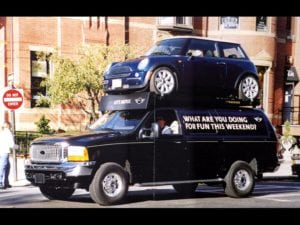
“What are you doing for fun this weekend?”
ibid
CP+B took this insight and did some testing. They created an “exhilaration scale” to clarify the price to WOW factor. And, then, they started looking for the definition of that experience.
At first they called it “going”- as opposed to driving, which was the operative industry word. Then, someone stumbled onto “Motoring” - it was driving- with a British twist- and “Let’s motor” was born. That, along with the badge, and distinctive non-traditional media, lead to a launch that out-lived some other small car brands (Scion) despite the car not excelling in the reliability or cost of ownership like the other newer brand launches.
Once they had a tagline, there were ads, and then there were stunts. Lots of stunts.
The ads were out of the box. Literally. Like putting a Mini Cooper on top of an SUV and driving it around a city.

“hello”
The key takeaway from this post are things we at The Next Wave preach in our tagline, Create Lust • Evoke Trust. To do that, we look at those six characteristics everyday. We search for universal truths that build easy inroads to consumers psyches, and then find a way to elicit emotion that sets your brand apart from your competition. It’s what Steve Jobs did at Apple with ease of use, putting the customer first- and creating “Bicycles for our minds” - something simple- and easy- and loved, to move people from thinking of computers as distant machines that spoke an arcane language, to “hello.”
There are other iconic brands that found a powerful voice through better positioning. We’ll list just a few.
- “Just do it” from Nike
- “The Ultimate Driving Machine” from BMW- which they walked away from, and have recently started edging back.
What would make your list.
If you’d like to discuss crafting your iconic brand, we’re here to help you find your insight and give you the tools to own your position in your industry.
How to be a great advertising client (or “10 commandments for creative excellence”)
![BEFORE YOU WORK WITH AN ADVERTISING AGENCY, READ THE 10 COMMANDMENTS FOR CREATIVE EXCELLENCE [SO YOU DON’T BLOW IT AND END UP POINTING FINGERS]](https://thenextwave.biz/wp-content/uploads/2018/07/How-to-be-a-great-client.jpg) A friend gave me a copy of Dick Wasserman’s 1988 book “That’s our new ad campaign…?” and I started digging in. Wasserman approaches the book as an effort to help everyone, from the CEO to a student understand how to tell a good ad from a bad one- via a system.
A friend gave me a copy of Dick Wasserman’s 1988 book “That’s our new ad campaign…?” and I started digging in. Wasserman approaches the book as an effort to help everyone, from the CEO to a student understand how to tell a good ad from a bad one- via a system.
Inherent in this story is a look at “how the sausage is made” and he is very clear that clients need to bring their A game to the table if they want great advertising. He cites a CEO who made a conscious effort to get better advertising.
Reuben Mark was the CEO of Colgate Palmolive- who made waves by hiring agency folks to run his marketing efforts and to manage their agencies. He was involved, but trusted his people to do the creative. He also realized that his agencies had to make money and actually raised their compensation level.
Here are Reuben Mark’s ten commandments for creative excellence, as listed in Ad Age:
- Be the best client they have.
- We must really care.
- True partnership/mutual trust.
- Ask for excellence.
- Clear, honest direction.
- Look for the big idea.
- Streamline approval procedure.
- Personal involvement of top management of client/agency.
- Ensure agency profitability.
- Be human.
The chairman of every corporation with an ad budget would do well to make these ten commandments his guide for dealing with his ad agencies.
~pg 26 of “That’s our new ad campaign…?” by Dick Wasserman
Much of this amounts to respect of the ad agency by the client- and an understanding that the big ideas won’t come if the foundation of the relationship isn’t solid. When you look at brands that consistently do great advertising, year in year out, you usually see a long term client/agency relationship. This has gotten harder and harder as we’ve come to believe that hiring a star “chief marketing officer” with an average tenure around 2 years, is a good way to manage marketing.
Typically, the best relationships are directly between the CEO of a company and the Chief Creative Officer of the agency. Look at the relationship between Steve Jobs of Apple and Lee Clow of TBWA\Chiat\Day, or Dan Wieden of W+K and Phil Knight of Nike. Those are the kinds of relationships that have generated some of the greatest ad campaigns and concepts of all time.
Clients who think their agency shouldn’t be bothered by being involved in something as mundane as an email blast or the design of a welcome packet- often miss the bigger picture of a clear brand voice. Jobs was fanatical about reviewing every single campaign, every package design because he knew brand voice was critical.
When it comes to the establishing of the relationship, clear contract terms are to be assumed; what is the client getting for their retainer or contract rates. If you approach an agency asking to pay less, don’t expect more, no matter how big you are in comparison to their other peers. A communication system, be it an online project management portal, or something like #Slack should be included in the working agreement. Not only should the means of communication be clear, but also responsibilities for responses as well.
But most importantly, if you want creative excellence, look for passion in the voices of your agency. Hire what Crispin Porter + Bogusky calls “ad people” well, they used to hire ad people.
Which isn’t what they used to say in their Employee Handbook from 2004.
AD PEOPLE.
These are the weird and wonderful people who are at the core of any great agency.
Just because you work at an ad agency doesn’t make you an ad person.First, ad people really love ads. They like to talk about them. They like to read about them. They like to see them. And they love being involved in their creation. Second, ad people are deeply interested in the advertising industry.They know which agencies have what accounts, they know which people are doing great things at other agencies.
They know what the trends are and they follow accounts on the move. They are emotionally involved in what they do. If youre an ad person, you have a career here. If youre not an ad person, you have a job. Whichever one you are, its worth taking the time to learn about the ad industry. Its like the old saying goes: the worst day in an ad agency beats the best day a bank ever had.
Passion is what really separates good agencies from the great ones. Just never mistake winning industry awards as passion for the craft. Awards are nice, but results should always be more important.
In what I consider the seminal book on advertising, “Hey Whipple, Squeeze This” by Luke Sullivan, he has a section where he he describes the disconnect between many clients CMO career path, vs those on the agency side- typically, one comes up through sales, and the other- comes up through- well, the creative consulting side of things. Really awesome clients ask their agency what books on advertising to read, and great agencies ask the client what they should read about their business. We have a booklist, but are really happy if our clients just read Whipple.
We have our own theory of what makes client/agency relationships create synergy: think of it more like a marriage, and not a contractual relationship. Choose your partner wisely, and realize, that gestation of a great campaign usually takes slightly longer than that of a baby. W+K wasn’t Nike’s first agency- who came up with “there is no finish line” but it was a few years after Nike moved the business to W+K when “Just do it” was introduced.
There is a learning period, and it’s not something that can be sped up. Clients who invest in teaching their agency about their business, usually get much better creative solutions. In a data driven world, this also means sharing not only web logs and analytics, but actual sales figures, customer data, and costs involved in making a sale. This is how targeting and marketing automation tools get optimized.
What may be the most overlooked aspect of the agency/client relationship however is what are the clients real objectives. Is it to get big and get bought, to maximize profits, to build the company, to be a leader in their field? While it may seem obvious, it’s not always clear to both parties and sometimes this is where the disconnect is. Steve Jobs was building “bicycles for our minds” when he launched Apple Computer. Watch him explain how he came up with that expression, and then figure out what does success look like for your agency/client relationship?
Apple computer may have grown to be the most valuable company in the world, but, since Jobs has left the planet, Apple has also seemed to lose his idealism. Apple doesn’t seem to remember its roots of being a company that helped you evolve and move the human race forward and that’s too bad.
The final word of advice in being a great client, and getting the most out of your relationship is to hire people who believe in what you do. We won’t take vape stores or manufacturers as clients, just like we won’t take on tobacco companies. We’re also not interested in your micro or macro beer brew operation, your distillery or your gun store. It’s not because we don’t think you deserve great advertising, it’s just that we aren’t going to be passionate about working on those types of accounts.
If you found this helpful, please take a moment to add any advice you may have for being a great client. Thank you.
Writing the best “please hire me at your ad agency” cover letter (internship applications 101)
In the land of ad agency cover letters, what stands out?
You are selling yourself to people who sell things for a living.
Make every word count.
Leave out all the stuff about being a team player, or motivated. Actions speak louder than words. Show us that you not only want to work for us, but that you actually took the time to learn about us.
Some actual cover letters (painful examples):
“To the Next Wave Team,
As a (Insert your majors) Studies major, I have taken it upon myself to seek out opportunities that aim to integrate my knowledge into practical application. With that, I feel that your open internship position would be a worthwhile endeavor to expand my skills and tailor them to the objectives that best serve the The Next Wave.”
Rule #1 - Make it Personal
Find out names of the people you are approaching. This isn’t an ad to the masses, it’s an ad to a real live person at a unique firm. Do your research.
“Hello, my name is (your name) and I believe that I could be a huge asset to your team. I am a graduate of (Insert Favorite) University with a degree in (some related field) and extensive experience in (skill 1) and (skill 2).”
Rule #2 - Know your Audience
What you think is great, sure, but what I think is all that matters. Talking about your school or your experience might be great, but there are legions of people who can say the exact same thing.
“As a confident, articulate and goal-driven production professional with (X)+ years of experience, I am an ideal candidate for this role with The Next Wave. I am a creative problem solver with a demonstrable record of helping organizations meet their goals. My positive attitude, world-class work ethic, and attention to detail have helped me succeed in a variety of operational projects. I take my work seriously and approach every undertaking with enthusiasm, diligence, and positivity.”
Rule #3 - Show, Don’t Tell
This one is important. Instead of talking about skills you think you have, demonstrate them. Your cover letter is an introduction, your resume the reference guide, and your portfolio should be the shizzle/sex appeal/show.
Not that we love to have our ego stroked, but, demonstrating a knowledge of the firm you are applying to says more about how you approach a client than how you get a job. If you want to sell BMW that you are the person who has the skills necessary increase BMW motorcycle sales, the cover letter is where it starts. Same thing with selling yourself to us, or anyone.
Make it easy for us to see that you know something about our firm, our culture, our clients, and how you will be an asset.
This example is overkill, but, when Chase Zreet, who was trying to get a job at Wieden+Kennedy to work on the Sprite account he did a whole video, with real production values. This is what your competition looks like:
Of course he got the job. Even the client noticed.
Getting noticed in this business is our business. Lawson Clarke may or may not be a great copywriter, but he got a lot of attention as the “Naked Copywriter”- and his site, www.malecopywriter.com
Go visit. You decide, is this the guy you would want coming up with your next campaign? Should you be hiring him to help you get the job you think you’re worthy of?
His campaign for a job came out in 2009. I still remember it.
AdWeek magazine has a helpful post: 9 Tips for landing your first job at an advertising agency. Hint, a lot of it applies to your second and third jobs at an agency as well. Other than Lee Clow (2 agencies) and Alex Bogusky (1 agency) most of you will do some job hopping.
So, key takeaways: The cover letter shows you know something about your target market (the agency you are applying to), you have some unique or interesting insight or skills, that will help them make money if they hire you, and it’s memorable. Some people think this means delivering your message like a stunt- wrapping it around a sandwich, which may be attention getting, but, I’m more inclined to be impressed with something that can spread, cost effectively, like both of the job pitches above. You aren’t going to buy the masses sandwiches to buy your product.
Your portfolio, speaks for itself. Including a client brief summaries , as well as Key Performance Indicators Met are the only additions to the work. The work should speak for itself. Clearly state what your part was in the project. Don’t show work others did without giving proper credit.
Resume: Clean and simple. Where you worked, what you did, what you learned. Include hobbies, interests, because, well, interesting people work in advertising. Even working at Burger King can be valuable, if the agency is working on a fast food account- if you can share insight you gained while working there.
And, lastly, make sure your resume has your name in the file name. Make sure it’s a PDF. If you have links in it- make sure they work. There is nothing worse than saying, “i want to look at that Bogusky kid’s portfolio again” and you search your computer for a file with his name attached that was named “My 1989 ad portfolio.” Sorry Alex,
Now, go get ’em killer.
note: I’d asked Alex Bogusky to review this post in an earlier form, and it went tangential, and the post got a re-write. But, here is the advice the Creative Director of the Decades gives:
The advice I give kids is pick three place that you would die to work at. Learn everything you can and do everything you can to weasel in from every angle.
1 place is okay too.
When you are talking top of the world beating agencies the weasel factor is key, because it’s you against everyone else who thinks they’ve got the next big thing in them.