Insights
How to prepare for your first ad agency meeting as a small business client
We had a potential client come in to meet with us today. The meeting wasn’t very productive because we failed to give them a preparation checklist. Our mistake is your gain, because here is a primer for how a small business can get the most out of an ad agency interview.
Picking an advertising agency isn’t like a date, it’s more like a marriage, only the divorce can be much less painful if you plan properly. But, talking about ending the relationship before we start is not a great place to begin- or is it?
Think about your goals in this relationship? When you go into meet with an agency- are you looking for a quick fix to a business problem, or a long term partnership to build your business. We can tell you some stories about quick fixes, but, if this is what you are looking for- let the agency know in advance. The best advertising usually doesn’t come on the first attempt- or even in the first year. It takes time for the agency to learn your business- and for your business to find the right brand voice. Here are some quick things to think about when it comes to prepping for that first meeting:
Who is your competition- and what do they sound like? Bring a list of who you believe to be your competition- and samples of their advertising. Be prepared to discuss what you like or don’t like in their ads.
What makes your company different? Can you make a list of what you do differently than your competition? Can you share some client testimonials or case studies on successes that you’ve had? Differentiation is one of the most powerful tools in marketing. Think about how brands like Harley Davidson or Apple stand out from their competition. Now think about your company- is there a clear differentiation? Is this something you want the agency to help identify or amplify?
What advertising have you done already? Did it work? Do you know how you get the customers you have now? Or if you are a start-up, how do you think you’ll build a customer base? It’s not like “Field of Dreams” -build it and they will come. Please bring all the examples you have of what you’ve done- from brochures to business cards to media buys. This is the first step in establishing the foundation of the relationship.
Are there companies you would like to emulate? Do you have samples of their ads, branding etc? Mostly- this is helpful for the discussion between an agency and a start-up, but, there may be someone who wants to be the Apple of the medical devices industry for instance, where good design and ease of use are critical to their differentiation.
Know why you are meeting with that agency as opposed to the others. There are a lot of agencies out there, all of them quite different. Finding the right one for your business has to do with the size of your agency- and the size of your budget (it’s sad but true). If you are going to be a small, niche, local business- going to a global agency is probably not going to work out. Make sure you research the agency, their work, their client list- and know why you are sitting in their conference room. Don’t be shy- tell them why you like them- and even who else you plan on talking to. Advertising is a pretty small, incestuous community- more than likely, they can guess who else you’ve been talking to- and can probably recommend who you should talk to next.
Never try to cherry pick: Although it may sound like a way to save money, cherry picking some work from one agency and other stuff from another is like being a polygamist. Find a partner who can deliver on most of your needs- and then stick with them. We have a client who thinks that having one company do her graphic design, another do her web development a third do her ads and then tries to buy her printing herself is a great way to save money. What ends up happening is she spends too much time with all her vendors to get the best out of any of them.
Have clear goals for the meeting: know your budget, and what your expectations are. That way, both sides can see right away if it’s going to be mutually beneficial to work together. The last thing you want is to be a client that isn’t worth the agencies time- because you’ll get shuffled off behind other clients if you can’t pay your bills on time, or have realistic ideas about how fast the creative work will work.
Who will own the work. This is the divorce part, and sometimes pre-nups are really good to get out of the way. Many small businesses will need all kinds of print work done- from invoices to brochures. The cost of recreating the files can be prohibitive, so it may be good to stipulate up front, what will belong to you and to the agency. If you make TV spots- who will own the raw footage? Answering these questions now- can save a lot of money at the end.
Lastly- know how much time the agency is willing to donate to this first date, or if you are expected to pay for your consultation. With small budgets, it may be best to ask first how much an hour of the agency’s time is- and be willing to pay for it, you may get some of the best ideas from agencies that won’t let you hire them, but feel indebted to you and share some great thinking.
Remember, one great idea can transform a business. For Nike it was “Just do it”- for Apple it was the idea of a portable mp3 player with a new interface and an integrated music library. In your search for growing your business- remember to keep an open mind on how best to take it to market, and ask the best minds in the business for their ideas. It only takes one really good idea to make you more money than you pay the agency.
Structured content conference and how it relates to marketing and CRM
The DocTrain conferences are a technical communicators think-tank- which is an odd place for an ad agency to be making a presentation- but, when you grok the importance of good support systems in delivering a memorable brand experience- it starts to make sense.
Our presentation was well attended, with heavy hitters from the corporate world and the open source community- as well as a lot of technical communicators who wanted to learn a faster way to communicate with their customers.
The Synopsis started like this:
The lines between a “Blog” and a “Website” are blurring faster than a speeding bullet, yet many business people still think blogs are platforms for personal publishing and self-expression, when in fact, they may be the most powerful tool to connect with your customers on the ‘net today.
Blogzilla: Why Blogs Are The Monster In The Business Closet - Sessions - DocTrain East 2008.
The key concept of modern technical writers could be referred to as Publishing 2.0 - where it’s critical that the content be separate from the presentation, so it can be easily updated and more importantly, delivered through multiple platforms.
The idea of structuring content- using the DITA (Darwin Information Typing Architecture) standard is so far removed from advertising and marketing, that few ad agencies would fit in at this event- but, if you are a large marketer looking to be ubiquotious in your delivery of message, across multiple platforms, languages and culture there is really no other way to control your message.
We proposed that using a WordPress Content Management System may be one way to work quickly at responding to new issues in the marketplace as a “scratch pad” for ideas and content that needs to be refined, typed and structured for general delivery. Speed of response is absolutely critical, as is having Google think your companies site is the first place to look for information concerning your products or services.
Failure to respond instantly is no longer an option.
We saw all kinds of other really interesting applications of technology and strategies for delivery of corporate communications, more on those as the presentation decks are available.
Here is ours:
Is a network of niches the answer to business survival?
With the latest economic crisis, the phrase “too big to fail” has been bandied about as a mantra of justification for a businesses right to exist (or be “saved”) yet, something is starting to sound inherently wrong about “economies of scale” in today’s networked market.
If there is one thing that is clear from The Long Tail, it’s that focused, niche products and services can find their customers easier and more efficiently today than ever before. Communities can pop-up almost anywhere, where like-minded consumers can meet and discuss their passions, without any intervention or support by business (such a community has popped up on this site for fans of WMMS, a rock radio station that dominated the Cleveland market in the late 70’s).
So, as we watch big banks, big car companies, the titans of Wall Street falter, the question of what will survive isn’t as important as what is the business model of the future. I’m starting to think it’s not WalMart, Best Buy, or even Target- although Target has done a better job of finding a target to market to.
It’s pretty obvious that deregulation came along with a total disregard for anti-trust as well. It was deemed anti-business to try to make sure that there was true choice in the marketplace.
The first place to really see the failures of this policy have been the very companies that fought regulation the hardest: the media giants. With deregulated markets we saw the elimination of competition in newspapers and the dumbing down of the press at the exact same time as we moved to an information economy. The answers of big business were to give us less info- at a time when people were virtually drowning in it. The same happened in TV and Radio broadcast, with an appetite for bigger audiences, the money believed the answers were bigger broad market programming, when audiences were increasingly able to pick and choose what fit them best.
The same has happened to mass-market retailers, who can easily be out-maneuvered by niche internet retailers, as long as the shipping costs aren’t too high, or the need to experience first hand a big part of the buying experience.
Even preferences in shopping experiences have changed from big malls to lifestyle centers, with big box “power centers” losing some of their appeal.
All of this points to a future that probably isn’t in the hands of the giants anymore- but to the most adroit marketers who have built a network of other symbiotic businesses to support each other. Working together as a loose network to promote unique experiences, products, services are going to not only be keys to business survival, but of communities, who can’t afford to trust those companies that are “too big to fail” yet still do.
The survival of social networks and open source development depends on the number of users/size of community that adopts the service and contributes. In business, the number of connections that are built, and the sharing of support functions like marketing- will work the same way.
The answer to success in this new economy is less about getting big, but in getting connected. Relationships are more important than ever and the best way to build your business may be by helping someone else build theirs as long as there is reciprocal behavior. Networks of independent businesses are part of the model of Amazon and EBay, two of the most successful online marketers. Google is making inroads by giving away services, software and social connections in return for relationships that can be exploited softly as time goes by.
While we’ve been teaching and preaching the benefits of Web 2.0 for several years, we’re just starting to push our clients to reach out and work together with other similar small businesses. If Goliath is going to fall, it’s because either he’s gotten so big as to miss opportunity- or that the guerrilla’s have organized to out network and out maneuver him.
Just as the transfer of electrons at almost no cost and high speed has changed the media markets, over time, some of our big cities may find that they are having a hard time competing with smaller walkable communities as gas prices rise, as people’s time becomes more valuable and our love of big loses its luster.
Yes, too big to fail now, may be the kiss of death very soon.
It’s time to think of your network and working on your niche.
The Next Wave goes to see the next wave in Advertising: The Ohio University ad clubs winning AOL presentation
One of the things that separates great ad agencies from the rest, is that they are made up of “ad people” instead of “people in advertising.” True ad people, take their Friday afternoon off to go see the students who won the American Advertising Federation 2008 winners of the National Student Advertising Competition instead of drinking beer or heading home.
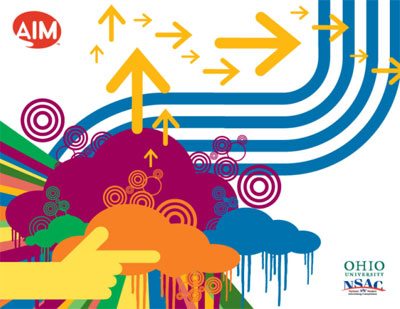
The OU teams planbook cover
The Next Wave was the only ad agency in attendance today when the Greater Dayton Advertising Association invited the 2008 Ohio University team who won our District- and then the national competition with their strategy on marketing AOL Instant Messenger or AIM. From the AAF site is this description of the competition:
the students conducted primary research to study AOL’s target market, including media habits and competitors. The team from Ohio University focused their initial research on how adults ages 18–24 use the AOL Instant Messenger service and its competing social networking Web sites. From there, they were able to determine their objectives and strategies to ultimately design a campaign with the goal of increasing usage by 15 percent. The overall creative strategy for Ohio University’s campaign was to add tabs to the currently existing AOL buddy list. Each tab would link directly to a different Web site, representing the new facets they wanted to add to enhance AOL’s social media capabilities, i.e. a social networking site, music, etc.
The team did some of the same things that The Next Wave does for their clients: coming up with new products or services that enhance the customer experience. Their implementation of a flexible tab bar to the familiar AIM buddy list, not only added functionality to the software service, in became a key part of the campaign tagline of “Keep your tab on _______________”
The integration between their product differentiation, their media plan and the execution strategy was well thought out and reasonable to implement, although the budget that AOL set at $25 million actually gave them too much cash to work with (considering Leo Burnett relaunched Altoids with less than half that amount).
The one thing that creeps me out about these team presentations, that I wish the NASC would stop encouraging- is the style of alternating sentences by team members into one complete canned monologue. I’ve written about this before from when I judged the district 3 year ago. If there are real agencies that do this- as opposed to allowing each expert from an agency present their part of the pitch individually, I’ll eat my kneaded eraser. Some schools even put theater majors up to present- thinking this is some kind of performance instead of a serious business presentation.
There is a complete press release by OU online which includes a informal video of the winning team discussing the process of getting this presentation together. OU were the finalists that were doing this from their club- not as a capstone course, which says even more about the strength of their concepts. Also, it means that the core presenters were all Juniors or below, leaving them room for a return visit next year. The team presenters were: Ryan Dease, Victor Rasgaitis, Liz Follet, Lauren Miller, and Katelyn Mooney. And although they forgot to bring their planbook, which counts as more of their score than the presentation in competition, their advisor, Professor Craig Davis promised he would e-mail me a PDF (thanks in advance Craig). Hopefully, he’ll allow me to publish it here too.
We took our entire office to this free event at the School of Advertising Art in Kettering, where the OU team had presented to the SAA students earlier. It’s too bad that no local school has entered the competition in past years, maybe this year will see a team from SAA. And while The Next Wave was the only agency there in strength today (only about 5 other firms were represented at all from Dayton) which is one of the reasons we believe we are an agency of ad people, not just people in advertising.