
Insights
Apple stole my tools
 Seth Godin doesn’t need more retweets, or shares, but when I read his post this morning, he struck a nerve. His post, “Peak Mac” talks about leadership in your field, and putting named leaders in charge. I believe Apple does that, but as they’ve gotten rich, large, cocky and even more arrogant, they’ve lost a connection to the people who got them there- the ones like Seth and me, who started out with a very underpowered machine (my first was in Jan 1985- a 512K Fat Mac) and we struggled together to make beautiful things against the odds.
Here is what Seth says (and btw- I also was a Ready Set Go guy- long before Quark 3.0 became usable and Pagemaker was still a bad joke).
I got my first Mac in 1984. I was a beta tester for the first desktop publishing program (ReadySetGo) and I’ve used a Mac just about every day for the last thirty years. It occurred to me recently that the Mac hit its peak as a productivity tool about three years ago.
Three years or so ago, the software did what I needed it to. The operating system was stable. Things didn’t crash, things fit together properly, when something broke, I could fix it
.Since then, we’ve seen: Operating systems that aren’t faster or more reliable at running key apps, merely more like the iPhone. The latest update broke my RSS reader (which hasn’t been updated) and did nothing at all to make my experience doing actual work get better.
Geniuses at the Genius Bar who are trained to use a manual and to triage, not to actually make things work better. With all the traffic they have to face, they have little choice.
Software like Keynote, iMovie and iTunes that doesn’t get consistently better, but instead, serves other corporate goals. We don’t know the names of the people behind these products, because there isn’t a public, connected leader behind each of them, they’re anonymous bits of a corporate whole.
Source: Seth’s Blog: Peak Mac
Customer service is marketing
Before buying anything these days, customers are able to find out all kinds of things about your products and your company- with a simple Google search. For many, the first place they may look is a review site- Amazon for general merchandise, B & H Photo and Video for photography gear, or user forums- either run by your company or by your fans.
There are also review sites that are independent, offering testing and evaluation of your product that will tell you more about your product than you probably ever want to know. In photography- you can go to:
- http://www.dpreview.com/
- http://www.shutterbug.com/equipment-reviews
- http://www.kenrockwell.com/tech/reviews.htm
- http://www.the-digital-picture.com/
I own and ride a BMW motorcycle. Invariably, I find lots of good information about outfitting, repairing, or general knowledge about my bike on the BMW forums- which aren’t run by BMW-
Where you can find information from people “just like you” who have the same questions.
All those searches, all those clicks, all those links- which could help the BMW brand grow its brand reach, are on sites where BMW doesn’t have any control.
You know the old adage, a happy customer tells a few people, an unhappy customer tells everyone? Well, it’s your job as the Chief Marketing Officer of your company to make a decision- do I spend more money on ads talking about how great we are, or do I spend that money making sure our existing customers are super happy and only telling a few?
Even though we’re in the business of making ads- we’re going to tell you that great customer service stories out perform any ad. Making ads about customer service stories only resonate if every customer gets that kind of level of satisfaction when they have a complaint/problem/issue with your product.

Tom Peters was into Wow! A long time before the Internet made it so easy to share experiences
Some businesses have distinguished themselves with outstanding customer service. Zappo’s is one example. They focus on creating “Wow” experiences. Don’t believe me- google it: zappos customer service stories. But don’t think they were the first to come up with this, Tom Peters wrote “The Pursuit of Wow!” back in 1994.
We’ve run into clients who don’t want to run a forum on their site to respond to customer issues. “We don’t have time for that” is what they say, yet, when they get call after call about the same issue- they may put up a lame-o FAQ or write a blog post, but only after the 10th call.
Forums are easier to manage than ever, as well as running great help desk type software. The difference between the two is who is answering the questions- on a forum, your fans and customers can work with other customers, while a help desk means you will be running it. We strongly believe that the investment in a well moderated forum is as critical as any large ad campaign. Customers will find out about your arcane policy on battery replacement, or that your manual has a problem on page 37 a lot faster than your staff will.
Smart companies don’t implement “social listening” without having a well supported customer service department to work through the problems. We often find the people involved in social monitoring to be more responsive than those in traditional “customer service” positions. The social media amplification factor of dissatisfaction is and can be deadly. Dell Computer learned this early on in the age of the web when Jeff Jarvis blogged about his customer service nightmare- which he called “Dell Hell” and it blew up online.
Here’s some advertising advice- go Google your products, and problems, and see where you end up? If it’s not on your own site that you manage, get to work. If you need help, you can call us.
And before you hire a celebrity…
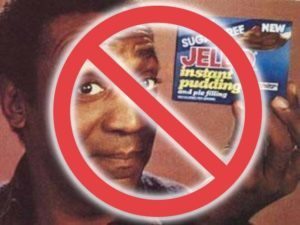
Can Jello wiggle out of this?
Let’s see, we can’t really figure out what’s unique or better about your brand or product.
The boss likes… hobnobbing with celebrities! Great, we’ll hire one, or create one, or associate our brand with one.
How’d that work out for?
- Hertz with OJ Simpson?
- Florida OJ with Anita Bryant?
- A whole bunch of brands with Bill Cosby- including Jello?
- Same for Tiger Woods.
- Kobe Bryant. Martha Stewart. Donald Trump…
Today, Subway’s spokesperson, Jared Fogel is being tied to child porn, although there are no pending charges or proof.
Why risk building a brand on a person who is human and capable of falling from grace? Even if it’s the CEO- Wendy’s has floundered since the death of Founder Dave Thomas.
Find your brand voice and build it so that it has a life of its own. McDonald’s Ronald McDonald, who never goes away. Kentucky Fried Chicken had the Colonel, then they didn’t, then they became KFC, and then after years of floundering- back comes the Colonel, only this one’s a lot more memorable.
Even if for three years, Apple used two actors to say “I’m a Mac and I’m a PC” you didn’t hear them identify themselves- or make claims based on their own credibility.
But, if you insist on going the celebrity endorsement route- make sure you buy celebrity fail insurance, because, as they’ve always said, “the bigger they are, the bigger they fall.”
Don Draper, Coke and the fundamentals of advertising in just a few words
The hint of what was to come in the ending was summed up in this very short exchange in the episode before the finale. Don is asked to fix the coke machine
His response: “Don’t they do that”
Coca-Cola is one of the top brands of all time, and they, for the most part, outsource the “fixing” of their brand to guys like Don. They make the Coke- but, the few, the proud, the brave, come up with the ideas to sell it, which Don proceeds to do in the last scene of Mad Men, sitting on a hilltop, meditating, Ommmmmmm…… ding!
Clients often their ad agenices “to give me a new one” when what they really need is a new way to connect emotionally with their customers.
We have a favorite quote from Guy Kawasaki that fits: “advertising is the plastic surgery of business,: a procedure to make ugly and old products look good” from his book Selling the Dream, and that’s what Don does.
How the big ideas come, is still the magical part of advertising. The really big ideas, almost always fit on a cocktail napkin.