Insights
Low budget ads to start a medical practice
Doctors spend a lot of time in school learning how to diagnose our ills. They run up big school debt. Then they are expected to start a business, usually with very little capital.
Even if they do have money- medical office marketing, as practiced by most physicians maybe one of the boringest categories of all. A picture, a name, a location and “now accepting new patients” makes up 90% of the ads. A few might say something like “specializing in smiles” or provide a laundry list of services or accreditations. Of course, comparative advertising is verboten by the medical society- because as my friend who failed the bar exam 7 times and is now driving a truck says: “what do you call the guy who graduated at the bottom of his class from Medical school? Doctor.”
So, if you do happen to have an exceptionally talented physician, who graduated near the top of his class, and you’ve known since he was just an Air Force captain working on bomb carrying model airplanes and was the kicker for the Air Force Academy, and is a really nice guy with a down home touch… and a small budget to create ads- what do you do?
Have fun!
Who wants to go to a doctor who is already going to bend you over- who runs an ad that looks like he has a stick in his ass before he’s even met you?
Meet Doctor Christopher Blasy, DO, who will not only be your favorite general practitioner if you live in Hinesville Ga, right outside Ft. Stewart and close to Savannah Ga. Besides giving Dr. McDreamy a run for his money- Chris will make you feel comfortable- even if he does have a rubber glove on and is coating it with KY. We had to make that come across in an ad- before he even had his formal “I’m a doctor” picture had shown in our e-mail:
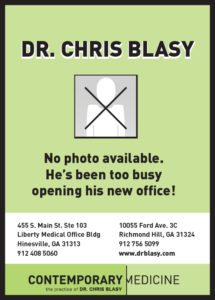
No photo, no problem. Dr. Chris Blasy opening office ad.
The people at the publication got the ad- and offered to insert a bad photo that they had of him- they didn’t get the ad.
When the “official looking” photo came in- with the white lab coat- a standard medical ad didn’t seem right either:

Find the Doctor. This is your first exam.
While it doesn’t exactly say “now accepting new patients” this ad also serves as a social filter- making sure that his patients have a sense of humor (science had already proven that people with a sense of humor live longer) thereby guaranteeing his patients will live longer than the competition. Good marketing can even improve your patient mortality rates- but don’t tell that to the hospitals who still like to run ads inviting sick people in for the highly risky procedures as opposed to working on preventative medicine.
There will be more ads for Dr. Blasy- but we thought we’d share some of our ideas for medical advertising to help other doctors realize your ads don’t have to be as boring as your med school text books.
The power of "Free" in modern marketing
Photo of Free Stamp sculpture in Cleveland Ohio
We have a book called “Words that Sell” and one of the best is the word “Free.”
The obvious question is how are you supposed to make money by giving things away? It all depends on what you are getting in return.
Getting attention is the wrong reason to give things away for free, although it’s unfortunately, the reason most businesses use it. They feel that the only way to get attention or to compete in a crowded marketplace is to give people an offer they can’t refuse. Unfortunately, this is the fastest way to going out of business too.
Sampling is often a code word for free. This is the hail Mary pass for marketers- thinking that if people only try my product once, they’ll be convinced that we have the better mousetrap. And while sampling can work great in-store for impulse type purchases (think the little lady’s in a grocery store offering you food to try)- the problem is that on your return visit- you may not have the prompt without them handing you a taste right there in the aisle. I’ve got a whole collection of razor handles- that came as a demo, but, my ability to find and justify the prices of the blades once in the store stops me from becoming a mach 6 regular.
The real benefit of “Free” comes when the customer thinks they are getting something for free- a service, an opportunity to win etc. without realizing they are in fact giving the marketer something back. These days- the most valuable asset a marketer can hold is a list of real, verifiable, valid potential customers with qualifying data. This is where “free” becomes a marketers best friend.
The perfect example of the power of “Free” as a business model is Google. Google provides a whole suite of “Free” tools to make your life easier- and what you give them in return is more valuable by far than the search results, e-mail service or software- you give them information about you, your buying habits and a fairly complete profile that only gets better with time.
Google knows what you want- and then sells access to you to advertisers in the forms of sponsored ads that are amazingly similar to what you are searching for. You write an e-mail to your friend about a yoga class- and there, next to your gmail message- are ads for yoga books, videos, mats etc. It’s non-intrusive and relevant if you want to take the bait.
Even if you aren’t Google sized, you can use the power of free to finely tune your brand messaging. With media becoming ever more fragmented and more expensive- making sure you are getting your message directly to people most likely to need your product or service can be the difference between making or breaking your advertising budget.
Working with a local orthodontist, we know that our market is parents of kids aged 8-16 and the kids themselves- that may need braces. It doesn’t do us much good to reach people without kids (or seniors who take their teeth out at night)- so by offering a contest to “Win free braces” we create an opportunity to build a database of potential customers so that we can focus our marketing dollars on only those with crooked teeth. In exchange for “Free” we’ve gained something extremely valuable to our small market client.
Another tool was to give away free mouth guard fittings for school aged athletes. You know the ones you boil in water and then press in place. The ones that almost never fit quite right. By buying the mouth pieces in bulk- and providing a branded case for the mouthpiece, we keep our brand in front of a group of influencers in our target market: jocks in junior high and high school.
Besides the acquisition of data, true free offers often generate buzz marketing- where consumers tell each other about the amazing offer. It’s absolutely mandatory that when the consumer follows through- they get what they were expecting. Chick-fil-a and Coke teamed up to offer a free sandwich with an online promotion- but, when I went into a Chick-fil-a to redeem the offer, I was told that they were a “remote store” and the coupon was only available in stores where they make the sandwiches. Needless to say- I’ve not been inclined to go to a Chick-fil-a ever again.
Many marketers confuse discounts with free by offering things like buy one get one (BOGO) offers- or other offers that really aren’t free- but just a price cut. Don’t make this mistake. Free must mean free- at least if you want the maximum number of leads for your business.
Of course, this is free advice, so you can take it or leave it, but, if you are interested in maximizing the effectiveness of your marketing/advertising dollar, never underestimate the power of free. Just make sure you are getting something valuable back from your free offer without the consumer knowing it.
How Newspapers can become relevant in a Web 2.0 world
The prognosis is not good for newspapers, when in fact, they should be kicking butt, but, these mass creators of content are totally clueless. From Media Week is an analysis of what’s happening to the newspaper industry:
Shrinking newsrooms. Falling operating margins. Double-digit declines in ad revenue. American newspapers today are awash in ink—but the ink is red. Soaring newsprint prices and stalled ad business have, in fact, led analysts to call this year the worst for newspapers since the Great Depression.
A recent Pew Research Center survey illuminated the sorry situation. More than half of 259 papers polled reported cutting full-time newsroom staff and the news hole over the past three years. Large dailies have been hit hardest, with waves of layoffs sweeping through the Atlanta Journal-Constitution, The Washington Post, the Tribune and McClatchy companies, and others.
And if you read the whole Media Week Wake for the industry, you’ll be even farther down the wrong road than the papers are as they toodle off to meet their maker. Newspapers should be thriving right now- because they are content creators- and content creators are the mac daddy of the digital world. The problems extend way beyond their model of delivery- they’d do well to go read Nicholas Negroponte’s excellent, 1996 book “Being Digital” to get a clue.
Usually, as an industry is in decline, the best version of the product appears. This hasn’t been happening in newspapers due to fundamental flaws in the idea of separation of editorial content and the business side.
Look at Google to get a clue. 70% of users ignore the sponsored ads- probably like 70% of newspaper ads get ignored too. The difference between the two- is Google understands it’s brought to you by those advertisers and does everything possible to make their ads relevant to the content on the page.
Take that model and look at your delivery of content and ads in any newspaper. No connection whatsoever.
Instead of learning about their readers, newspaper editors have for years thought it was their job to teach us about the world. That kind of arrogance today just doesn’t cut it. There has to be a quidpro-quo in the exchange of news and ideas. We’re not talking TO our audience, we’re talking with them.
Tell that to editorial boards around the country.
Next- we’re living in a world of information junkies. People are in constant contact via computer, pda, phone etc. How any newspaper can live on a “Daily” news cycle is nuts. The actual paper they print on is their biggest mistake. Think about it. A Kindle is $359, the cost of a years subscription to a paper- highly subsidized by advertisers who aren’t getting any feedback at all-is around $200- instead of delivering a one directional piece of daily garbage to the door- doesn’t it make more sense to give them a Kindle with a 2 year commitment? And, then charge advertisers via pay per click?
Instead of increasing content, most are shrinking their news hole. That’s the last thing Google would do- shrink the number of responses it gives. Sure, no one looks to see who comes last out of the 1,287,000 results, but, the reality is- people want more content, they want video, photos, charts, links to relevant information to explore and verify if you are indeed giving them “all the news that’s fit to print” (or in this case “distribute”). The value is in knowing your customers better by watching what they read, what they click on- and then giving advertisers access to the exact customer they are looking for.
No advertiser needs a million impressions of anything. They need buyers. This is where newspapers haven’t made any advancement at all. Even the New York Times who seems to be getting it- still serves me with the same ad for a Westin hotel at the bottom of my iPhone reader- over and over- even though I don’t often stay in hotels- and there isn’t a Westin anywhere near me. Sorry- NYT, you are missing your role in selling the ad right.
Even when Newspapers do build in “Web 2.0” features- few give the consumers who comment any “Respect” back. I’ve not seen a newspaper that provides a subscribe to comments feature via e-mail- which I believe can be easier than adding a feed. Few allow you to build back links to your site- a reason the most savvy bloggers leave comments. And lastly- they insist on limits of 3000 characters- or some other arbitrary “control freak” tendency. Sorry- but space on a hard drive shouldn’t be an issue - you want the people on your site, writing away- for as long as possible.
Some people don’t mind when the Cheesecake Factory hands you a menu that’s full of ads, but any kind of Pop-up, drop down, walk-over or auto-play ad on your site is intrusive and offensive. Newspapers may be desperate for ad revenue, but getting in my way of ease of use doesn’t make me like an advertiser more. It also doesn’t help if it’s not relevant (see above). Car dealers who are used to screaming in their TV ads seem to love intruding on my web reading: here is a hint: STOP.
And if you can’t give up on your multi-million dollar printing press dinosaurs, at least, think about this: design matters. The great copywriter Howard Luck Gossage said “people don’t read ads, they read what interests them, and sometimes it’s an ad”- so how come I can look at beautiful magazines all day long, and most newspapers still look like they were designed either for a LinoType or a comic book? Where is the grace of great typography which we can do faster, better than before- where are the beautiful photos that we can gather 10 frames per second without having to wait for developer and prints? The paper is at the end of it’s existance as a paper- make it great.
Last but not least: CONTENT RULES. While I can get content of the world straight from the horses mouth in any language on any continent at this point- why are you still giving me a menu based on what you think is relevant instead of what I like and need. No, I’m not talking about custom portals- but, figure out how to be intelligent in suggesting other similar content. Give me the links to the sources you used in your research, build a relationship between the news editor and the news reader. It may get dangerous with the best editors building their own following- but, hey, at least they’ll still have jobs, unlike the rest of you if you continue on the path that you are on.
Thoughts?
There is more, but this is to whet your whistle. We’d be happy to teach your newsroom on how to survive in a web 2.0 world. That’s what we do at The Next Wave, marketing • innovation.
Hyper local marketing- advertising for a small business.
There aren’t ad agencies bending over backwards to solve the problems of the micro-enterprise unless they want to win awards, because the value equation just isn’t there. Big clients equal big media budgets, small clients equal no media budget, and even though the media budget shouldn’t have any connection to the compensation of an agency, every one would rather have Burger King instead of Benjamins Burger Meister on their account list.
So, if you own a small business, and may want to be big one day- this post is for you. But, right now, you just want customers and have a small marketing budget and need real answers so here we go.
Branding is the most critical decision you can make. They say “what’s in a name” and the simple answer is everything. Yet, I don’t know how often little thought is given to the corporate moniker and the associated mark. This will be what you have to live with for the life of your business. The name needs to be unique, catchy, have meaning, be memorable- and preferablly spellable with out having to go to phonetics.
Here’s the short don’t list:
- Don’t name it after yourself, in case you ever want to sell the business. Yes- I know it worked for Ford, Chevrolet and Chrysler and Toyota, but, there was no Mr. Scion, Mr. Lexus or Mr. Infiniti.
- Don’t name it after the location- in case you ever have to move the business ie. Dorothy Lane market has three locations- none on Dorothy Lane.
- Don’t make it cute using numbers for words or abbreviations- ie. Marketing4Performance or Gold4yaMouth.
- Don’t limit your business by a technology or what you do- ie. “Muffler Brothers” does complete car care and “Dayton Electrolysis Center” now uses lasers to remove hair.
After naming comes the brand mark. Nike originally paid $35 for the “Swoosh” and thought it would never be as good as the Adidas 3 stripes which actually helped reinforce the shoe. Next Computer paid Paul Rand $100,000 for their logo- only to have the company last a few years.
Rule of thumb- it’s not a good logo if only you would ever want to wear it. Invest in a good design.
15 years ago, the URL wouldn’t make a difference- now it does. It’s preferable to get a dot com address- even though search engines have made this really irrelevant (a good site will be found no matter what). Find something people can spell- like www.smileodontics.com as opposed to www.phonyx.com
The importance of a website that can be searched and indexed is absolutely critical- and it’s why we teach our Websitetology seminar at least once a month in our market. Small business can’t afford to either have a static website that isn’t updated frequently, or an over the top Flash site that looks uber cool but can’t be updated or found. If nothing else, make sure your business is listed in Google local.
While we could spend quite a bit of time on building a better site your website must have the following:
- a search tool
- a way for customers to comment
- an RSS feet
- a unique URL for each key concept or product
- webstats
- content should be separate from presentation.
- Blind friendly W3C section 508 compliant
All of these can be accomplished with an Open Source Content Management System. If you don’t know what some of the above mean- spend some time on our websitetology site.
While having a great brand and site are a good start- the real problem is how to tell people where you are and what you do- FOR THEM. It’s not about you- it’s about how you solve your customers problems.
If you are a restaurant- what will be different, what is your value proposition, what kind of experience you will provide. This was dubbed “The Unique Selling Proposition” or USP- and today it is even more relevant. In a web 2.0 world where ideally, the consumer is all knowing of all options available, how will you convince them to buy from you? While paid media was the method of choice for the last century, recent studies are suggesting that 57%+ of internet shoppers are more likely to trust “someone like them” than a professional reviewer. Remember where we said customers need to be able to comment on your site- well, either they’ll comment on yours- or someone elses (this restaraunt lasted a little over a year).
Building links to the community isn’t any faster than building an ad campaign. No one shot silver bullet solutions- it’s a long term commitment to forging ties that connect you to your marketplace. Sure, sponsoring t-ball leagues doesn’t seem like a sophisticated marketing strategy, but for an orthodontist, it’s one way to reach kids that will probably need braces.
Mass media is failing small business miserably. While local broadcast TV used to be a viable solution- with the addition of first cable, then sattelite, then competing IPTV over phone lines- it’s becoming less of a BROADcast and more of a hit-or-miss cast. Local radio is now splintered by multiple formats, owned by a very few companies, providing very little localization. People are tuning into internet radio, podcasts and their own personal music servers (iPods). Newspapers are losing readers in droves in print- and picking up readers online- yet, the ads they serve are just as untargeted as before. Until these media build a marketing profile of their customers to gain permission to provide focused marketing in exchange for their content it’s still a hit-or-miss marketing strategy.
This one-to-one marketing relationship is the holy grail of our current media landscape. The best example of providing meaningful targeted advertising is now coming from “sponsored search” where marketing messages are keyed to the topic you are searching. Google has become a mega brand and a powerful force in media by only showing text ads that relate to the searches you are making. No pretty pictures- just words based on your words. Even though 70% of searchers ignore the sponsored ads, these may actually be the best option for small business available. Even with the spectre of click-fraud, and high cost per click, at least the ad is being served to someone looking for your specific product or service.
Ideally, you are on the first page in organic search. It can be done for any business, if you make the effort. Instead of spending time cold calling or shotgun marketing- work hard at building your site to be the “expert’s answers” to your customers problems. We provide the most complete listing of our competition for ad agencies in Dayton on our site as one way to make sure we are considered in a customers search for an ad agency. You can do the same for your local business, or join in a trade association that keeps a list.
While we’ve spent quite a bit of this post on internet strategy, old fashioned Public Relations (PR) and event marketing should also be part of your plan. Even though readership is decreasing in newspapers- there is nothing like an article on your business to build awareness. Look to become friends with local business writers and bloggers- and be available as a source. Any time there is a new development in your field, make sure to write about it on your site- to share your expertise on the subject.
Knowing your customer: We can’t stress enough the importance of getting at least a name and e-mail address from every single customer. Comment cards in restaurants can be a great tool- but only if you reward your servers for getting completed cards from every table. A simple bowl to enter to win a meal, or movie tickets can be your best source of leads for your next promotion.
If you are still reading at this point- you must really care about marketing your business and want to differentiate your business from the competition. Here is the magic that makes small business work- you have passion for what you do, and love being the best at what you do.
Often times this means not taking yourself so seriously. Seriously. Have fun, make your business the place that people like to talk about, make your ads that you do run- fun, friendly and funky. We once names an electrician “Singing Joes Electric”- only to have it nixed by Singing Joes Wife. After years of struggling as the boring “Electrical Quality Services” he bought an established brand “Jahn Electric” and took over their brand. We’ve run into too many people who want to stand out- yet say they want an ad just like the competitions- don’t make that mistake.
When we do posters for the Second Street Public Market events- people steal them, frame them, decorate their room in the same color palette. When was the last time you wanted to take one of your ads home with you? What happens when customers want to wear your shirt, hang your poster up, or stick a bumper sticker on their car? Business.
We have no problem laughing at beer ads during the Super Bowl- but, when it comes to wiring a kids mouth with braces- why not make fun of it? Marketing is about building relationships- and there is nothing better than humor and fun to break the ice.
So when looking for an agency to work with your small business, look for the one that has ads that you would want to take home with you, the ads that speak on multiple levels, that interest, intrigue, inform or just instigate some sort of emotional connection between you and the brand.
You aren’t hiring an agency to spend your money on media- but to give you a message that people would want to make a part of their life. And remember, the agency can only make an introduction- it’s the execution and delivery of your product or service that will cement the relationship and be the platform for your business to grow.