by Next Wave Team | Nov 19, 2007 | 1 to 1 marketing, Change the world, Differentiating Your Brand, Future of advertising, Future of TV, Marketing & the Web, Personalization of Advertising, Retail
 Remember, people scoffed at the first iPod, $500 for an MP3 player. They ridiculed the video iPod- “Who is going to watch a movie on that small screen, and pay $1.99 for a tv show I could watch the night before for free- puhlleeezeeeeee”
Well, we know what happened there. And remember, Apple wasn’t the first mover.
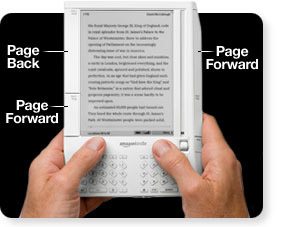
Today the news broke on the Kindle, Amazons entry into e-readers. E-readers haven’t exactly taken off, but then again- Sony has been hitting a bunch of singles lately, and they are behind the most successful e-book to date.
Amazon has taken the e-book to a new level, with constant connectivity via the Sprint high speed cell network, but, there are some hidden gotcha’s that make this book worth passing on - mostly, the fact that Amazon wants to charge you to upload your own data, or to subscribe to blogs. Eh, better luck next time.
Here is a brief description of the reader from the lengthy Newsweek article, which is well worth reading:
Amazon: Reinventing the Book | Newsweek.com
First, it must project an aura of bookishness; it should be less of a whizzy gizmo than an austere vessel of culture. Therefore the Kindle (named to evoke the crackling ignition of knowledge) has the dimensions of a paperback, with a tapering of its width that emulates the bulge toward a book’s binding. It weighs but 10.3 ounces, and unlike a laptop computer it does not run hot or make intrusive beeps. A reading device must be sharp and durable, Bezos says, and with the use of E Ink, a breakthrough technology of several years ago that mimes the clarity of a printed book, the Kindle’s six-inch screen posts readable pages. The battery has to last for a while, he adds, since there’s nothing sadder than a book you can’t read because of electile dysfunction. (The Kindle gets as many as 30 hours of reading on a charge, and recharges in two hours.) And, to soothe the anxieties of print-culture stalwarts, in sleep mode the Kindle displays retro images of ancient texts, early printing presses and beloved authors like Emily Dickinson and Jane Austen.
But then comes the features that your mom’s copy of “Gone With the Wind” can’t match. E-book devices like the Kindle allow you to change the font size: aging baby boomers will appreciate that every book can instantly be a large-type edition. The handheld device can also hold several shelves’ worth of books: 200 of them onboard, hundreds more on a memory card and a limitless amount in virtual library stacks maintained by Amazon. Also, the Kindle allows you to search within the book for a phrase or name.
My bet would still be on Apple- with a tablet style iPod Touch, or tablet Mac. Combined with the iTunes store, you have an integration that’s already proven- plus an Apple device would be able to play video- a key media tool that can’t be ignored. And hopefully, Apple won’t try to gouge you on uploading your own content- after all, it’s an Open Source world- shouldn’t you be able to upload anything you want that’s yours to your own device without paying the piper?
The big question is when does this device become cheap enough that it becomes cheaper for a newspaper to give you a reader instead of a printed newspaper? When does your choice of reading materials start serving up targeted ads? Amazon will have suggestions, no doubt- but, how will this help their partners move the sales needle?
Watch and see?
In the mean time- what do you think? And, do you want one? Even if it is butt-fugly?
by Next Wave Team | Nov 17, 2007 | Advertising, BMW Advertising, Brand Relevancy, Branded Content as Advertising, Creativity, Differentiating Your Brand, Everything You Want to Know About Advertising, Guerrilla Campaigns, Low Budget Advertising, Marketing & the Web, Practical Marketing 101, Procter & Gamble Advertising, Public Relations in the Web 2.0 world, Secrets of Great Advertising, Web strategy
 Today I was at the farmers market and their were clowns/mimes there from Cirque Du Soleil doing advance work for the Saltimbanco show next week. Call it “street teams” or guerrilla marketing, it was refreshing to see a business go out and actively seek customers in their environment. Doesn’t happen much anymore. We’ve gotten lazy- trying to invite our message in by interrupting their entertainment with commercials, their landscape with billboards and their websites with ads.
But while I was shopping, I was listening to American Public Radio’s Marketplace on my iPhone, and heard a story of how Procter & Gamble invented the market for Crisco- and it reminded me why they are the marketing powerhouse- not just by dollars spent, but by long history of working hard to connect with consumers. Our current industry fixation with “Branded Content” is nothing more than a new name for the soap opera- a P&G invention.
Here is an excerpt of the podcast- and a link to the whole she-bang. Highly recommended short podcast:
Marketplace: Crisco: A marketing revolution
…Crisco maker Procter & Gamble was a pioneer in the emerging science of creating demand. Historian Susan Strasser says the Crisco experiment started in 1911, when the company was selling Ivory soap. Cottonseed oil was a key ingredient.
Susan Strasser: And they decided to develop a product that would use a lot more cottonseed oil, so that they could control that market, really.
P&G’s scientists came up with this white, fluffy substance. It sort of resembled lard, and yet had no taste and no smell. It wasn’t food, exactly, but the company would ask consumers to bake and fry with it. Thus began an American mass-marketing milestone.
Strasser: Originally, they tried to call it Crispo, but then they discovered that a cracker factory already had the trademark.
P&G hawked its new product as a “scientific discovery.” The company sent free samples to every grocer in America. They held Crisco teas — an early version of the focus group. P&G even niche-marketed the product as kosher to the Jewish community….
In the podcast they talked about how P&G educated the consumer in how to use their products- something that the web is incredibly useful for. Yet, how many company websites feature big how-to communities built around their product?
 For instance, BMW motorcycles has an xplor area that’s focused on tips and tricks for sport touring - the segment of the market that they have a preferred position. How to pack your bike best, tips on GPS usage, and segments on where to go. However, it’s a members only site for BMW owners- you have to provide a vin number- and not open to the general public. Why not open the doors- so that potential customers can get a feel for what “joining the family” by buying BMW means?
Back to the Crisco story:
Marketing scholar David Stewart says P&G’s genius was not only giving people a convincing reason to try the product but training them to use it as well, with free cookbooks and recipes.
David Stewart: First of all, they focused on the health benefits — recognizing that this was a time we didn’t know about transfat and so forth. And then they taught people how to use it, they taught people how to cook. They gave them ideas. And between giving them a real benefit and information about how to use the product, they were able to get people to adopt it.
Crisco’s crowning achievement was creating demand for something nobody knew they wanted.
In today’s open information economy- putting your “recipes” behind a log-in is as silly as trying to charge for it. Would Google have been as successful if they had asked users to pay per search? Sounds absolutely stupid, doesn’t it? How about having to log in to use Google? Again, very silly.
To make friends with consumers today you have to be informative, useful, practical- and be able to demonstrate value. So, before you do an ad that is either hard sell- or entertaining- think first about what it does to enhance the customers life. The same way P&G introduced Crisco as the consumers friend: “Honestly, with a little Crisco in your frying pan, you can have supper on the table in a jiffy.”
That was marketing.
by Next Wave Team | Nov 9, 2007 | Advertising, Crispin Porter + Bogusky, Everything You Want to Know About Advertising, Great Ad Agencies, Low Budget Advertising, Practical Marketing 101, VW advertising
I guess they are stuck on companies that start with V in their rolodex at Volkswagen- bringing in former the Volvo ad director to direct marketing and VW agency Crispin Porter Bogusky to try to sell some Vee dubs in the USA. It won’t help until VW addresses shoddy workmanship, poor resale value, low JD Power ratings and now, they will be fighting a rock bottom dollar when compared to all major world currencies. VW may as well put a revolving door on the office- and keep it spinning.
Volkswagen Taps Volvos Ellis as VP-Marketing - Advertising Age - News
Volvos global advertising director, Tim Ellis, is moving to Volkswagen to run its North American marketing operations, according to a Volkswagen spokesman…
New title
Though his title is new, Mr. Ellis will succeed Kerri Martin, director of brand innovation, departed the automaker in January. Volkswagen works with MDC Partners Crispin Porter & Bogusky in the U.S. and Omnicom Groups DDB Worldwide elsewhere. Volkswagen spent about $419 million in measured media last year the U.S., according to TNS Media Intelligence.
Mr. Ellis ran the recent account review that ended up with Volvo shifting its global ad business from Havas Euro RSCG to sibling Arnold and independent Nitro.
In a recent interview, Volkswagen of America President-CEO Stefan Jacoby told Ad Age that the marketer didnt plan to change agencies, though he did say some of the work done under Ms. Martin was too narrow. “We have to address our communications with a wider net,” he said.
Creative reputation
Since joining Volvo in 2003 from independent Swedish agency Forsman & Bodenfors, Stockholm, where he was a managing partner, Mr. Ellis, an American, has been known for doing more creatively with fewer ad dollars than his competitors.
Mr. Ellis is best known for 2004s “Mystery of Dalaro,” a hoax that started with a fake news story about 32 families in a tiny Swedish town all buying the new Volvo 540 model on the same day from the same small dealership. That led to a documentary about the eerie coincidence, which was soon revealed as a fake, by a director who didnt exist. The “Mystery of Dalaro,” created by Euro RSCGs Fuel Europe, ran across Europe in TV spots, and at great length on Volvos website.
Mr. Ellis, and Fuel, followed up with another low-budget, web-oriented effort called “Life on Board.” To make Volvo seem warmer and friendlier, they staged a series of conversations pairing interesting people who had never met getting to know each other by chatting in a Volvo.
Interesting revelation that VW spent $419 million on media- a bump from what was previously reported as a $300 million dollar account. Also, Mr. Ellis moved Volvo to Arnold- VW’s previous agency. Could a change be in the works? Stay tuned to the continuing drama of VW’s search for the old Bernbach mojo.