Facebook stock is being hammered. Wall Street and even Facebook itself, doesn’t understand the value of the business. It’s not an ad platform- it’s a social site, a private party. When advertisers stop thinking they have the right to interject themselves in everything, they may start having some real success. The key for businesses on Facebook is to be invited to the party. The secret to that is better market research- and that’s where Facebook is the holy grail of consumer data. We know who your friends are, where they are, what they are doing- all from the aimless chatter.
Facebook needs to monetize data, not users.
Reading in the New York Times:
For its stock price to go up, Facebook has to convince Wall Street analysts and investors that the personal data its 955 million users share about themselves can be better used to make money. Despite the fact that Facebook has information about a user’s friends, habits and photos, advertisers are not convinced that Facebook ads are more effective than online ads appearing elsewhere.
So far, its revenue comes largely from advertising and from proceeds of virtual games that people pay to play on the Facebook platform. On both counts, Facebook has struggled, as the company reported slower sales in its earnings report in late July. Its users are increasingly logging in to their accounts on mobile devices, where Facebook has only recently — and cautiously — started selling advertisements.
Facebook has to be careful about intruding with ads in the limited screen environment. With customers facing data caps on mobile devices, the only way advertising will be welcome is if those advertisers subsidize their data plans, or offer real services or additional value in return for their interruption. If you need a case study of an internet behemoth failing because they refused to respect their users and community, just study the fall of AOL.
While advertisers still believe they should have the right to engage for supporting “free content” they have to realize that now, more than ever, you can only earn that right by offering a premium service in return. Look what the iPod did to CD sales, or what online music services have now done to the iTunes store. Is it becoming clear?
Facebook is social media- stop trying to turn it into commercial media.
In the Internet radio wars we have newcomer, the Swedish Spotify vs. the US based Pandora. Usually, the first mover has the advantage, but in the incredibly fickle world of music powered by technology, being the new kid on the block may give you an advantage to roll out a different flavor faster.
If you are a Spotify Free user, you have probably heard the ads about how the company rolled out free mobile radio similar to Pandora where users create stations based on artists and/or songs.
Our latest app features free radio - the only radio where you can save the songs you love. Now you can discover, save and enjoy an unlimited amount of music on the go.
Here’s how it works
Create stations based on any song, artist, album or playlist, and let Spotify bring you one great song after another.
When you like a song, give it a thumbs up and it’ll be saved to a Spotify playlist on your desktop. So you can listen whenever you like.
Get busy with your thumbs
By liking songs, you’ll help to personalize your stations – meaning they’ll play more of the music you want to hear.
Premium users can enjoy a premium radio experience that’s ad-free. Free users, you’ll hear occasional ad-breaks just like you do on your desktop.
So get the free app now to enjoy mobile radio - Spotify-style!
Free radio in all its glory
Free radio is powered by the entire Spotify catalog, the biggest of its kind.
Unlimited songs and stations - listen forever!
Like a song? Save it to your Spotify playlists with a thumbs up.
Great music choices from our shiny new recommendation engine.
Taking a quick look at both of them, they have a few more differences than similarities. Spotify has the ability for users to pick and choose the artists and songs they want to listen to on demand for free on computers ($9.99/month on mobile devices), whereas Pandora does not. With Spotify’s new radio function, which works similar to Pandora, users can “star” or “thumbs up” songs to save to them on the Spotify app and listen to them whenever they want. It’s likely that this will make Spotify reign supreme in the world of internet radio. Where Pandora users are used to constantly giving thumbs up or down to songs, Spotify users can simply thumbs up a song then listen to it whenever they want.
Beyond features, Spotify appears to have much better social media integration than Pandora, especially with Facebook. In fact, Facebook integration was an obvious focus for the Swedish company; users with the Spotify app enabled have their activity displayed on the timeline and can share songs and playlists. It should be noted that Spotify forces users to sign up through their Facebook account whereas Pandora does not, but this quirk is made up for by the flawless social media integration.
From our standpoint Spotify has got everything that Pandora has and more, even at the free level. The only thing that Pandora had over Spotify was their mastery of internet radio. Now that Spotify Radio launched on mobile, it’s going to force Pandora to react.
Considering the ultimate goal is to be able to deliver highly targeted ads or get paid to be the end users only music source, none of this is good for old fashioned terrestrial radio which failed in every way to react and adjust to the changes the Internet has forced on them. It will be interesting if at some point, Pandora and Spotify will find a standard for selling ads so that local businesses can target their most likely customers.
There is a difference between selling Apple products and clothes. Ron Johnson, formerly Apple’s retail chief and the new CEO of JC Penney is finding that out quickly. Critics of his move from constant sales to an always fair pricing strategy are having a field day with a Forbes article calling it an “Epic Rebranding Fail”
But nevertheless they launched “Fair and Square Pricing” whereby promotions and sales would be a thing of the past, for the most part, and in their stead would be everyday prices, “best prices” which would be available to consumers on the first and third Friday of each month, plus they would mix in some month-long values, too.
The new tagline ”Enough. Is. Enough.” would speak to the belief that consumers were inundated with promos, coupons and sales and what they really wanted was just plain, old-fashioned, everyday low prices.
It’s easy to armchair quarterback these bold moves, many (including this author) thought when Apple decided to open bricks and mortar stores it was a move in the wrong direction. Gateway had failed miserably doing the same thing- and yet, Apple is now considered the most profitable retailer on the planet.
However, there is a big difference between JC Penney and Apple- JC Penney is more of a curator of retail while Apple is the owner of the product. Yes, I can get Apple products elsewhere, but at an Apple store I’m dealing direct. At JC Penney, I can get the products elsewhere and anywhere- there is no exclusivity to what JC Penney sells- or what the brand stands for.
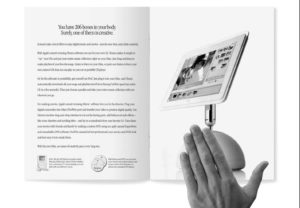
JC Penney Doesn’t Pass the Hand test
Put your hand over the logo and you still know what company made the product and the ad.
In Marty Neumeir’s classic book, “The Brand Gap” he uses Apple as the example when introducing “The Hand Test.” If you cover up the logo of the product in the ad- will you know what the product is? Apple passes with flying colors. JC Penney can’t ever do this. Their products, the brands they sell, their brand itself isn’t able to stand on it’s own. By their very nature, the department store model is nothing other than the supermarket of shopping in comparison to the convenience store. Same products, different experience in selection and purchase. There is nothing exclusive to JC Penney products and once you buy them, they belong to you- not to JC Penney. Compare that to Apple. Once you have an iPhone or a MacBook Air- the brand cachet is still there and there is a connection between you and the brand.
Pricing isn’t a strategy- it’s a tactic
This seems to be the part that Mr. Johnson missed in Marketing 301. Price alone isn’t why people buy- it’s perceived value that is critical. What does JC Penney add in value to the products they sell? Well, nothing really. Do we have any reason to trust JC Penney as a qualified curator of value? Nope. They’ve been through three rebrandings in as many years- and even before that, it’s been a long time since JC Penney held any kind of unique position in the eye of the consumer- if ever. For most consumers the JC Penney brand could go away tomorrow and they wouldn’t miss it. We’ve seen it before as Macy’s has gobbled up other regional department stores, rebranded them and customers barely skipped a beat. The brand name of most department stores stands for nothing- possible exceptions being Neiman Marcus which once stood for exclusivity and expensive, Nordstrom which built a reputation on amazing customer service and Sears which had brands like Craftsman, Kenmore and Die Hard that stood for solid American values.
JC Penney is a brand without a position. And since brands aren’t controlled by the marketer, but by the consumer, the way they introduced their new positioning of the brand has been way off target. Pointing out that consumers are tired of being assaulted with ads promising values based on inflated initial pricing is true. Focusing on the competition isn’t usually the best way to spend your advertising dollar. Yes, consumers know that MSRP is a joke, and from diamonds to donuts, everyone wants to pay less- but, are always willing to pay a little more for perceived value. Where is the value proposition for JC Penney?
The Value of “Fair and Square Pricing”
We believe in fair honest prices. When gasoline is sold for dollars per gallon, it’s insane that we still see $3.59.99 prices, especially when the penny, the 1cent piece, is on the verge of being done away with. The old psychology of .95 or .99 cent pricing to erase perceptions of whole dollar prices being more may still work with the geriatric set, but younger consumers are less likely to be swayed by it. The value of JC Penney not manipulating prices up and down is great- but, when buying fashion, the brand needs to stand for something. We’ve seen denim jeans elevated from durable work clothes to designer label with outrageous price tags- yet, say the word JC Penney and what emotional trigger do they hit?
Our friend Sally Hogshead lists seven triggers in her book Fascinate: Passion. Mystique. Alarm. Prestige. Power. Rebellion. Trust (well, actually, she changed Lust to Passion and Vice to Rebellion just to be absolutely correct). You can find out more about the seven triggers here: The Fascinate System If JC Penney is going to rebrand and be relevant to the consumer, they need to at least score highly on one or two of the triggers. right now, they don’t. Is “Rebellion” against sales and manipulation enough? Hardly, Walmart and Target have been promising some sort of everyday low prices for years.
The “Enough. is. Enough.” line is more about the mendacity of marketing than about the value to the consumer. The TV spot introducing the new pricing is enough to instantly annoy a viewer who already views TV commercials an intrusion to their entertainment.
It will take JC Penney more than a few quarters to transform themselves into a value retailer, which many consumers may find attractive as they grow to understand it. Think about how most department stores are deployed- in a mall with several other competitors. Shoppers go to the mall to find fashion, after looking in Macy’s, Sears, and the other two anchor stores, as well as places like The Gap, Hollister, Abercrombie & Fitch, Aeropostal etc Penney’s may win over converts if they can get consumers to come through their doors to compare. Changing the experience of shopping can take time and while the pundits are quick to write this concept off, once JC Penney finds its new voice and can trip one or two more emotional triggers, they may find the success they are seeking.
Knowing what your brand stands for in the consumers head is the first step to making the sale. Since the consumer controls your brand, changing those perceptions isn’t an overnight or several quarter effort. We believe that Mr. Johnson has the right tactic but needs to find the strategy to convince customers that the value of “Fair and Square Pricing” is more than just saving a few bucks- it’s a statement above fashion about fashion.
Yes, consumers are tired of being lied to, but, they still want the mirage of an oasis beyond the doors to your store.
When wearing clothes from JCPenney becomes a fashion statement (I have the common sense not to be gullible), JC Penney will win.