by Next Wave Team | Dec 1, 2012 | Future of advertising, Personalization of Advertising
An advertisers life was much easier when there were only 3 tv networks. Reaching everyone in the country wasn’t too difficult. Now, we know that even presidential campaigns need to spend billions to reach the entire country- and even then, there is overkill since there are still a lot of people who aren’t even registered to vote.
In doing some research for a friend into software for his medical practice, I came across a new marketing channel- attached to a software as a service. Doctors are mandated to switch to Electronic Health Records as part of “Obamacare” and by insurers including Medicare/Medicade. Practice Fusion is a provided of a software as a service solution- and instead of charging physicians for the system, they are counting on advertising to support the system:
How is your EHR free?
We have a unique ad-supported model. This allows us to provide a world-class EHR technology at no cost to you. These ads never pop up, never interfere with your workflow, and only display one at a time—see a sample ad here. We also make sure to provide you with ads that add value, such as co-pay coupons for your patients. A paid ad-free version of the EHR is available upon request.
via Free EMR | Providers of Medical EMR Programs and Services.
With pharmaceutical companies spending hundreds of millions to reach physicians to inform them of their newest drugs- Practice Fusion is in the enviable position of being able to put an ad in front of a physician while in the process of prescribing for that exact ailment. The ultimate sponsored search ad may be helping to keep the costs of health care down.
What other new media channels are being built to reach very specific markets by providing service in exchange for attention?
Imagine what could happen when textbook companies see this as the new model?
Will Google enter this focused market model too? It could be even more lucrative than search.
by Next Wave Team | Nov 1, 2012 | Differentiating Your Brand, How To Select An Ad Agency
We were invited to a pitch today. The potential client has grown quickly and out grown the agency they had. This is always an unfortunate situation, but, it’s always better to refocus early, before things get totally out of wack.
In a fast growth market, there are certain places a brand wants to be: first, biggest, most well known. Ideally, all three. The problem comes when you’re none of the above and searching for an added edge to continue your growth. This pitch was a bit different, in that we weren’t given much time (a week) and we weren’t given a brief, it was more of a capabilities presentation. Of course, the first question coming out of the audience (it’s a franchise organization so there were a lot of bodies in the room) was have you done work for someone like us before? The old catch 22 question which is why the old industry adage of “it’s better to be lucky than good” often comes to play in matching agencies to clients. Or, as they also say- it’s not what you know, but who you know.
In our background research we were finding that they are in a segment experiencing phenomenal growth. They’re on the map as a one to watch. The problem is, the number one player in their field, carved a niche away from the original number one by offering a very clear point of differentiation and then proceeded to own the niche like it’s the main event. The number two and three brands have been busy trying to out niche the leader and our potential client was trying to play leapfrog on the very same platform.
Stop.
This is what challenger brands should never do. Don’t play follow the leader. Don’t assume that what works for the leader can be copied, duplicated or improved- need proof, how’s Barnes and Noble really doing vs Amazon in just the eBook reader market? Never mind the selling of books. If you are going to be a challenger brand, the most important thing that you can discover to build a strong brand DNA is your brands “unique selling proposition,” a concept developed by Rosser Reeves for the Ted Bates Agency in the fifties. Brands that find their USP find that their products and services are much easier to sell and have a conversation with their customers because there is no cloud of confusion surrounding their products. Apple is a great example of a challenger brand that still isn’t the biggest by market share, but has grown from near bankruptcy to the most valuable company in the world based on the USP of products that are beautiful and easy to use. Google has grown by proving itself useful. Neither were first to market, but both found that by sticking to simple messaging they could own a position that could be unique to them. You’d think that other computer companies would figure out that ease of use is important, but it hasn’t happened yet.
While McDonalds and Burger King and sometimes Wendy’s, Hardee’s, Jack in the Box and countless others fought to be “THE” burger chain, Subway grew to have the most outlets by focusing on a more approachable business model with easier entry for franchisees. Five Guys is making all the burger joints look twice at trying to be something for everyone, as they stick to the knitting of making a better burger. When McDonalds began, there were no chicken nuggets, salads or coffee bars, it was burgers, fries and milkshakes.
If you want to be a challenger brand, that’s fine. But, the truly great understand that to steal a phrase from designer/author Marty Neumeier, in his book, “Zag“, “when others zig, zag.” He stresses the need for radical differentiation. It’s not just enough to talk about a strategy, you have to actually have one. Five Guys isn’t winning the burger wars because they have free peanuts, it’s because they hyper focused on a better burger and a simplified menu in a no-frills space.
Challenger brands that find their USP and convey it in a clear, differentiated voice, soon find themselves in a category all of their own. Find your USP, or find an agency that you can talk to about finding it, and you’ll be on your way to success.
by Next Wave Team | Sep 24, 2012 | Practical Marketing 101
Apple is famously and profitably successful because of their attention to design detail and simplicity and consistency of their user interface. And while they’ve made more than a few mistakes along the way, the replacement of the Google maps application which has been a part of the iOS operating system from day 1, may become a classic business case study in what not to do.
Taking away benefits/functionality from your customers without their consent is a very dangerous move.
To summarize what happened- Apple and Google are no longer friends because the open source Android mobile operating system has gone head-to-head with the proprietary and highly regulated Apple iOS. Apple deleted the Google Maps application in favor of their own mapping software with iOS6- despite it not being either an improvement or even a good replacement for the original software. When you start making the New York Times about your product changes, it should be a bit of a worry.
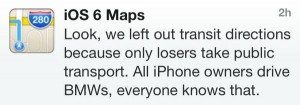
Apple’s reckless deletion of functionality of transit maps in their iOS6 mapping app brings satire to the surface
Missing are the highly useful public transit details- a system that is invaluable in NYC, and much of the data that has been tweaked and refined over the years by millions of users. Frankly, Apples map program is being forced on users as an “upgrade” when it isn’t. This isn’t what the customer bought when they bought their iOS devices.
The right to take away a purchase after it’s been bought is a slippery slope, that smacks of “Big Brother” - the very same one that Apple so famously rallied against in their classic Superbowl ad 1984 that launched the Macintosh. What’s next- publishers having the right to come to your home and take back books that you bought because they were too useful? (Textbook manufacturers are becoming guilty of this- but that’s another matter).
Rumors abound that Google is going to release a version of Maps via the Apple store- however, that would and could possibly sink the chances of the Apple maps app from ever reaching parity. Digital maps data is improved by the size of the user base, a primary reason Google was probably willing to allow Apple to use their data when the iPhone launched before they had an Android OS.
Google could probably rake in millions by selling their app on the iTunes store now, but the shopkeeper, Apple, despite a chance to gain 30% of sales may still block it from happening (debate is raging on this subject).
But this is a lesson for all marketers. The restaurant that used to offer free bread that now charges, the gas station that stops offering free air both risk alienating customers by taking away something that was previously accepted. Once one fast food chain began offering free refills on soda for dine in, going back is nearly impossible as is not offering the same option.
Apple may be getting cocky at the wrong time and place as the newest king of corporate monopoly, but we’ve seen companies make potentially fatal flaws before: thinking they know what’s best for their customers and trying to force a reset. Quikster anyone?